Left is not a dirty word
Finding our way back to humanity
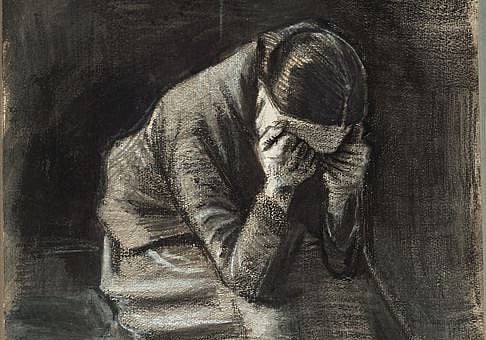
Vincent van Gogh, Weeping Woman, Chicago Insititute of Art, via Wikimedia commons
Pope Leo wants us to forget about the idea of a “just war.” Prof. Amos Goldberg, speaking at a conference on genocide, reminds us that the genocides of the past half century were the results of “just wars” – bloody conflicts that one side felt were existential. Both the pope and the historian are hitting on an essential issue: The slaughter takes place within a historical context, in which those committing the atrocities are convinced they are doing so to protect their homes and their very identities and continued existence. And, just as there is no justice in war, there is no absolute innocence. The rules of war and against genocide do not deal with innocence, but with actions taken against an entire population, rather than enemy fighters. The pope warned against wars waged for internal political gain. We must ask ourselves not who prevails, but who benefits. And where is the justice in that?
While Trump has waged war with Iran, here in our little corner of the Middle East, things stalled, but not quietly. The Israeli army has used the opportunity to seize the southern strip of Lebanon, “purifying” the rocky piece of territory as it advances and proclaiming it will be there “for a while.” It remains in Gaza, while most Gazans cannot return to their homes, scrabbling, instead, to scrape together the money to pay the exorbitant price of a sack of flour. Hamas still, after three years of war, controls the humanitarian aid that comes in by the truckload each day. Israel looks the other way. We cry that Hamas is once again amassing arms and fighters, but we never agreed to let Gaza have an alternative. Where is the justice? Who benefits? Who is innocent?
Trump’s real estate buddies Witkoff and Kushner have come up with a general plan for negotiating ceasefires: Make the first stage vague and leave the sticking points for the next phase. That means in the case of Iran, according to reports, that the issue of enriched uranium — which is somewhat existential for us and a point of honor for them — is left for the next phase. He’ll stop blockading their blockade if they just sign a piece of paper agreeing to talk about that deadly stuff at some undefined time in the future. In the case of Hamas and us, the next phase includes them disarming and us agreeing to an interim government that includes Palestinians. No one believes either will happen. In the case of Lebanon, the ceasefire negotiated by Biden’s administration included a requirement that the Lebanese army prevent Hezbollah from operating on our borders, and it was given a deadline. That deadline has passed, and Hezbollah is still around, now armed with deadly drones.
Where is the justice? Who benefits? Who is innocent?
Trump likes deadlines – he likes to throw them around – but they seem to be mostly present in the ways they are circumvented. What we are left with is a new kind of ceasefire, one in which the fighting continues, in which civilians cannot return to their homes, or, in the case of those on Israel’s northern border, live under daily attack.
For Gazans, the war has not ended. My Gazan friend wrote:
These almost three years since October 7 have been painful, heavy, heartbreaking, and deeply inhuman for me and my family. The pain has not become lighter with time. In many ways, it has become heavier as the destruction and suffering in Gaza continue and as my family continues living through it every day.
My hometown, Beit Hanoun, was completely destroyed and occupied. There is almost nothing left of the place I once knew, not even my father’s grave. But Palestinians hold onto memory. This is how we continue holding onto our land, our people, and our history no matter how much destruction takes place.
What I have witnessed during these years is a continued attempt to strip Palestinians of their humanity and to treat our lives, pain, and losses as if they matter less.
It is time, my fellow Israelis, to reframe the conflict. Let’s listen to the pope, even though he is not “ours.” Let’s listen to the high court, which kindly pointed out that, technically, some of the things we did and are doing in Gaza fall under parts of the legal definition of genocide. We are not innocent, and they may not be innocent, either. That is not relevant. You cannot convince me, or the international court, that extreme cruelty is the way to win.
It is time to find our way back to ideas of humanity. That includes remembering that all pain matters; that all people matter. It is time to give up on the idea of “total victory,” as Bibi once promised, or even victory won through the use of arms, alone. Because every day that we stay in Gaza and Lebanon, every day that we refuse to see the humanity of the other side, is another day we are losing. I mean that in the most literal sense. When a government minister condones the terror Jews rain on Palestinians or videos himself abusing detainees, we are announcing to the world we have lost our own humanity, and therefore have forgotten how to recognize it in others.
Pope Leo was addressing the US president and his war with Iran, which has been tragedy and farce rolled into one. But it applies to our wars, as well. If we can rid ourselves of the notion that there is a right side somewhere in this war, that G-d told us to fight, or even that the abuses taking place in Gaza and the West Bank have anything to do with protecting our homes, we might be able to take a step forward, out of the “situation” we’re in. If we can acknowledge the human rights of 2 million Gazans, we might be able to turn our fake cease-fire into a real one. If we can look for justice outside of the battlefield, rather than in the midst of gunfire, we might take yet another step in the right direction.
I don’t believe Pope Leo was naïve to come out against the entire concept of a just war. Wars are bloody and deadly. The most we can hope for is to end them. We should not deceive ourselves into thinking we can gain justice through killing and abuse. We cannot continue to tell ourselves that the war we entered into on Oct. 8, as much as it was not our choice and it may have been defensible on that day, justifies the conditions and horrors we have visited on Gaza. The inhumanity Hamas practiced on the hostages it took that day and held for months does not justify our own inhumanity. There is no equation here: In the face of our inhumanity, it is our own responsibility to restore it, and as quickly as possible.
Related Topics
Related Posts