


Where history exposes power and moral failure
Fitim Krasniqi on Kosovo, Disability and The Journalist’s Mission
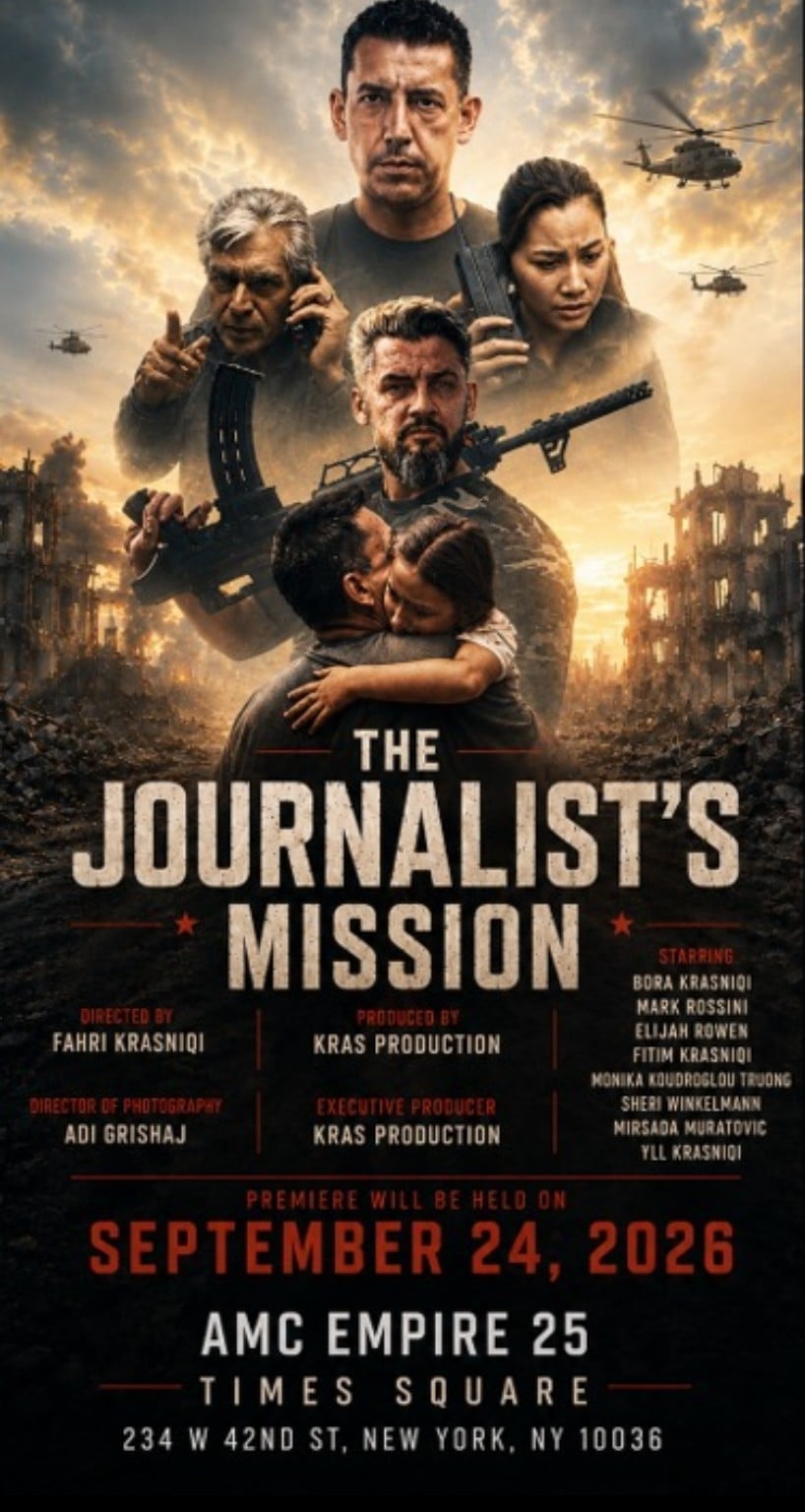
The Journalist’s Mission promotional artwork, used with permission under press credentials provided by EmFergusson PR.
Fitim Krasniqi was a teenager during the Kosovo War. Nearly three decades later, his experience of the conflict and his gratitude toward the people he believes helped the people of his homeland became the foundation for The Journalist’s Mission, an independent film centered on an American journalist and an American-Albanian girl.
“I called it The Journalist’s Mission because it was an idea to honor their work, what they’ve done, to make this movie because journalists told the truth about what happened in Kosovo,” Krasniqi told me when we spoke on October 4.
Krasniqi also credits American military intervention with helping people like him survive the war. His film brings those two parts of his experience together: the journalists who documented what was happening in Kosovo and the Americans who intervened while it was happening. Now Krasniqi is taking the film across the United States on a fifty-state screening tour, where the filmmakers also plan to document the American military veterans they meet along the way.
Making the film required Krasniqi to return much more closely to a history he had survived. For years after the war, he had been able to live with what happened without experiencing the kind of flashbacks that began when he started writing The Journalist’s Mission.
Writing the screenplay and making the film forced him back into the events repeatedly. Krasniqi sought treatment during the creative process. He remembers being told by the doctor that what he was doing was “like scratching a wound that was bleeding.”
He continued. Krasniqi described himself during the process as “determined.” He “had a purpose.”
Journalists covering Kosovo were working while control of information had become part of the political machinery of Slobodan Milošević’s government. Independent and opposition media faced censorship, punitive regulation and other forms of suppression. Aleksandar Vučić became Serbia’s information minister in 1998. Nearly three decades later, he remains one of the dominant figures in Serbian politics. He resigned as president on September 27 and is now seeking the prime ministership in Serbia’s October 25 parliamentary election.
I asked Krasniqi what feels different to him about Serbia now and what feels familiar.
He very carefully separated his answer into relations among people and relations between governments. In his experience, Serbs and Kosovo Albanians are capable of peacefully coexisting. However, Krasniqi sees far less change politically. Serbia still does not recognize Kosovo, and Krasniqi is troubled that people who were allied with, mentored by or politically formed around Milošević have remained powerful in Serbian politics.
We also discussed the recent funeral of Ratko Mladić, the former Bosnian Serb military commander convicted of genocide, crimes against humanity and war crimes. Krasniqi saw the public and political treatment of Mladić after his death as evidence that problems left by the Yugoslav wars have not been resolved.
None of this made Krasniqi reluctant to take his own film to Serbia. When I asked whether he would attend a Serbian screening of The Journalist’s Mission, his response was enthusiastic. He absolutely would.
The filmmakers had already made an overture in New York. Krasniqi told me that they invited the Permanent Mission of the Republic of Serbia to the United Nations to attend the film’s September 24 premiere.
He described the invitation as an effort to expand cooperative dialogue between representatives of Kosovo and Serbia about their public history and unresolved issues between them. He did not want the film used simply to reopen old wounds. No Serbian official attended the premiere.
“Everybody has to make peace,” Krasniqi told me regarding Kosovo and the Serbia of today. Speaking about Serbia and Kosovo as geographical neighbors, he said, “Sooner or later, they need to see one another well.”
BRIEF SPOILER!
The following section reveals an element of The Journalist’s Mission. Krasniqi consented to its inclusion in this article.
One Serbian soldier in The Journalist’s Mission receives an order to kill and cannot carry it out.
Krasniqi put the moment into the film deliberately. He wanted the Serbian soldier to remain an individual human being capable of making a moral choice during a conflict in which Serbian individuals were ultimately convicted of war crimes and crimes against humanity.
The scene sits comfortably beside what Krasniqi told me about showing the film in Serbia. His criticism of Serbian political leadership does not become an indictment of every Serbian person, just as his account of crimes committed during the war does not require him to write every Serbian character as their embodiment.
His own experience of the war also extends beyond the political history he has put on screen. When our conversation turned to disability, Krasniqi immediately spoke about people still living with the consequences.
“There are a lot of people with disability who are still there, women with trauma because of r*pe,” he said.
The Kosovo War continues in the lives of people who survived with spinal cord injuries, traumatic brain injuries, blindness, deafness, various forms of trauma, and the effects of abuse and grief. Krasniqi encountered part of that history again in himself while making the film. Years after the events themselves, reconstructing them closely enough to write and film them produced the flashbacks for which he sought treatment.
His account complicates the familiar idea of a historical film as a retrospective exercise. Krasniqi was not simply researching events that had ended before he began writing about them. He was making scenes from events he had survived, and the process affected him badly enough that he needed help while doing it.
He and fellow filmmakers Farooq Krasniqi and Fahri Krasniqi nevertheless finished the film through Kras Productions. It had its premiere at AMC Empire 25 in New York City on September 24. The film features an international cast, with Fitim Krasniqi appearing as a Kosovo Albanian resistance fighter.
The Journalist’s Mission is going on a fifty-state screening tour. During that tour, Krasniqi and the other filmmakers plan to make a documentary about the American military veterans they meet and the veterans for whom they screen the film.
Many American veterans live with disabilities acquired or aggravated through military service, alongside persistent problems involving healthcare, housing and other disability-related needs. Krasniqi will therefore be traveling with a film about the consequences of war for Kosovo Albanians while meeting Americans who may be living with consequences of military service themselves.
Fitim Krasniqi’s reason for seeking out those audiences in particular begins with gratitude for his experience during the Kosovo War. Krasniqi believes United States intervention in Kosovo occurred for the right reason, and he credits American military personnel with helping people like him. He also credits journalists whose reporting showed the outside world what was happening.
He hopes audiences take Kosovo beyond Kosovo. When genocide or other mass violence occurs elsewhere, he wants people to understand that journalism can affect what the world knows and that intervention can affect what happens to the people caught inside it.
At the same time, Krasniqi did not romanticize war at all while explaining why he remains grateful for a military intervention.
“Politics destroys every place,” he said. Wars, he said, are “never bringing peace.”
His own position comes from having survived the circumstances in which those propositions collide. He can believe that war does not produce peace while also believing that military intervention was necessary in the war he survived. He can condemn Serbian political decisions and the crimes committed against Kosovo Albanians while inviting Serbian diplomats to his premiere. He can discuss Mladić’s funeral with anger about what has persisted politically and still tell me that he would gladly screen his film in Serbia.
The fifty-state tour will add another layer to that history. Krasniqi and his colleagues will be documenting veterans while those veterans watch filmmakers from Kosovo tell an American audience what American involvement meant to them.
Krasniqi has an even larger ambition for The Journalist’s Mission. He told me he wants to win an Oscar. Instead of simply stating lofty ambitions, he was specific about why he wants the golden statue in his home. He acknowledged that “everybody wants to win an Oscar,” but he then stated that an Oscar would give him a larger platform for an anti-war message, which he wants to thread through his ascending career.
It is an extraordinary objective for a small independent film about a war few discuss. This film is not Saving Private Ryan, and Mr. Krasniqi did not pretend otherwise. The scale of the platform is precisely the point. He has made a film because he believes journalists once helped people outside Kosovo understand what was happening there. Now he is trying to get his own account in front of as many people as he can.
The project has already required him to revisit memories that brought him into treatment. It is taking him through fifty states to meet veterans. Its filmmakers invited representatives of Serbia into the audience in New York, and Krasniqi remains willing to bring the film to Serbia itself.
The Oscar may or may not ever enter the story, but the anti-war and pro-journalism message already has. That is the point.