Urban Sociologist and Global Affairs Commentator
Five Factors and Artificial Minds: A Sarkarian Reading of the AI Age
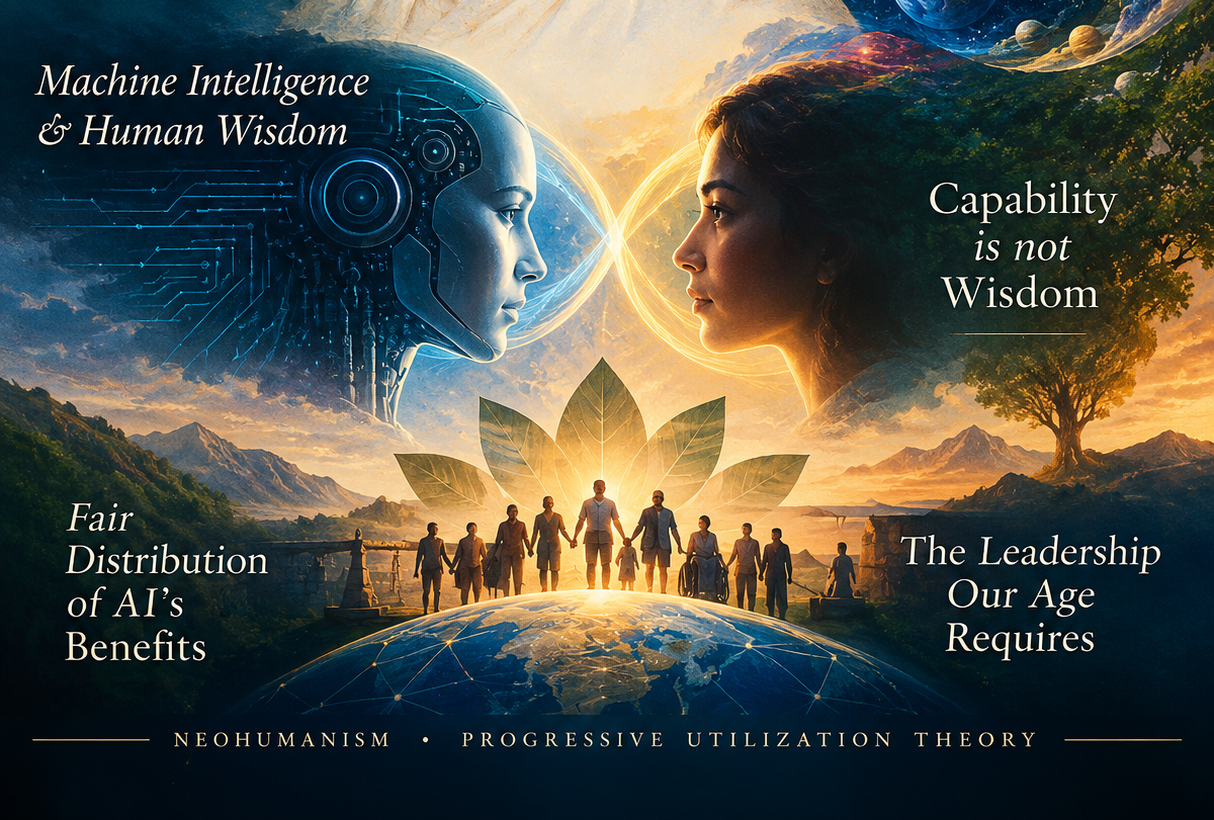
Neohumanism as an Ethical Compass for AI. An AI Illustration.
Artificial intelligence now solves abstract problems that occupied human minds for generations, from mathematical proofs to protein structures. This raises questions technology alone cannot answer. What is intelligence? Is it the same as wisdom? And if machines can do what we once thought distinctively human, what remains for humanity to be and to do?
This essay turns to the philosophy of Shrii Shrii Anandamurti (Prabhat Ranjan Sarkar, 1921-1990), founder of Ananda Marga. Sarkar taught that the universe unfolds from Consciousness through five fundamental factors, that this unfolding is half of a great cycle which also carries everything back toward Consciousness, and that mind, matter and Consciousness form one continuous reality. He also proposed an ethical outlook, Neohumanism, and an economic model, the Progressive Utilization Theory. The essay asks what these ideas imply about machine intelligence, how they separate capability from wisdom, and what they suggest about the fair distribution of AI’s benefits and the kind of leadership the age requires.
One caution: Sarkar died decades before today’s AI and said nothing about it. This is an interpretation, not a claim about what he would have said, and a philosophical reading, not a scientific one.
Mind as a refinement of matter
Sarkar taught that the manifested universe unfolds from Consciousness through five fundamental factors, which he called the quinquelemental factors: the ethereal (space), aerial (gas and movement), luminous (light and heat), liquid (fluidity) and solid (earth). Each is denser than the one before it, and each retains the essence of the subtler factor that preceded it. The account describes a gradual condensation from the subtle to the crude, not five separate substances.
The central consequence is that reality is not divided into dead matter and living mind. It is a continuum, and solid matter is never wholly cut off from the subtler stages that gave rise to it. In Sarkar’s wider writings the mind is itself a subtle layer of this same process, not a foreign substance. Consciousness (Purusha) is the witnessing ground, and Prakrti, the operative principle, shapes it into increasingly concrete forms.
Seen this way, there is nothing metaphysically scandalous about machine intelligence. If mind is a refined expression of the same fabric that becomes solid matter, it is unsurprising that complex arrangements of matter, here silicon, electricity and mathematics, can perform operations we once thought uniquely human. A tradition that does not draw a hard wall between matter and mind is not threatened when a machine proves a theorem or predicts a protein’s structure. Those who insist that only biology can think are often the ones most surprised by AI.
The cycle of creation: Saincara and Pratisaincara
The five factors describe only half of Sarkar’s picture. He called the whole movement of creation Brahmacakra, the cycle of Brahma, and divided it into two phases: Saincara, the outward movement from subtle to crude, and Pratisaincara, the return from crude to subtle.
Saincara is the descent already described. Prakrti acts upon Consciousness and gives rise to the Cosmic Mind, from which the five factors unfold in sequence. Sarkar explained this through the three fundamental qualities of Prakrti: sentient, mutative and static. In the early stages the sentient quality predominates, and as manifestation proceeds the mutative and then the static quality increasingly take over. At the solid stage the static quality is strongest, which is why matter appears inert and heavy. Saincara is a progressive crystallisation, driven by the forces of Prakrti, with no choice involved.
Pratisaincara is the ascent. Out of solid matter arise the simplest living forms, then plants, then animals, and finally human beings. At each stage the mind becomes more developed and more capable of reflecting Consciousness. In this account evolution is not accidental. It is the pull of Consciousness drawing everything back toward itself. In plants and animals the movement happens largely through natural processes, but humans are different, because they can understand the cycle and take part in it consciously. This is where spiritual practice enters. Meditation and ethical discipline are, in Sarkar’s view, a way of accelerating Pratisaincara by individual effort, moving the mind from identification with the crude toward identification with Consciousness.
Three points follow. First, the cycle has no absolute beginning or end, so creation is a movement within Consciousness and not a single event. Second, matter and mind are different positions on one continuum, one reached by descent and the other by ascent, and so they are not enemies. Third, evolution has a direction and a meaning: human life is the stage at which the return journey can become conscious and deliberate.
This gives us a standard for judging technology. Machine intelligence, however impressive, is an arrangement within the realm of Prakrti, the structured and operative. Pratisaincara concerns something else: the movement of the mind toward subtlety, love and Consciousness. A civilisation can advance enormously in one while stagnating in the other. The question this essay keeps returning to is whether AI supports the return journey or distracts us from it.
What AI achieves, and what it does not
Sarkar’s framework allows a useful distinction. He described the mind in layers: the citta, which stores and records impressions; the aham, the sense of doing and an “I”; and the mahat, the most subtle sense of simply being. Today’s AI systems excel at something resembling the first layer, absorbing vast amounts of recorded human thought and recombining it with extraordinary skill. Solving in months an abstract problem that took human mathematicians centuries is an achievement of pattern, memory and search at a scale no individual mind can match.
But in this philosophy intelligence is not the same as Consciousness. Computation belongs to the realm of Prakrti. The witnessing principle, the one for whom experience is experienced, is not obviously produced by adding more computation. Whether machines could ever be conscious is a question this essay cannot settle, and Sarkar’s followers disagree about it. The more practical lesson is that capability and wisdom are different axes. A system can move far along the first while saying nothing about the second. The danger of the AI age is that we mistake the scaling of capability for the scaling of understanding, and hand over judgment to systems that lack the grounding that makes judgment trustworthy.
Intellect and intuition
Sarkar repeatedly distinguished the rational intellect from intuition, which he saw as the fruit of spiritual practice and as a capacity that sees beyond what logic can derive. Intellect works within the finite, analysing, dividing and calculating. It is powerful but bounded.
This helps us read the present moment. AI is perhaps the greatest triumph of the analytical intellect ever externalised. That triumph should neither frighten nor intoxicate us. It frees humanity from calculation and routine reasoning, but it also removes the excuse that intellect is the highest human faculty. If machines can out-calculate us, the distinctively human vocation lies elsewhere: in ethical sensitivity, in compassion, in the capacity to ask what is worth doing at all. In terms of the cycle, the intellect is a tool for the journey, not its destination. A civilisation that defines itself by cleverness will feel obsolete. One that defines itself by its capacity for wisdom and love has more to offer, not less.
Neohumanism as an ethical compass
If the return journey is the measure, we need an ethic that fits it. Sarkar’s most directly applicable idea here is Neohumanism, the extension of humanist ethics beyond the human to all living beings and, in a certain sense, to the whole of creation. He warned that humanism itself can decay into narrow sentiments, such as nationalism, communalism and anthropocentrism, which divide where they should unite. His remedy was to anchor ethics in the recognition of a common underlying Consciousness.
The AI debate is full of exactly these narrower sentiments. Nations race to dominate each other with the technology. Companies chase market share. Debates are framed as humans against machines, or one civilisation against another. A Neohumanist reading would ask a different question of every deployment: does this increase the welfare of all beings, or does it concentrate benefit in one group, one country, one class? The unity of the five factors, in which the grossest matter still carries the subtlest essence, becomes an ethical argument. No one stands wholly outside the web, so no one’s flourishing can be secured by another’s diminishment.
Economic democracy and the distribution of gains
Sarkar was not only a spiritual teacher. He also proposed the Progressive Utilization Theory (PROUT), a socio-economic model built on the idea that the world’s resources are a common patrimony, to be used maximally and distributed rationally, with a guaranteed minimum of basic necessities for everyone and economic power kept decentralised and democratic.
AI makes this proposal newly urgent. If advanced systems can do a great deal of intellectual and, increasingly, physical labour, the central question is no longer whether production is possible but who owns the means of production and who benefits. Left to concentration, AI could produce unprecedented wealth alongside unprecedented dependence. PROUT’s insistence that accumulation beyond need must be socially bounded, and that productive assets should serve the community, offers one framework for thinking about shared ownership, public benefit and universal provision in an age of abundant machine capability. There is also a link to the cycle. Spiritual and ethical growth requires time, security and freedom from want, so if AI’s gains are shared widely, they could give more people the leisure and stability the return journey needs. If they are hoarded, the same technology deepens deprivation and keeps people absorbed in survival. One need not adopt the whole model to see its value as a counterweight to winner-take-all dynamics.
The need for moral guardians
Sarkar also argued that society needs leaders who combine intellectual strength with moral character, whom he called sadvipras. His worry was that power in the hands of the clever but unprincipled leads to exploitation, whatever the political system.
The parallel is direct. The people who design, deploy and regulate powerful AI systems are making decisions with civilisational consequences. Technical competence alone cannot guide them. A philosophy that treats ethical development as inseparable from capability suggests that the institutions overseeing AI should cultivate integrity, humility and service as seriously as they cultivate expertise, and that the pace of technical scaling should not outrun the pace of moral maturation.
Practice as the human response
Finally, Sarkar’s tradition insists that philosophy must be lived. Meditation and ethical discipline are the means by which a person takes conscious part in Pratisaincara, moving beyond identification with limited physical and mental experiences. In a world where information and cognitive output become cheap, attention, stillness and inner clarity become scarce goods. People who have cultivated them are better placed to use powerful tools without being used by them, to resist manipulation, and to keep sight of ends rather than being swept along by means.
Limits of the reading
An honest account should name its limits. The five-factor scheme and the cycle of Saincara and Pratisaincara form a spiritual cosmology, not a scientific theory. They should not be used to make empirical predictions about what AI can or cannot do, nor treated as rivals to physics or biology. Their claims about Consciousness cannot be verified by the methods that evaluate AI systems. Their value is orientational: they supply a vision of unity, a hierarchy of values in which wisdom outranks cleverness, and an ethic of shared welfare.
Neohumanism: AI’s ethical compass?
The quinquelemental philosophy teaches that reality is continuous, that subtlety and density are expressions of one underlying whole, and that creation is a cycle in which everything descends into form and is drawn back toward Consciousness. Applied to AI, this suggests three things. We need not fear machine intelligence as an alien intrusion into a mind-matter divide that was never absolute. We should refuse to equate intelligence with wisdom, since the former can scale without the latter. And we should steer the technology by ethical principles of unity, namely Neohumanist compassion, equitable distribution and morally grounded leadership.
The machines may solve problems that took centuries. The measure of their worth, in Sarkar’s terms, is not how much they can compute but whether they help living beings move along the return journey toward greater subtlety, compassion and freedom. That is a question only conscious, caring humans can ask and answer.
Related Topics
Related Posts