Five Lithuanian Institutions Now Have Papilė’s Names

The evidence was published. Now the municipality, encyclopedia, heritage authorities, archive and local library have been formally asked to correct, clarify or produce the record.
On September 20, I published Papilė’s Stone Says ‘Helpers.’ The State’s Historian Named Them. It began with my grandfather Samuel Gochin, born in Papilė in 1902, and followed the destruction of the Jewish community through the records that survived: police custody, the July 1941 shooting, the transfer of women and children into the Žagarė system, the murder of my relatives, the 1967 exhumation and trial record, and the language Lithuania still uses at the site today.
The article ended on a contradiction Lithuania’s own sources created. The memorial uses the word “helpers.” Alfredas Rukšėnas’s archival reconstruction names Bronius Paliulionis, Vincas Viskantas, Kazys Malinauskas, Kazys Milevičius and local police or auxiliary-police participants. The public heritage record calls code 21109 merely “Žudynių ir užkasimo vieta” — “murder and burial site.” The names exist. The public record often does not use them.
Publication was not the end of that record. It changed its status. Evidence in an article can be ignored as opinion. Evidence formally delivered to the institutions that control the monument, encyclopedia, heritage register, archive and local historical dictionary becomes notice. I have therefore filed five QES-signed requests. All five are public.
Five institutions now have the documents
The first request went to Akmenė District Municipality and Papilė Eldership. It asks them to preserve the current webpages and memorial wording, identify who owns and controls the site and sign, correct the public description of KVR object 21109 so that it identifies the Jewish victims and the 1967 removal of remains, address the Kerežiai/Dilbyčiai location discrepancy, and consider whether the word “helpers” should be supplemented by an explanatory plaque naming the participants documented in the archival reconstruction.
The second request went to the Visuotinė lietuvių enciklopedija through the National Library. Its Papilė entry currently attributes the July 22 killing to the order of Nazi German occupation authorities but names none of the Lithuanian police, security-police or local administrative participants identified by Rukšėnas. I am not asking VLE to erase the German occupation structure. I am asking it to add the Lithuanian implementation chain its own country’s documentary scholarship records.
The third request went to the Cultural Heritage Department concerning KVR code 21109. It asks for the full current object card, the public data concerning owner, manager and responsible bodies, the 1994 registration documentation, the basis for the present Kerežiai location, any 1967 exhumation or reburial material in its possession, and a reasoned decision on whether the object’s name and description should be clarified. This request is deliberately narrower than an accusation. A register can only be corrected properly after the authority produces the record on which the entry rests.
The fourth went to the Lithuanian Special Archives. It asks for the 1967 case against Vincas Viskantas and the other Papilė policemen, including the indictment, hearing records, judgment, execution material, witness statements, forensic documentation from May 11–13, 1967, exhumation and reburial records, photographs, plans and any victim lists. One question is central: did that Soviet-era proceeding actually adjudicate the murder of Papilė’s Jews, or only other killings attributed to the defendants? I will not claim an answer the archive has not yet produced.
The fifth request went to the Akmenė Public Library and the editors of the Akmenė regional encyclopedic dictionary. Its entries on “ŽYDAI,” “ŠIAUDINĖS DVARAS” and “DILBYČIAI” use passive formulations and inconsistent figures for the Papilė killings. The request asks the editors to preserve the existing versions, reconcile the numbers and place names, identify the documented participants, and link readers to the underlying Rukšėnas study or another verified archival source.
What these requests do not claim
None of these filings says that an inaccurate memorial inscription or incomplete encyclopedia entry is automatically a crime. None assumes motive merely because an institution has published an incomplete account. None asks a present-day Lithuanian to inherit the guilt of a murderer. The requests ask something more concrete: preserve the record, identify the responsible authority, produce the underlying documents, correct what the evidence can correct, and explain any refusal in writing.
That distinction matters to me because Papilė is not an abstract historical dispute. It was my grandfather’s town. Meyer Shimon Gochin, Rochel Reiza, Miriam and four-year-old Raymond belonged to my family. Tsila Gochin and her household belonged to my family. Mones Gochin was my grandfather’s uncle. His daughter Mascha and her five children were deported from Norway and murdered at Auschwitz. In Kristiansund, Norway, Stolpersteine name that family one by one. In Papilė, Lithuania’s current heritage list gives the Jewish murder site a generic title that names neither the victims nor the perpetrators.
That is why the five filings belong together. The municipality controls public description and memorial practice. VLE controls a national reference text. KPD controls the heritage-register record. LYA controls archival evidence that may settle the 1967 accountability question. The local library controls public historical entries read by people trying to understand Papilė. Each institution has a different function. Each now has the same documentary problem before it.
The next evidence will be their answers
The Substack article assembled the historical case. These five signed requests convert that case into institutional notice. If the records are corrected, that correction will matter. If an archive produces documents that narrow or contradict my conclusions, those documents will matter too. If an institution refuses after receiving the evidence, the refusal and its reasons will become part of the record.
For decades, arguments about Lithuania and the Holocaust have too often become arguments about patriotism, motive or identity. Papilė permits something simpler. There is a site. There are victims. There are archival names. There are public institutions with custody over the way that history is described.
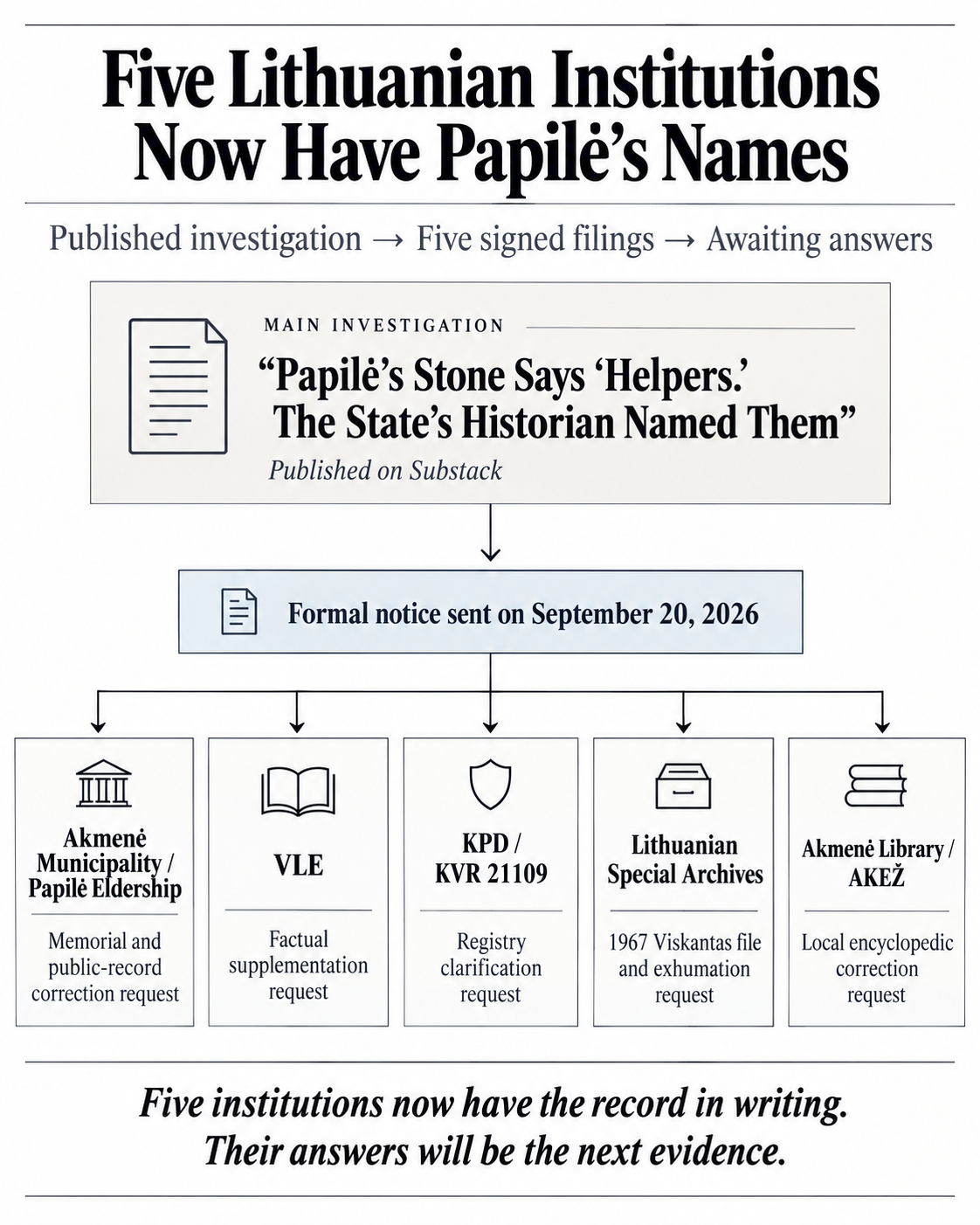
The stone says “helpers.” The historian gives names. Five institutions now have those names in writing. Their answers will be the next evidence.