
Five Questions for Señor Bardem on Palestine
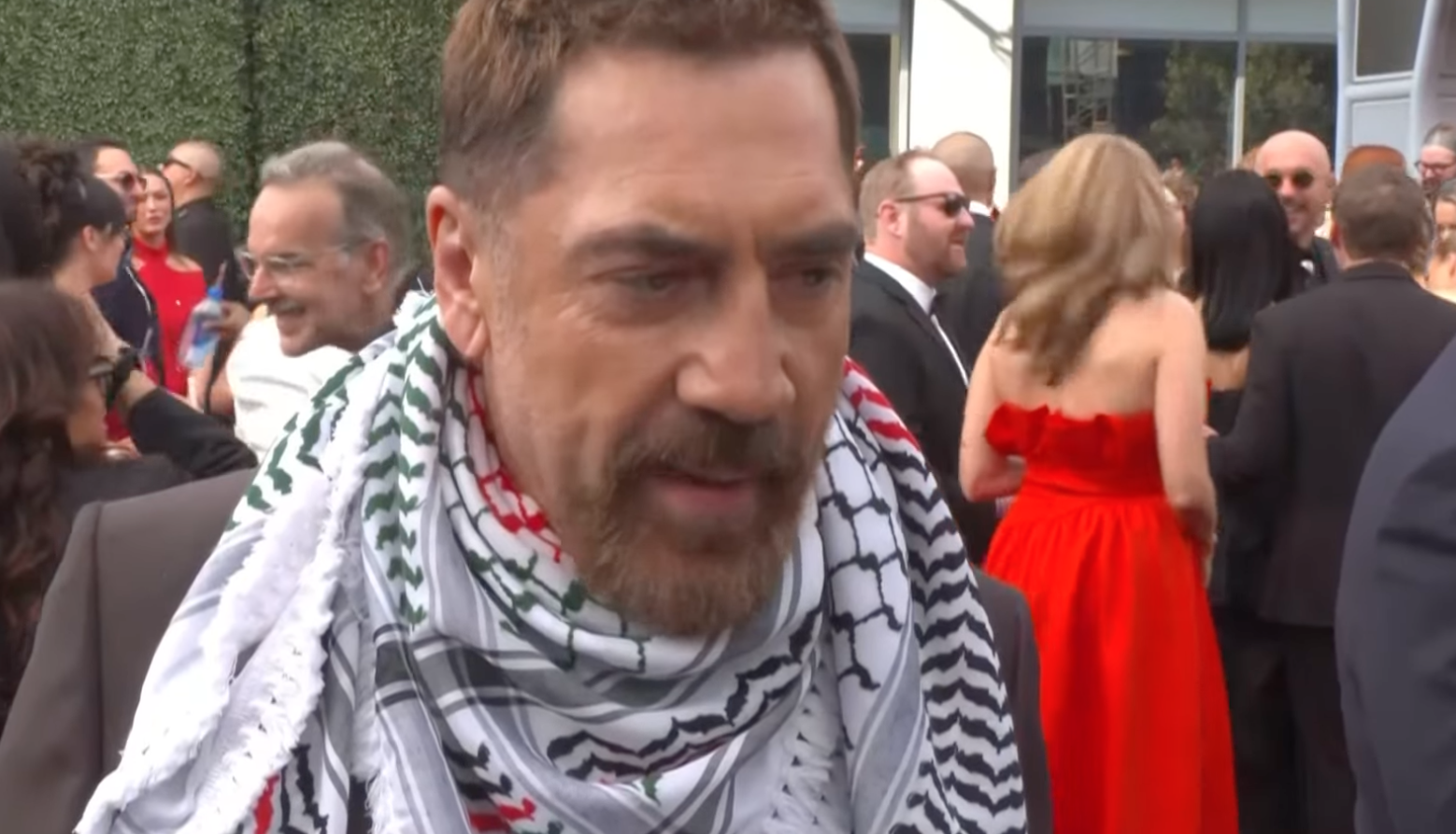
Whenever I try to navigate geopolitical complexities, I never forget to consult celebrities. And thank God, this week there was no shortage of “insights” coming from them.
As a woman with a niche set of interests, Hollywood events, like the Emmy Awards, are not exactly my natural habitat – and even Jewish actress Hannah Einbinder’s desire to appease the crowd by shouting “Free Palestine” would not have sufficed for me to pay attention. After all, there are plenty of self-loathing Jews worldwide or Ukrainians who find sympathy for Vladimir Vladimirovich.
But the “insights” from Spanish actor Javier Bardem, admittedly, made me heed the event I was originally taking no interest in.
Draped in a keffiyeh and addressing a reporter, Bardem shared his “geopolitical wisdom” with the world, outlining two arguments in support of Palestine—or rather Hamas, the so-called “freedom fighters.”
His message boiled down to two claims: The conflict didn’t begin on October 7. It began in 1948.
I say, perfect, Señor Bardem.
As a political scientist—though the term itself often feels oxymoronic, as any practitioner knows there’s only so much science to politics—I’d like to thank him for making my life easier with these “insights” as they help me avoid going into all the historical and divine wilderness of who was there first and why.
But I’ll definitely use this opportunity to push back against all his claims on the need to punish “evil Israel” and protect the “Palestinian martyrs” by asking him five questions, with 1948 serving as a reference point.
Question 1: Were there historical preconditions for Israel’s emergence as a state specifically in this region?
Question 2: Was pre-1948 Palestine a nation-state or a territory? And what is the difference between the two?
Question 3: Who rejected the two-state solution in 1948 and who launched the subsequent war? Name the aggressor and the victim.
Question 4: What is sovereignty, and how is it established and defended?
Question 5: In war, who decides the outcome?
I don’t expect a man with Bardem’s level of expertise to answer these questions in any meaningful way, so I’ll go ahead and answer:
- Yes, there were clear historical preconditions—the Roman Empire’s records suffice.
- Pre-1948 Palestine was a territory under the Ottoman Empire and later under the British mandate, never a nation-state like France which started moving away from absolute monarchy in 1789.
- The Arab states rejected the partition of Palestine and the idea of a two-state solution, and launched a war against Israel the day after it declared independence in 1948, aiming for its eradication. Aggressor: The Arab League. Victim: Israel.
- Sovereignty is a state’s right to govern itself as it sees fit. It is established through a set of governing bodies and entities like the army. Sovereign states have definitive borders and citizens, and are protected by these very same governing bodies.
- The side that wins determines the outcome.
Accordingly, Israel had reasons to be in this particular place of the world. Palestine was a territory, which ceased to exist as such after the British ended their mandate. It had a chance to become an internationally recognized state in its modern understanding but turned down the offer in 1948. Instead, Arab states launched a war against a sovereign Israel—recognized by the US and the USSR on the same day, with multiple countries joining afterward—which they lost.
That’s the root of the conflict, Señor Bardem. Everything else—from the occupation to the annexation of the Golan Heights to the wars in Gaza—flows from this existential truth.
To comfort himself and hide his man-tears, Señor Bardem may put another keffiyeh over his head. But this is what happens when you face true resistance to the porridge of an argument you solemnly present to a gullible Hollywood reporter, citing the big “G”: meaning genocide, not what you might have thought of at first.
What’s happening in Gaza today is a war—yes, a terrible one, and yes, civilians are suffering, which is a disheartening sight. But it is, as Bardem correctly noted, the continuation of 1948. The only way of stopping it permanently, not temporarily, is for the Palestinians to accept the original outcome of that war and abandon the goal of eradicating Israel to build their own lives.
There’s really no other way—whether you like it or not.