Five Years Later, Abraham Accords Still Anchor Regional Cooperation
On Thursday, the Holon Institute of Technology (HIT) and the UK Abraham Accords Group (UKAAG) signed a memorandum of understanding to strengthen their cooperation on artificial intelligence, bringing together Israel, the United Kingdom, and the broader Abraham Accords community.
The signing ceremony was held at the British ambassador’s residence in Tel Aviv. This agreement is a continuation of the collaborative research between HIT and the UKAAG, which has revealed promising opportunities for AI-driven collaboration across various sectors, including health, energy, education, and governance. Officials pointed out that the focus will be on responsible AI, professional training, and creating shared regional standards and best practices.
UKAAG Director of Policy @MatthewL_Davies travelled to Israel this week to sign a Memorandum of Understanding with the Holon Institute of Technology at UK Ambassador @simonwaltersuk’s Residence in Tel Aviv. At the signing ceremony, we were delighted to be joined by leaders in… pic.twitter.com/y5ofcFqlem
— UK Abraham Accords Group (@UKAbrahamAccord) November 26, 2025
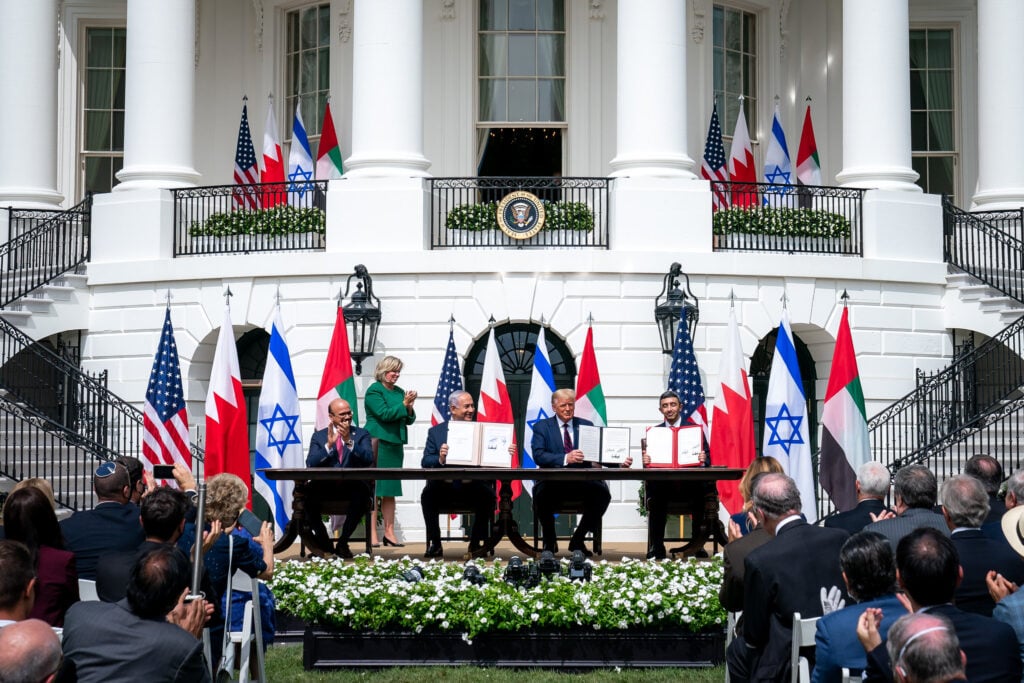
In a world fraught with conflict, political instability, and a relentless tide of misinformation, the Abraham Accords have emerged as an unexpected source of stability. It has been five years since the UAE, Bahrain, and later Morocco joined the agreements. Despite the challenges—and the upheaval following October 7—the Accords have shown remarkable resilience, defying many expectations.
The American Jewish Committee AJC’s podcast, Architects of Peace, pulls back the curtain on how the Accords have survived. The show dives into the people, assumptions, and quiet back-channel work that’s kept this unlikely peace alive during Israel’s hardest stretch in decades.
There’s one thing that stands out over and over in these conversations: The Abraham Accords were never supposed to be some empty handshake for the cameras. Right from the start, this was about changing the region—from a place known mostly for conflict to one focused on cooperation, trade, and shared opportunity.
AJC Abu Dhabi hosted a panel discussion with Dr. Tal Becker, one of Israel’s top experts on international law, in a conversation moderated by AJC Abu Dhabi Director Amb. (ret.) Marc Sievers. The session looked at Israel’s growing regional ties in the context of the Abraham… pic.twitter.com/m4BjYZXGHD
— American Jewish Committee (@AJCGlobal) November 26, 2025
Anne Dreazen, who spent 18 years at the Pentagon before joining AJC’s Center for a New Middle East, kicks off the series with this:
“One thing that I have learned from my many years at the Department of Defense is that military instruments of power are not sufficient to really build long-lasting peace and stability. The importance of trade, of economic development, of people-to-people ties, is so essential to what we think of as an enduring or a lasting peace.”
That belief—security alone just isn’t enough—has quietly kept the Accords alive, even through the darkest days of the Israel-Hamas war.
The UAE’s Take: Peace With People, Not Just Governments
If anyone really lives out that idea, it’s Dr. Ali Rashid Al Nuaimi. He is a top Emirati lawmaker and one of the first public supporters of the Accords. His explanation for why the UAE didn’t walk away, even when everyone else seemed to be losing hope, is refreshingly honest.
“Why didn’t the UAE pull out of the Abraham Accords? My answer is this: it’s not with the government, our engagement. Governments will change. Our Abraham Accords is with Israel as a nation—with the people… This is where you build the bridges of trust, respect, partnership, and shared responsibility.”
That difference—between deals made by politicians and real connections between societies—probably explains why the Accords survived all the chaos of the last two years.
Even after October 7, when cultural exchanges stopped for a while, the cooperation didn’t just dry up. It changed shape. The UAE stepped up, sending nearly half the humanitarian aid that reached Gaza, building desalination plants, running field hospitals, and evacuating patients. Dr. Al Nuaimi says none of that would have happened without years of trust-building first.
A New Security Setup
From Washington’s point of view, the Accords opened doors that used to seem locked tight. Anne Dreazen points to one example that would’ve sounded crazy just a few years ago: the Pentagon moving Israel from EUCOM to CENTCOM.
“For decades, it had been thought that wouldn’t be feasible,” she says. “But after the Abraham Accords… it became clear that increasing cooperation between Israel and Gulf partners made strategic sense—especially given shared concerns about Iran.”
This move basically rewrote the playbook for regional security. Now, Israeli and Gulf military leaders can plan and train together, even if a lot of it happens quietly behind the scenes.
Business Ties: The Quiet Engine of Peace
But honestly, the most powerful part of the Accords—and the one people talk about least—is the economic side.
Retired Ambassador Marc Sievers, who leads AJC Abu Dhabi, calls it “a revolution in normalization.” He points out that past peace deals never managed to get people working together or tie economies together in any real way.
What is happening now in the UAE and Morocco is different. Tally Zingher of Blue Laurel Advisors summed it up at the AJC Global Forum:
“The region is really driven by national agendas… and those agendas now align with Israeli strengths.”
So you get this new, practical ecosystem. Emirati and Israeli entrepreneurs are teaming up on water, energy, agriculture tech, and healthcare. Not just for show—these are real partnerships that make sense for everyone involved.
Benjamin Rogers, AJC’s Director for Middle East Initiatives, explains why this matters:
“Business relations are the most resistant to political conflict… When you tie the relationship to your own value and your own work, you’re more likely to endure the political storms.”
That is probably why, even as political talk cooled off in 2024 and 2025, private sector partnerships held steady.
Bahrain: A Tougher Path
Of course, not every country has seen the same benefits. Dreazen points out that Bahrain, with its smaller economy and less overlap in tech sectors, hasn’t gotten the same economic boost as the UAE.
But she also sees an opportunity:
“Bahrain is prioritizing training its youth for IT and financial services. This is one area we want to look into more—building relationships that provide jobs for their young workforce.”
Here is the heart of it: peace in the Middle East will not last unless it actually gives young people in the region a shot at a better life.
A Moment of Reassessment—and Possibility
There is a pause right now—a bit of uncertainty, but also a real chance to rethink things.
Back in late 2025, the U.S. announced a ceasefire in Gaza and rolled out a big 20-point peace plan. The mood in the region shifted. Excitement faded, people grew cautious, and nobody’s falling over themselves with optimism. Still, the basic diplomatic groundwork is there.
Saudi Arabia, especially after Crown Prince Mohammed bin Salman visited Washington, feels like the next big player to watch. They’re not budging on their demands for Palestinian statehood, though.
And then there is the unexpected: Lebanon, Syria, and even Indonesia are quietly talking in ways nobody would have believed a few years back. Marc Sievers singled out something Indonesian President Prabowo Subianto said at the UN, and it hit a nerve:
“We must have an independent Palestine… but we must also guarantee the safety and security of Israel… The descendants of Abraham must live in reconciliation.”
If Indonesia—the biggest Muslim-majority country on the planet—moves closer to formal ties with Israel, that would shake things up far beyond the Middle East.
The Youth Factor: Winning Hearts, Not Just Agreements
Now, let’s talk about the real challenge: the next generation. At the core of the AJC’s new Center for a New Middle East is a clear truth—peace only works if young people actually buy into it.
Dr. Al Nuaimi doesn’t sugarcoat it:
“It is very important to focus on the youth… to create a narrative that will gain the heart and mind of all youth in the region—the Israeli, the Palestinian, the Arab, the Muslim.”
This is the urgent battle now: fighting back against extremism on both sides. The far-right in Israel, radical groups in the Arab world—they feed off each other’s anger.
So where does that leave us? The region is still choosing hope over hostility, even after everything that happened on October 7. That’s the real story behind the Abraham Accords. They were never just about signatures on a treaty. They’ve always been a gamble—a bet that the Middle East could look completely different.
A place where working together pays off more than fighting.
Where business and diplomacy matter more than old grudges.
Where ordinary people, not just politicians, keep the peace alive.
And where young people get the chance to chase opportunity, not just inherit old anger.
Nearly every leader on the podcast said it the same way: after all the pain and horror, the Accords survived because everyone knows what the alternative looks like.
To quote Dreazen, who kept coming back to this idea:
“Military instruments alone cannot build lasting peace.”
Five years later, the Accords are not just surviving—they are turning into the foundation for whatever comes next in the Middle East.