Fleeting Frames of Pictures – and Tears
Pictures. Collective. Personal. One image superimposed on another. Tears. One over another. Receding into other pictures.
Bondi Beach, Sydney – a massacre with the lighting of the first candle of Chanuka. The news flash interrupts a radio interview with returned hostage, Gadi Mozes, citing reasons why Israel needs a Commission of Inquiry to investigate the events of October 7 and how it could have happened – and not only that. The inquiry the government avoids, proposing a political alternative with commissioners that it appoints.
Gadi said an inquiry should examine other related issues about how this government has led Israel to fall out of favor among so many nations, to such an unprecedented degree. After the news flash from Australia, Gadi was asked to comment. He posed the rhetorical question, logically following his remarks before the news: Why are there so many incidents of antisemitism around the world?
Thinking: There will probably always be antisemitism around the world.
Can it be curbed? Why is it on the rise in recent years? Was Zionism not overly presumptuous to think it would provide a solution to antisemitism?
Can Hamas be defeated? Is it feasible to expect Hamas to lay down its weapons? Is it reasonable to believe we can obliterate Hamas?
Day after day. Photos of the massacre victims. A child. A Holocaust survivor. Tears. The courageous Muslim Arab man who risked his life to grab the weapon from one of the terrorists in Sydney. Good people are good people. Bravery. Crying again. As if crying is a passive act while sipping coffee.
Another article sent to me about the government of Israel backing illegal activities and violations of human rights by right wing Israeli citizens attacking Palestinian communities in the West Bank. Frightened. Feeling helpless. Perplexed. How do so many Israelis overlook this, or knowingly, tacitly endorse it, thinking it serves some interest of theirs. Tears. Demoralized, thinking of many Jewish Israelis who would shrug their shoulders, raise an eyebrow, dismiss the harm of such matters were I to insist on bringing them to their attention. I suspect some such people would say nothing in order not to argue nor upset me. I’m upset.
Pictures in my mind. Photos on my phone. Two weeks ago, we attended Shabbat morning services in Abu Dhabi at the Abrahamic Family House. More security arrangements than last year. My sister, the Dubai local, handled arrangements, photocopying our passports to submit in advance. Following several visits in the past two years, beginning to feel at home in the community, just as we enjoy meeting other visitors from Israel, the UK, the US, Morocco, Iran.
Guest head of community from Marrakesh tells his story after kiddush about documenting Morocco’s Jewish cemeteries with the support of the king. He shares his vision for a center in Marrakesh like the Abrahamic Family House in Abu Dhabi. The king endorsed the idea, but funding was not forthcoming. The appeal implied.
An American, Iranian-born woman tells listeners about recently traveling to Teheran to bury her father at the Jewish cemetery. I was captivated by the tale of bureaucracy and a flexible Muslim clerk unknowingly enabling the presence of a minyan after she brought her father’s body from the Muslim cemetery where it was held, to burial at the Jewish cemetery.
Attending Shabbat services was Haim’s choice this trip. His daughter and our 8-year-old granddaughter were with us – their first trip to the UAE. Haim wanted them to experience the premises, the davening, the community, and the government-sponsored kiddush luncheon in a Muslim country. He wanted them to experience safety as Jews in a Muslim Arab-ruled environment, knowing his daughter comes from a perception of Muslim and Arab invariably spelling Palestinian and danger – no matter how we plead to differ.
After kiddush, my sister and I intend to grab a sister moment. Her son, also visiting, Haim and his daughter head to see the mosque on the premises. My granddaughter seems to prefer the coffee break. When the rest of the bunch returns from the mosque, they had for the church. Only when our granddaughter hears there are Christmas decorations and Santa figures in the church is she convinced to join them. As a Jewish Israeli child, she is drawn to the colorful, festive spirit of the holiday and its décor which she knows from social media (despite physical examples in Israel in Christian communities). She busily takes photos of every Christmas decoration she sees in the UAE.
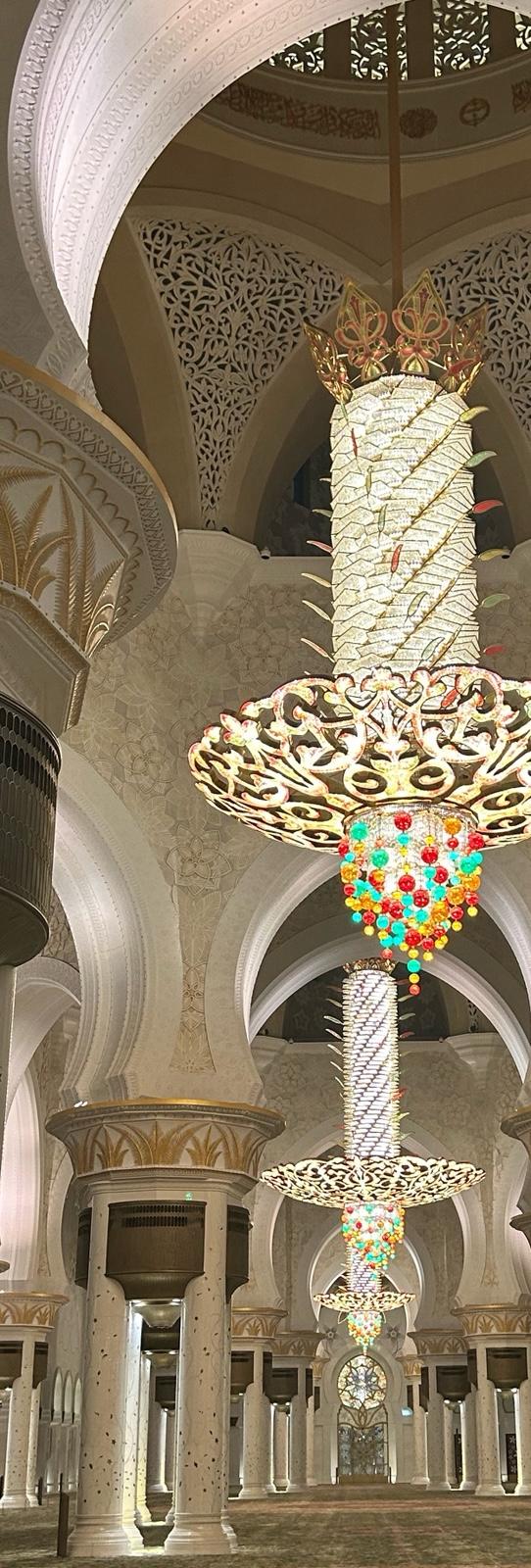
After a mangrove forest, we head for Sheikh Zayed Grand Mosque. Five trips to the UAE, our fourth visit to this mosque. Although struck by different aspects of its grandeur with each visit, the only reason for this fourth visit was Haim’s insistence that his daughter see it. She was reluctant. Her daughter shared her lackluster enthusiasm.
We approached the mosque at dusk. Illuminated white minarets, columns, arches over gradually darkening skies catch even the attention of a child absorbed by YouTube.
The women donned required dress in respect for the religious environment. The 8-year-old insisted on covering her head like the adult women. She pedantically video-filmed one view after another at the mosque – illuminated pools and fountains on the premises, long hallways, majestic carpeting and chandeliers. I asked if she planned to show the videos to her friends. She immediately reminded her mother to send all her photos to her teacher.
Haim’s hidden purpose achieved. Visiting a mosque can be a positive experience. Not necessarily associated with fear, or the enemy. When stories reached family at home, the reaction followed – a week with Harriet and anyone will go to a mosque.
A few days later, back home. Photos and video clips from the trip posted on social media for Haim’s daughter’s friends to see. Not a fleeting frame with the mosque.
A Muslim Arab from Syria, living in Sydney, saved Jewish lives amidst a massacre.
Harriet Gimpel – December 20, 2025