Macklemore turned a concert into a political ambush
I grew up at a time when celebrities regularly gathered to raise money and awareness for causes larger than themselves. Farm Aid drew attention to the struggles of American farmers. Live Aid raised money for famine relief in Africa. Musicians from the United States, Canada and the United Kingdom recorded “We Are the World,” “Tears Are Not Enough” and “Do They Know It’s Christmas?” Artists lent their voices, fame and cultural power to people whose suffering might otherwise have remained invisible. I admired them for it.
Years later, I was there when George Clooney was arrested outside the Sudanese Embassy in Washington while protesting violence and an impending humanitarian crisis in Sudan. I heard Michael J. Fox speak twice at Reform Jewish conferences I staffed, including when he received the Maurice N. Eisendrath Bearer of Light Award for his activism on behalf of Parkinson’s disease research and stem-cell research. More recently, I applauded Boy George for releasing “We Will Dance Again,” a song supporting Jews and Israel.
I do not believe artists should remain silent about politics. Celebrities can draw attention to suffering, mobilize resources and reach audiences that politicians, journalists and nonprofit organizations often cannot.
But those experiences had something important in common: they were opt-in.
People attended Live Aid knowing they were attending a benefit. They bought charity singles knowing what their money and attention would support. Those who gathered outside the Sudanese Embassy understood that they were witnessing a protest. Those attending the Union for Reform Judaism Biennial knew that Michael J. Fox was being honored for his advocacy on behalf of Parkinson’s disease and stem-cell research. Boy George released a political song that listeners could choose to play, share, criticize or ignore. The causes were not smuggled into unrelated experiences. The audiences were invited to participate.
That is different from buying a ticket to an Ed Sheeran concert and discovering, once inside MetLife Stadium, that an opening act intends to turn the stage into a political rally. The distinction is not between art and politics; those have always been intertwined. It is between persuasion offered to a willing audience and political messaging imposed upon a captive one.
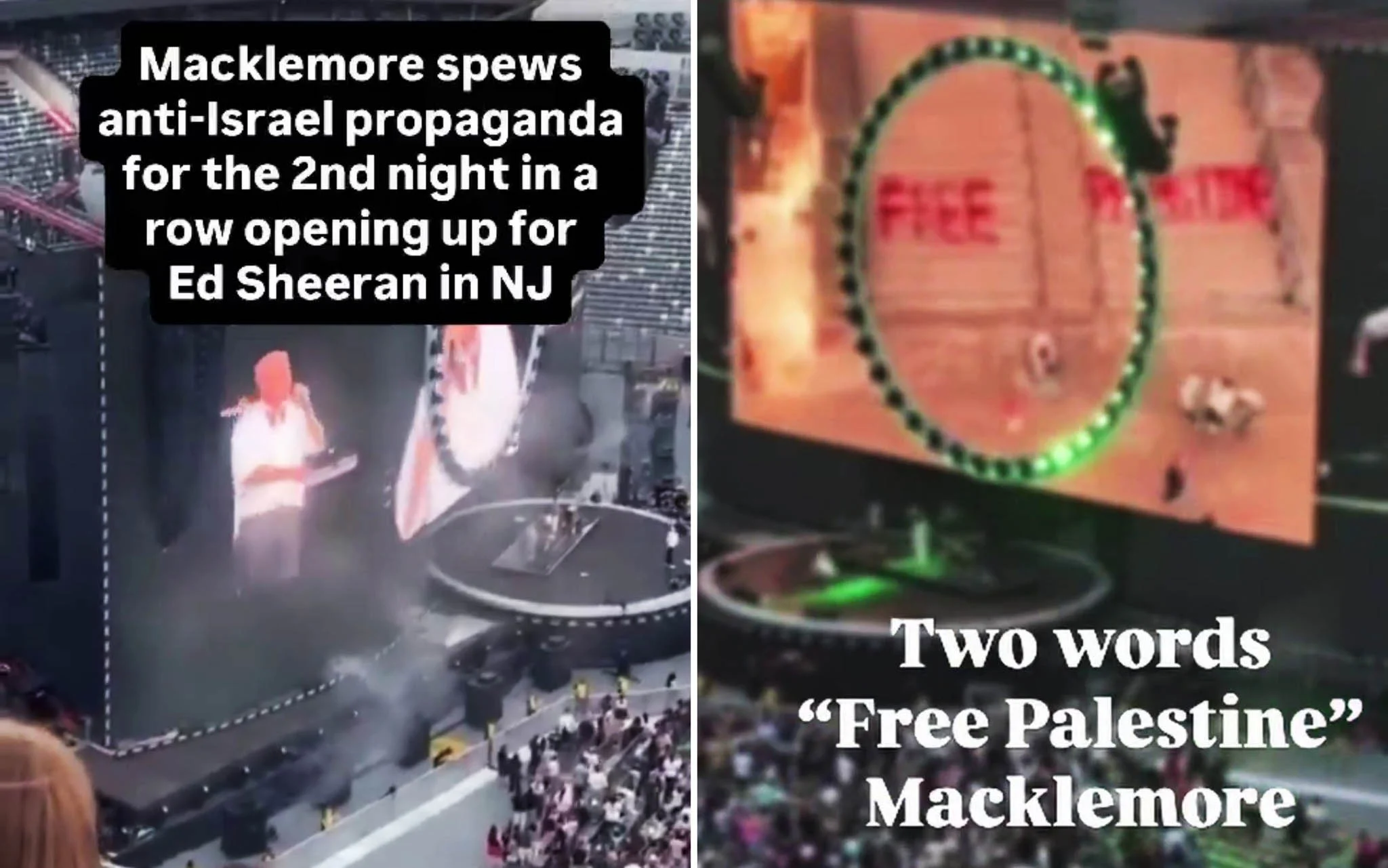
At MetLife Stadium, Jewish and Israeli fans arrived expecting music and instead encountered Macklemore performing “Hind’s Hall,” calling for a “Free Palestine” and displaying images from Gaza. Some audience members cheered. Others reportedly walked out, saying that they had purchased tickets for a concert, not a political rally.
Pink has since entered the debate, sharing a post calling on Ed Sheeran to apologize and offer refunds to concertgoers who had not agreed to attend a political event. Her intervention reinforces the central question: Are audiences entitled to know what kind of event they are being asked to join?
Concertgoers were not literally trapped. They could leave. But by then they had bought tickets, traveled to the stadium, passed through security and taken their seats among tens of thousands of people. Leaving meant forfeiting an experience, and often a considerable amount of money, because someone else had changed the terms of the event after they arrived.
That is not meaningful consent.
A concert is particularly powerful terrain for political persuasion. Music, lighting, video and crowd response create a heightened emotional state and a feeling of collective solidarity. There is no opportunity to question a claim, supply missing context or offer another perspective. Applause can make one position appear universal, while those who feel impacted are left to remain silent, join the response or visibly remove themselves.
Political speech at a concert does not automatically constitute indoctrination. But entertainment moves in that direction when an audience has not knowingly chosen a political event, contested claims are presented as unquestionable moral certainties, and the emotional machinery of the performance is used to make assent feel like part of the show. The concern becomes more serious when the message affects people who already feel unsafe.
Jewish concertgoers did not hear Macklemore’s performance in a vacuum. They heard it amid rising antisemitism, threats against Jewish institutions and growing anxiety about expressing a connection to Israel publicly. They heard it after years in which criticism of Israel has repeatedly spilled over into hostility toward Jews. And they heard it from a performer whose own record has given Jewish audiences reason to distrust him.
In 2014, Macklemore performed wearing an exaggerated prosthetic nose, black beard and wig, an appearance that evoked one of the oldest and most recognizable antisemitic caricatures. He denied intending to portray a Jewish stereotype and apologized for the offense he caused. Intent matters, but it does not erase the meaning of imagery with such a long and ugly history.
Criticism of Israel is not inherently antisemitic, nor does political speech become antisemitic simply because Jewish listeners disagree with it or find it painful. But speech should not be evaluated in isolation. Context matters. The speaker’s history matters. The rhetoric and imagery matter. And so does the experience of Jewish audience members hearing that message at a moment of heightened insecurity. Antisemitism should never receive a pass simply because it is packaged as criticism of Israel, or delivered through music.
Nor is it acceptable to normalize hate speech by presenting it as ordinary political entertainment. When a performer with a history of antisemitic conduct is repeatedly given an enormous stage without challenge or acknowledgment, the danger extends beyond a single performance. Repetition confers legitimacy. Silence lowers the threshold of what audiences are expected to tolerate, while those who feel targeted are told that their discomfort is merely political disagreement.
When politics enters an entertainment space, the question is not only whether the message is protected. It is also whether the people affected by that message still feel protected.
For some Jewish members of the MetLife audience, the concert did not merely become political. It stopped feeling safe. A concert, at MetLife Stadium, of all places, should not require Jewish fans to choose between remaining in the room and preserving their sense of safety.
That brings us to Ed Sheeran.
Sheeran may not have known what Macklemore intended to say or perform on the first night. A headliner cannot anticipate every word uttered by an opening act, and providing a platform does not constitute endorsement of every opinion expressed on it. But Macklemore was given the stage again the following night. By then, Sheeran and his team knew that he intended to use it for political declarations accompanied by Gaza imagery, and that some audience members had felt blindsided and alienated.
Silence may not prove complicity. Silence combined with a second invitation is no longer merely silence.
We cannot know whether Sheeran personally shares Macklemore’s views. But we can judge his conduct: He controlled the stage, knew how it had been used and chose to provide it again. That does not prove ideological agreement, but it does demonstrate permission. A headliner may not own every word spoken on his stage, but he owns the decision about who receives the microphone and whether that person receives it again.
Sheeran should acknowledge what happened and its effect on Jewish and Israeli fans. If he believes Macklemore’s performance was appropriate, he should say so. If he believes the stage was misused, he should say that clearly. What he cannot credibly do is pretend that silence means neutrality.
I remain grateful for artists who use their prominence to confront suffering and injustice. But advocacy is more honest when it identifies itself as advocacy. A benefit announces its cause. A protest declares its purpose. A political song allows listeners to decide whether to listen. Each invites participation rather than presuming it.
Artists have the right to be political. Audiences have the right to know when they are being recruited into a political event. And Jewish fans have the right to expect that the person whose name appears on the ticket will notice when his stage becomes a place where they no longer feel welcome.
The difference between entertainment and an ambush is consent. Ed Sheeran’s audience was not given that choice.