
Flowers over the wall
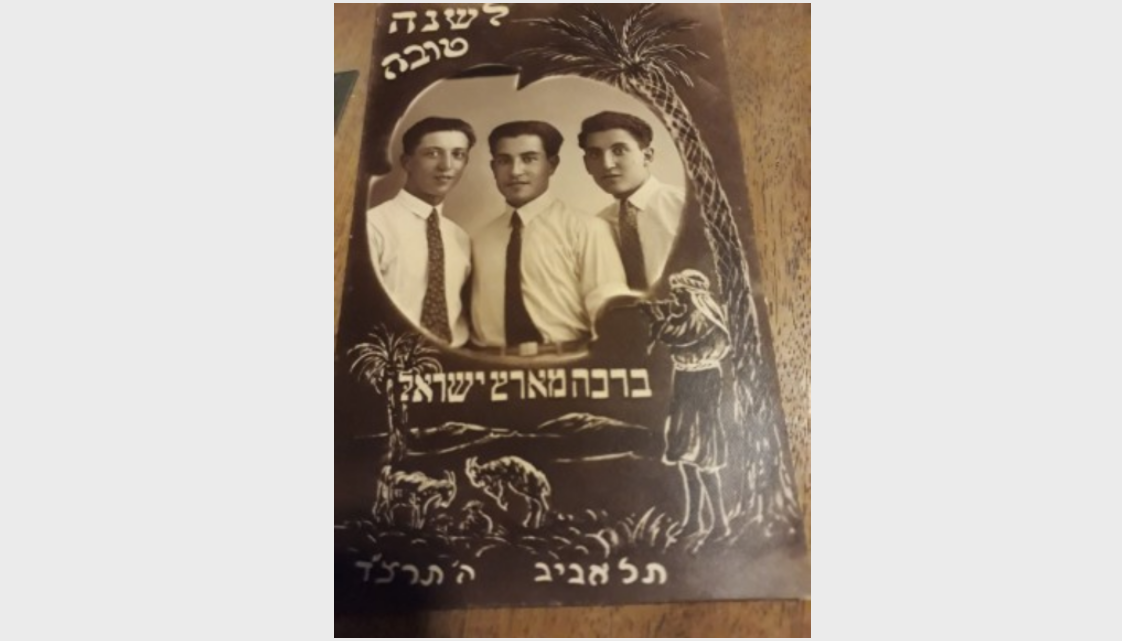
In 1941, September 26 was a Friday—as it was this year, 2025. On that day, the New-York based Jewish telegraphic agency reported this news from the Warsaw ghetto:
“Sympathy with the Jews in Nazi-held Poland was demonstrated this Rosh Hashanah by Poles in Warsaw gathering in groups near the Jewish ghetto and throwing flowers and baskets of fruits over the ghetto walls, it was reported here today. The Jews in the ghetto have not seen any fruit for several months, since the Nazi authorities issued an order prohibiting Jews from buying fruits and vegetables.
Simultaneously the Polish secret radio broadcast on Rosh Hashanah a message in Polish and in Yiddish demonstrating the unity which exists between the Polish and Jewish population under the Nazi occupation. The broadcast urged the Jews to bravely carry their burden of Nazi oppression and emphasized that though this Rosh Hashanah is being met by Polish Jewry under conditions of unprecedented misery and persecution, it can be hoped that the new year will bring them liberation in a restored free Poland. The broadcast was announced as ‘being sent by Polish Christians to the Jews of Poland.’
Assuring the Jews that ‘every Pole, Catholic as well as Protestant, shares the persecution, torture and degradation which the Jews suffer under the common enemy called Hitler,’ the broadcast expressed “brotherly greetings” to the suffering Jews on the occasion of their New Year and told them to feel that the walls of the ghetto have not separated them from the Polish people.
On the other hand the Nazi-controlled Polish press came out with articles bitterly attacking Poles for continuing to maintain relations with Jews. The Nowy Kurier Warszawaki complains that there are still Poles who are helping the Jews. The paper threatens that the property of such Poles will be confiscated and that the owners will be sent into the Jewish ghetto.”
http://pdfs.jta.org/1941/1941-09-26_239.pdf
An account of this courageous act of kindness, narrated by Henry Shoskes, is also quoted in Philip Goodman’s Rosh Hashanah Anthology:
“Some of the Jews still had radios hidden away somewhere which they sometimes tuned in after they had locked the doors. That night they heard a secret Polish station broadcasting a New Year’s greeting to the Jews in the Warsaw Ghetto. ‘We Poles of whatever party or religion are mourning together with you Jews in this, the darkest hour of our history. We are waiting for the time when our and your tragedy will have finished and a new Poland will rise from the ashes. We see the sun rising for a better morning—even for you, within the walls of the ghetto. Together we will destroy our common enemy, the Nazis.’ During the same night a group of Polish workers approached the walls of the ghetto near Chlodna Street and threw flowers over the wall. There was a little card, too, which said that this was a New Year’s greeting from the Polish workers of the Wola factories” (254).
Soon after, this tragically beautiful gesture was overwhelmed by the intensifying and systematic mass murder of the Jews—with the complicity and in some instances collaboration of much of the Polish population. As a result, some acts of kindness such as what happened in the Warsaw ghetto in 1941 on the eve of Rosh Hashana have fallen into relative oblivion.
What I fear might also be falling into oblivion and distortion is our understanding of who may and who may not accurately depict themselves as courageous and persecuted figures of resistance.
There is some truth in the recently circulating meme in which a crying Greta Thunberg is sarcastically imagined to say, “How dare you agree to a peace deal?”
https://www.instagram.com/p/DPkeZ1RDDC9/
It can indeed be a challenge to distinguish between those who genuinely want peace and those who have realized that speaking in the name of peace and justice might be the only way to enjoy, in today’s polite society, the pleasures of moral superiority over Jews. From the Gaza flotilla to BDS and other anti-Israel activism, are we beholding silenced pacifists or rather individuals who are engaged in their own club building and who harm the Palestinian people by emboldening radical leaders among them?
Another effect of anti-Israel activists in the West is that as a result of their efforts, I feel closer to understanding my late grandparents. When confronted with anti-Israel activism today, I feel a visceral sense of connection to what my grandparents and people of their generation endured in Europe in the years before the Holocaust (my grandparents all left before the Holocaust).
When my late grandfather, Menachem Lichtenstein, was growing up in Poland, some children shouted at him, “dirty Jew, go to Palestine” (and by Palestine they meant the British mandate of Palestine; there was never a sovereign Arab state called Palestine). Today, BDS activists have been trying to chase the grandchildren of my grandparents’ generation out of the international academia.
In 1934, my grandfather (pictured left in the card at the start of this post) and his brothers Meir and Yitzhak sent a greeting card for Rosh Hashana, the Jewish new year, from their new home in Tel Aviv. We do not know the exact story, but the words “a Shana Tova (happy new year) greeting from the land of Israel” seem to suggest that such cards were designed to send to loved ones back in Poland (with a copy of the card kept at home in Tel Aviv). The card captures the Zionist aesthetic of return to ancient Israelite culture, embodied in the image of the shepherd, and of the land conceptualized as largely empty—an image that can come under attack but that also shows that the agenda was to settle in parts of the land that were not already inhabited rather than to forcefully displace Palestinians (displacement happened later after Arab leaders decided to reject the UN partition plan and started a war).
When my grandfather and two of his brothers sent the card in 1934, they did not know that their parents and siblings in Poland—like most Jews in soon-to-be-Nazi-occupied Europe—had less than a decade left to live in their current life cycles and that the coming years would prove to be tortuous. Today, it is estimated that there are about two million Jews fewer than before the Holocaust:
https://www.timesofisrael.com/israel-says-worlds-jewry-still-2-million-shy-of-1939-numbers/
How did my great-grandparents in Poland feel when they received the Rosh Hashana card from their three sons?
Where was this card in the weeks, days, hours and minutes before my great-grandparents and their other children who remained in Poland were murdered? And what happened to it after they were murdered?
I imagine that quite a few European Jews likely had such cards in their possession as the Nazi grip tightened and as it eventually became impossible to send or receive mail. Perhaps some Jews, as they were boarding the cattle trains to the death camps, had in their breast pockets Rosh Hashana cards such as the one that my grandfather and his brothers sent to their parents. I wonder if cards such as these ones gave them some comfort, knowing that their children were alive and working hard to make ends meet and to build a sovereign state: a state that is Jewish but that treats minority groups with equality—a state that seeks peace but that will defend itself against the genocidal agenda to destroy it.
There is a famous Holocaust song called “Shtiler, Shtiler” (Quiet, quiet, says a mother to her child in Yiddish):
https://wwv.yadvashem.org/yv/en/exhibitions/music/shtiler-shtiler.asp
This is the opening stanza in English translation:
“Quiet, quiet, let’s be silent,
Dead are growing here.
They were planted by the tyrant,
See their bloom appear.
AII the roads lead to Ponar now,
There are no roads back,
And our father too has vanished,
And with him our luck.
Still, my child, don’t cry, my jewel,
Tears no help commands,
Our pain callous people
Never understand.
Seas and oceans have their order.
Prison also has its border,
But to our plight
There is no light.
There is no light.”
https://yiddishsongs.org/shtiler-shtiler/
Listening to this song in Hebrew translation as a child, I remember racking my brain to try to understand the meaning of the words “our pain callous people never understand.” Growing up in a family, society and educational system that conditioned me to seek to empathize with other people’s narratives, I did not know how to make sense of the assertion that there are people who “will not understand” the pain of an innocent victim. But decades later, the anti-Israel agenda in the West, which falsely depicts Israel’s tragic necessity to defend itself as if it were deliberate cruelty, has helped me to understand what I could not grasp as a child.
The lines “but to our plight there is no light, there is no light” appear in the Hebrew translation that I am familiar with as “there is no limit, there is no limit.” For many years (perhaps due to a listening glitch, or perhaps there might be different versions of the song), I thought that the word in Hebrew was not plight but love. With this in mind, I sang the song in my mind as if it were about the ultimate spiritual triumph of boundless love. Humming the song to myself, I took its meaning to be, “quiet, quiet, my child; callous people will not understand our pain. . . but have comfort because our love is without bounds, without bounds.” And even if the translation into love is likely a mishearing glitch on my part, the lyrics continue to give me comfort.
“Shtiler, Shtiler” was performed in the Vilna ghetto in 1943. Nehamka Rahav, then a teenager, remembers the effect of the performance:
“Mirele, a tiny little girl, goes up to the stage. And when she starts singing—her voice sounds like bells—everybody begins to cry. Not hysterically, not wailing—their sobbing was terrible but silent, out of the depths. It was perhaps the first time people there had let themselves express what they had been feeling for a year and a half. I didn’t cry when they took my father away and murdered him in Ponar. I didn’t cry, not once. But that day I cried too, and my tears kept falling, and Mirele stood there, singing—that’s something I’ve never wanted to forget.”
https://www.tabletmag.com/sections/history/articles/a-song-of-the-vilna-ghetto
As I write this in the early hours of October 11, the ceasefire has gone into effect, but the hostages have not yet returned. The feeling of euphoria over the hope that the hostages will return home is a visceral reminder of what Israeli culture values— life. And in the face of the callous spreading of lies and distortions about Israel—and in the face of manipulations that are likely yet to come—this valuing of life will continue to be a source of resilience even if sometimes “Shtiler, Shtiler” is the best that one can do.