Fool Me Twice Ayatollah, Shame on Me
There is an old warning that travels well from the bazaar to the Situation Room: Fool me once, shame on you; Fool me twice, shame on me. Great powers ignore that rule at a high price. The United States has not, in the modern era, wandered into major wars for poetry or boredom. Its large campaigns have usually followed two hard interests: Cold War competition and energy security. Only under George W. Bush did a third rationale become explicit and durable—the war on terror. Vietnam was the Cold War in rice paddies and jungles. The first Gulf War was energy security made visible: Saddam Hussein’s seizure of Kuwait threatened the oil architecture on which industrial civilisation still ran. After 9/11, terrorism joined the list. Those three motives have rarely appeared together in one theatre. A confrontation with the Islamic Republic of Iran is the rare case in which they do.
Vietnam was not about Vietnamese villages as such. It was about containing a communist bloc that Washington believed would keep moving if it were not stopped. The first Gulf War was not a seminar on Kuwaiti sovereignty. It was a decision that a revisionist dictator would not be allowed to hold the world’s energy tap. The Bush-era wars added something new: the claim that networks, ideologies, and state sponsors of terror could not be managed as ordinary diplomatic problems. One can argue about execution, cost, and wisdom. The pattern of motive is clearer than the mythology that America fights everywhere for no reason.
A campaign against the Islamic Republic gathers all three strands at once. A revived great-power contest call it Cold War 2.0 runs through Tehran’s relationships with Russia and China, its role as a spoiler, and its usefulness to any coalition that wants to bleed American attention. Energy security is obvious: the Persian Gulf remains a strategic reservoir, and the Strait of Hormuz is the narrow door through which a large share of seaborne oil still must pass. Terrorism is not a slogan in this case. It is a method proxies, militias, deniable attacks, nuclear brinkmanship, and the mixing of ideology with criminal finance, including narcotics and black-market energy. When those three motives converge, the conflict is no longer a sideshow. It becomes a war that defines the system.
Closing the Strait of Hormuz was therefore not merely a battlefield tactic. It was an invitation. A state that treats a global artery as a hostage hands its adversary a reason and a justification to seize control of that artery. If the United States and its partners come to police the strait, they do more than punish Tehran. They put a hand on a line that China cannot ignore. Beijing’s factories, tankers, and strategic reserves still live downstream of Gulf energy, even if China has stockpiled, electrified, and diversified faster than many neighbours. A durable American grip on Hormuz would not by itself freeze a Taiwan crisis. It would raise the cost of one. China cannot casually open a second chokepoint war while its energy and industrial chemistry remain exposed to the first. In that sense, Tehran’s attempt to weaponise the waterway converted a regional feud into a systemic one. Cold War rivalry, terrorism, and oil ceased to be separate files. They became one war with a petroleum spine.
That is why a half-finished outcome is more dangerous than a hard one. First, enriched uranium has not been removed from Iran. Material already driven close to weapons grade can be turned into a handful of bombs if the regime can enrich further and if it can dig, hide, and reconstitute. Estimates around eleven weapons’ worth of potential are not poetry; they are the arithmetic of stockpiles that inspectors can no longer fully see. Second, there is the unresolved problem of buried infrastructure the suspicion that centrifuges or related kits could survive in mountain complexes such as Pickaxe Mountain and other underground sites. A program that can hide in rock is a program that can return. Third, the Islamic Republic is not a normal state that abandons its methods after a ceasefire. Nuclear leverage, proxy warfare, energy blackmail, illicit markets and killing over 100,000 Iranians are not hobbies. They are the regime’s comparative advantage. If this cabinet in Washington loses nerve, Tehran will use the pause to rebuild.
President Trump prefers deals to military action. That preference does not erase the logic of unfinished business. If the Mullahs survive twenty more months of delay, they will not wait politely for American permission to cross the nuclear threshold. They will treat survival itself as a mandate. With a bomb, or even with a convincing dash to one, they can again take Hormuz hostage and multiply the price of energy. A nuclear weapon in the hands of a revolutionary Islamist state would also smash the taboo that has, however imperfectly, limited proliferation among Muslim-majority governments. Other capitals would read the lesson immediately: the bomb is the only language that stops American hegemony and, in their telling, Israeli power. The quiet formula is already there, a kind of strategic taqiyya: let the Islamic Republic build first; we will build behind it.
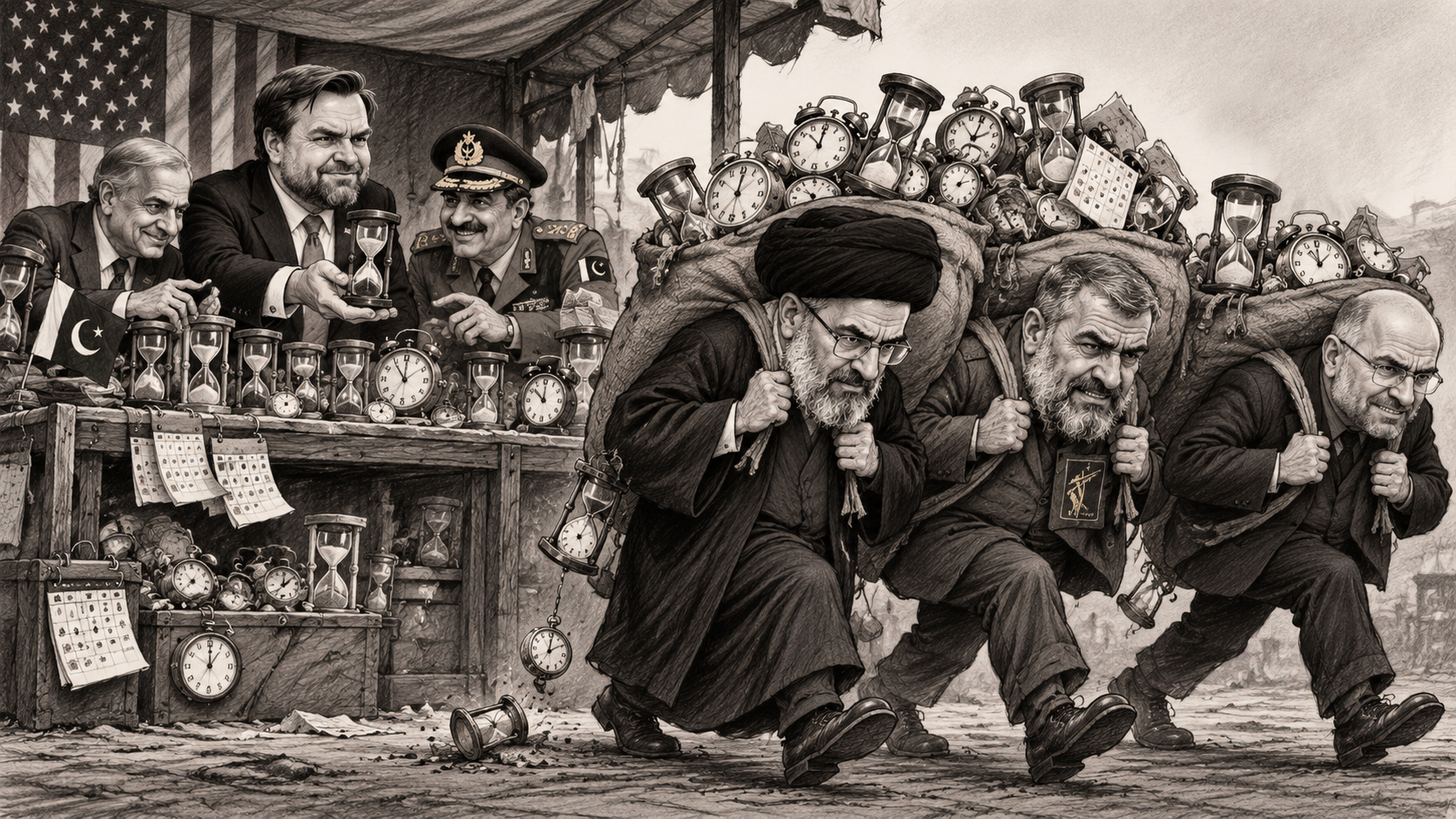
That is why placing too much faith in Pakistan, Turkey or Qatar was a mistake, and why a Vance-style memorandum collapsed in public humiliation. Intermediaries with double books cannot police a regime whose whole method is delay, denial, and reconstitution. The precedent is personal. In Trump’s first term, the message from Tehran was, in substance: win a second term, then we will have a deal. They did not have a deal; they ran out the clock. Now the rhyme is midterms: win the midterms, then we will have a deal. Nobody knows what the midterm outcome will be. The regime’s intention is easier to read. It wants time, legitimacy, sanctions relief, and intact nuclear residue. It wants Washington to accept a pause as a victory.
Fool me once, shame on you. Fool me twice, shame on me. A country that has already seen this play should not applaud the encore. Diplomacy is not surrender, and force is not a substitute for politics. But a war that unites Cold War rivalry, energy security, and terrorism cannot be left as a monument to fatigue. The West must wake from the self-deception that it can ignore the people of Iran; there is no path to a stable Middle East except support for those people and their central demand. For forty-seven years this approach has failed. Until that mindset is abandoned, nothing will change. A deep wound must be treated at the root, not covered with a bandage.