NAnews - Nikk.Agency Israel News
‘For Assistance in the Defense of Kyiv’: Israel’s Ambassador Receives Award
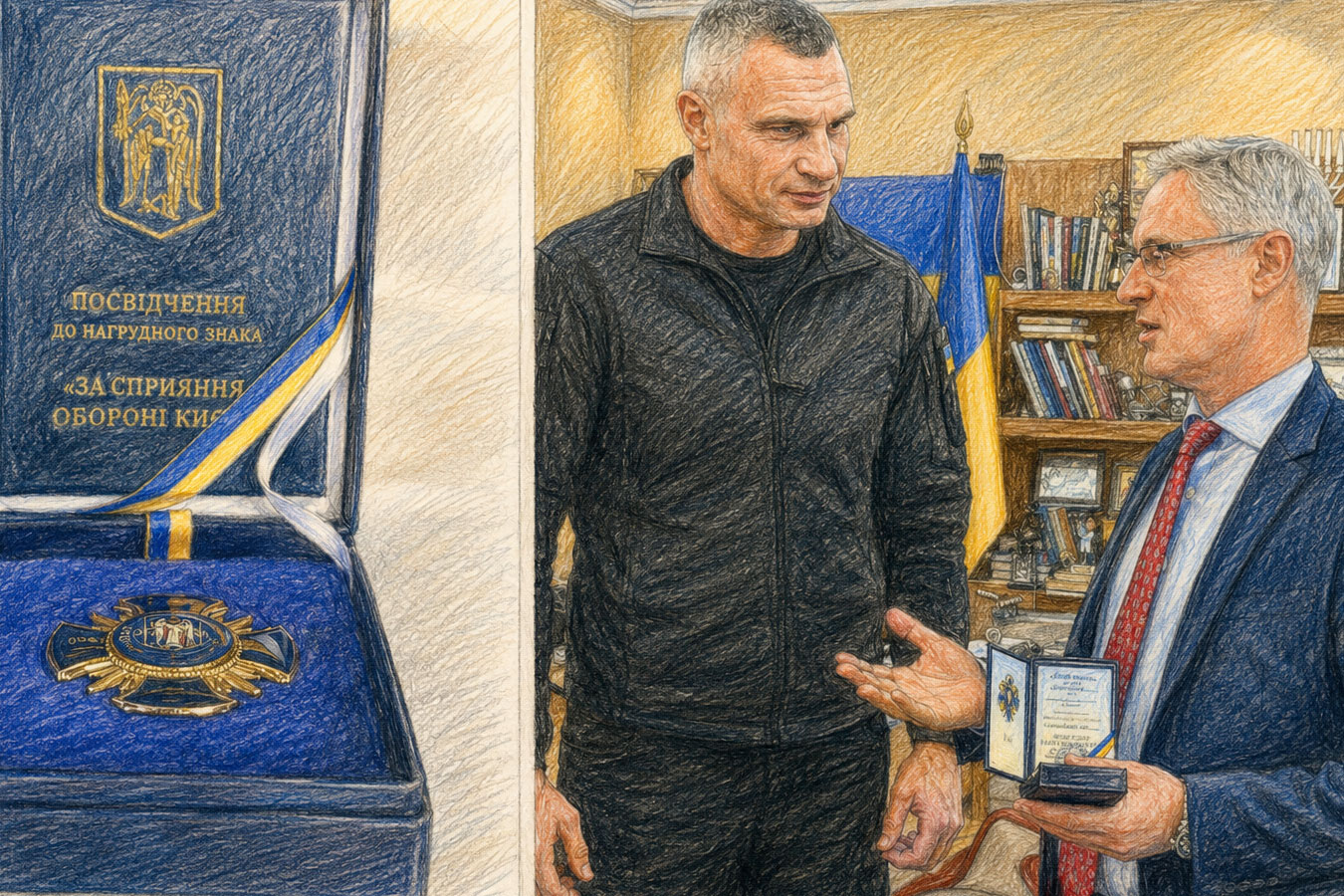
“For Assistance in the Defense of Kyiv”: Israel’s Ambassador Receives Award. The image was created using AI.
On June 4, 2026, Kyiv Mayor Vitali Klitschko met with Israel’s Ambassador to Ukraine, Michael Brodsky, who is completing his diplomatic mission in the country, and presented him with the city’s badge of honor “For Assistance in the Defense of Kyiv.”
The original Ukrainian name of the award is “За сприяння обороні Києва” — a formulation that is important in itself. It does not simply mean “thank you for humanitarian aid.” It means that Kyiv sees this support as part of the broader story of the capital’s defense during Russia’s war against Ukraine.
At first glance, this could look like a standard diplomatic ceremony: a mayor, an ambassador, an official meeting, a farewell gesture.
But this story is much deeper than protocol.
It is about Israel and Ukraine, about Kyiv after February 24, 2022, about October 7, about civilian resilience, hospitals, trauma care, Jewish-Ukrainian ties and the practical meaning of solidarity when cities are under attack.
According to Klitschko, the award was given for the support provided to Kyiv and its residents during one of the most difficult periods in modern Ukrainian history. In 2022, with the involvement of Israel’s ambassador, modern medical equipment worth more than 40 million hryvnias was provided to one of Kyiv’s children’s hospitals.
That detail matters.
A children’s hospital in wartime is not just a medical institution. It is a place where the consequences of war become visible without political language: injured children, frightened parents, exhausted doctors, emergency needs and the constant pressure of possible new Russian strikes.
The Israeli Embassy in Ukraine also transferred 50,000 ready-to-eat food packages with heating elements to Kyiv. The city later handed them over for the needs of the Armed Forces of Ukraine.
In 2023, Kyiv received 30 active wheelchairs for children with disabilities.
These facts should not be lost behind the word “award.” The medal is symbolic, but the reasons behind it were practical: medical equipment, food, mobility support for children and long-term psychological assistance.
This is exactly why the story deserves attention in Israel.
For many Israelis, Ukraine’s war sometimes appears distant — another front, another geography, another crisis. But the details show something else. Israeli knowledge, Israeli diplomatic work and Israeli humanitarian channels became part of Kyiv’s wartime survival infrastructure.
One of the most important examples is the Kyiv Resilience Center, the first center of its kind in Ukraine, opened in April 2023 with the personal support of the Israeli ambassador.
This is where Israel’s experience became especially relevant.
Israel knows what long-term trauma means. It knows what it means when civilians live under rockets, when children grow up with sirens, when emergency services and psychologists have to work not after a crisis but inside a continuing crisis.
Ukraine, after Russia’s full-scale invasion, faced its own version of this trauma on a massive scale.
According to Klitschko, thanks to the Israel Trauma Coalition, over three years about 12,000 specialists completed psychological resilience training through the center. These included people from critical infrastructure, security and defense, social policy, education, healthcare, municipal security and condominium associations.
This is not a small humanitarian footnote.
It is the transfer of Israeli wartime knowledge into the Ukrainian reality: how to work with trauma, how to support those who support others, how to help a city remain functional when the pressure is not temporary but constant.
Michael Brodsky himself wrote that when he arrived in Ukraine five years ago, he could not have imagined that one day he would receive an award connected with the defense of Kyiv.
The very phrase “defense of Kyiv,” he said, once seemed like something that belonged forever to the history of the Second World War.
Then Russia brought that phrase back into the present.
That is one of the central meanings of this award. It reminds us how quickly words that once sounded historical can become current again. “Defense of Kyiv” is no longer only a chapter from the 1940s. Since 2022, it has again become a living phrase, connected with checkpoints, volunteers, air raid sirens, hospitals, shelters, soldiers and civilians.
Brodsky also said that over these years many important projects were carried out together: medical equipment for children’s hospitals, water and generators for the city, and the creation of the Resilience Center, where thousands of Ukrainian psychologists were trained.
For Israel, there is another layer in this story.
Brodsky thanked Vitali Klitschko and Kyiv for their long-standing support for Israel, especially after October 7, when the Israeli flag appeared on billboards across the Ukrainian capital.
This detail is not decorative.
Kyiv was already living under Russian attacks. Ukraine was already paying a huge price for its own survival. And still, after the Hamas massacre in Israel, the Ukrainian capital publicly showed solidarity with Israelis.
For an Israeli audience, that should not be treated as a minor gesture.
In moments of national trauma, symbols matter. Flags matter. Public messages matter. The fact that the Israeli flag appeared across Kyiv after October 7 tells Israelis something about how Ukraine sees this relationship — not only as diplomacy, but as recognition of shared pain.
That is why NAnews — Israel News treats this story not simply as news about an award, but as part of a larger Israeli-Ukrainian conversation.
There is also a historical and symbolic line here.
Earlier, on July 20, 2023, Chief Rabbi of Ukraine Moshe Asman was awarded “For Heroism in the Defense of Kyiv.” In Brodsky’s case, the award is different: a city badge from the Ukrainian capital, “For Assistance in the Defense of Kyiv.”
The common point is not the exact name of the award.
The common point is the symbolic chain.
Kyiv has separately honored people from the Jewish-Israeli space who, at different stages of Russia’s war, helped the capital, its residents, hospitals, soldiers, refugees and those living under attack.
That is the real story here.
Not just medals. Not just ceremony. Not just diplomatic language.
It is about how Kyiv remembers those who stood near the city when the capital was threatened. It is about the way Jewish and Israeli figures became part of the Ukrainian wartime story — not as observers, but as people connected to practical help.
This does not erase the complexity of Israeli-Ukrainian relations.
Ukraine has often expected more from Israel, especially in the field of military assistance. Israel’s governments have acted cautiously, often much more cautiously than many Ukrainians and many Israelis with Ukrainian roots would have wanted.
But this award shows another layer of the relationship.
Even when state policy is cautious, real connections continue to exist through cities, hospitals, communities, diplomats, rabbis, volunteers, trauma specialists and people who understand what it means to live under attack.
Foreign policy is not only made in government offices.
Sometimes it is made through medical equipment in a children’s hospital. Through food packages sent to a city at war. Through wheelchairs for children. Through resilience training for psychologists and emergency workers. Through a mayor who raises the Israeli flag after October 7. Through an ambassador who helps build bridges in a country under fire.
This is why the award given to Michael Brodsky is also an Israeli story.
It reminds Israelis that Ukraine is not just a distant war in Eastern Europe. Ukraine is connected to Israel through history, Jewish communities, immigrants, trauma, memory, diplomacy and the shared experience of defending civilians from enemies who target cities and families.
It also reminds Ukrainians that Israel is not only a state with complicated politics and cautious decisions. There are Israeli diplomats, experts, organizations and communities that have contributed to Ukraine’s resilience in very practical ways.
Kyiv thanked Brodsky at the end of his diplomatic mission.
But the meaning of this moment goes beyond one farewell ceremony.
It says that the Ukrainian capital remembers who helped it during the war. It says that Israeli experience mattered in Kyiv. It says that after October 7, the connection between Ukrainian and Israeli trauma became even more visible.
And it says something else too: in wartime, symbolic gestures are never only symbolic when they stand on real actions.
That is why such topics must be examined to the end — and followed as they continue to develop.
Related Topics
Related Posts