Learning The Lessons Of History
Foreign-Directed Violence Is No Longer Distant
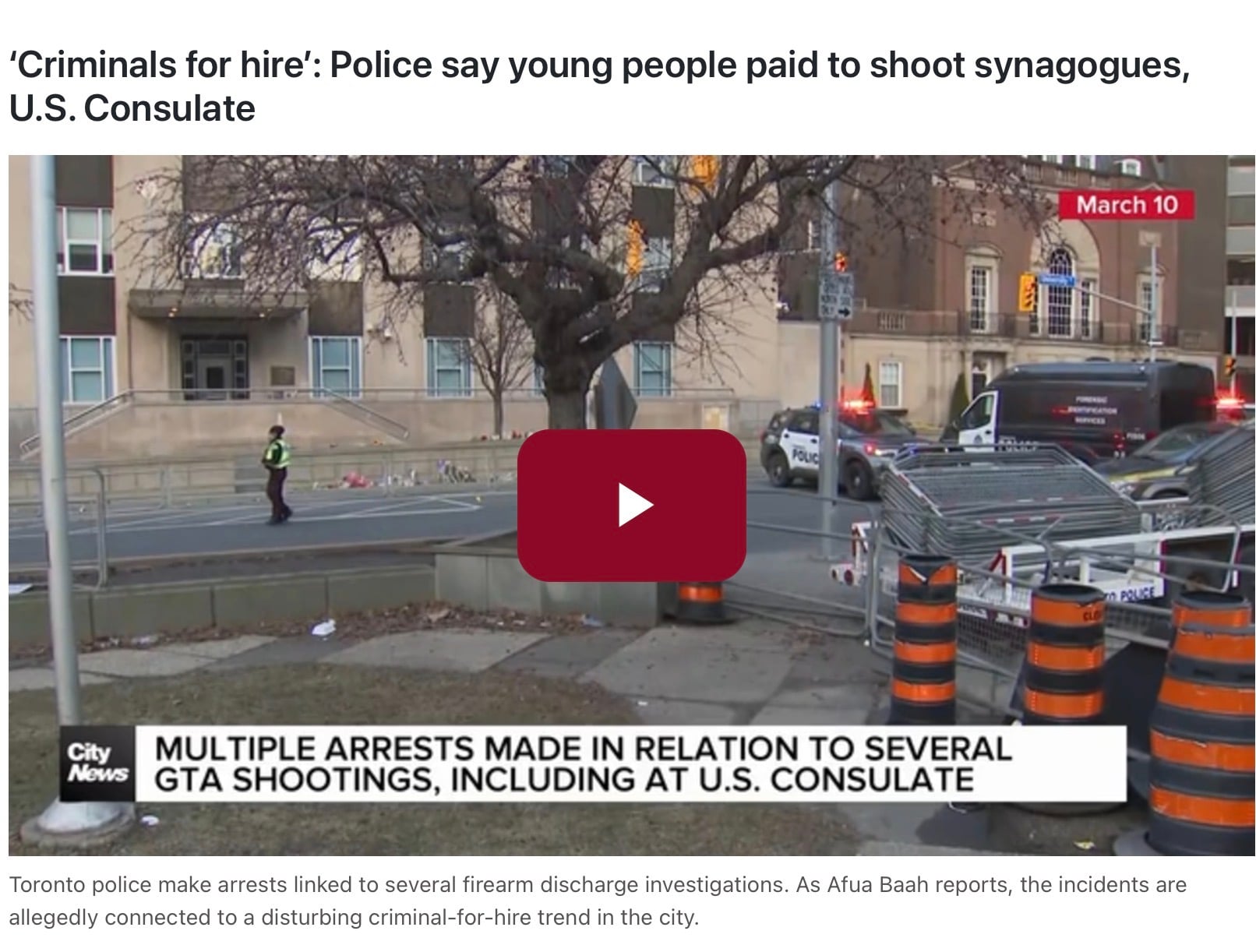
Guns For Hire (Screenshot used in accordance with Clause 27a)
A troubling investigation
The news emerging from Toronto should concern every Canadian.
What began as a shooting investigation involving the US Consulate has evolved into something far more troubling. Toronto Police have described a pattern of “criminals for hire,” where young people are allegedly recruited through encrypted messaging apps, paid to carry out shootings, and required to film their attacks as proof.
Police have linked the investigation to multiple firearm incidents across the Greater Toronto Area, including attacks involving the US Consulate, synagogues, and Jewish schools.
This should be a wake-up call.
Foreign interference is not always abstract
For many Canadians, foreign interference is still understood as something abstract: cyberattacks, election influence, disinformation, or espionage. Those threats are real. But this case points to something more immediate and more dangerous.
Foreign actors do not always need to send trained operatives into Canada. They may be able to exploit local criminal networks, recruit vulnerable young people, provide direction from a distance, and use violence to intimidate communities here.
That is not a theoretical risk. It is a direct threat to public safety, community confidence, and national security.
Distance no longer protects us
Canada has long benefited from a sense of distance. Many Canadians assume that conflicts elsewhere remain elsewhere. But geography no longer provides the same protection it once did. Encrypted communications, transnational criminal networks, illegal firearms, and ideological extremism can move faster than borders can contain them.
When a diplomatic facility is shot at, when synagogues and Jewish schools are targeted, and when police are investigating whether local violence may be linked to broader international actors, Canadians need to pay attention.
This is not just a policing issue. It is a national security issue.
The cost is already being paid
The death of Toronto Police Constable Marc Pinizzotto makes that reality even clearer. A Canadian police officer lost his life during an operation connected to this broader investigation. What may have begun as an attack directed at a symbolic or political target became a domestic tragedy carried by a Canadian family, a police service, and a city.
That is how foreign-directed violence works. The direction may come from elsewhere, but the consequences are felt here.
What this means for Toronto’s Jewish community
For Toronto’s Jewish community, this investigation carries an additional and deeply personal significance.
Since October 7, 2023, Jewish Canadians have lived through a sharp deterioration in their sense of safety. Synagogues, schools, community centers, businesses, and Jewish organizations have faced threats, vandalism, intimidation, and violence. Many families have changed how they move through the city. Some avoid visible signs of Jewish identity. Others now expect security at institutions that were once simply places of worship, education, and community life.
The allegations emerging from this investigation deepen that concern.
If attacks against Jewish institutions are being carried out not only by isolated individuals, but by people recruited, paid, or directed through organized networks, then the threat environment changes. It becomes more complex, more difficult to detect, and more difficult for any one community to manage alone.
This matters because security for the Jewish community is not simply about protecting buildings. It is about protecting the right of Jewish Canadians to live openly, worship freely, send their children to school, gather as a community, and participate fully in Canadian society without fear.
When synagogues and Jewish schools become targets, the issue does not belong only to the Jewish community. It belongs to Canada.
A country that cannot protect one community from intimidation cannot claim that all communities are equally safe.
The broader lesson for Canada
Canadians should not panic. But we should not be naïve.
This investigation demonstrates how quickly international conflicts, extremist agendas, and foreign-directed hostility can find expression on Canadian streets. It also shows how organized crime, youth recruitment, illegal firearms, encrypted platforms, and ideological violence can intersect.
That combination demands a serious response.
Canada needs stronger coordination between police, intelligence agencies, border authorities, community organizations, and all levels of government. Communities at heightened risk need meaningful support, not only after an incident, but before one occurs. Public officials must also speak clearly about the nature of the threat without minimizing it, politicizing it, or hiding behind vague language.
The warning is clear
Foreign interference is not only something that happens in government offices, computer systems, or election campaigns. It can also appear as bullets fired into buildings, threats against religious institutions, and violence carried out by local proxies on behalf of people operating from elsewhere.
That is why this case should matter to every Canadian.
An attack intended to intimidate one community weakens the safety of all communities. A threat directed at a diplomatic facility is a threat to Canada’s public order. A network that can allegedly recruit young people to carry out violence today can be used against different targets tomorrow.
Canada is not immune. Toronto is not immune. No community should be left to face this alone.
This should be treated as a wake-up call — not after the next attack, but now.
Related Topics