
Forget Propaganda: Small Parties Don’t Burn Votes
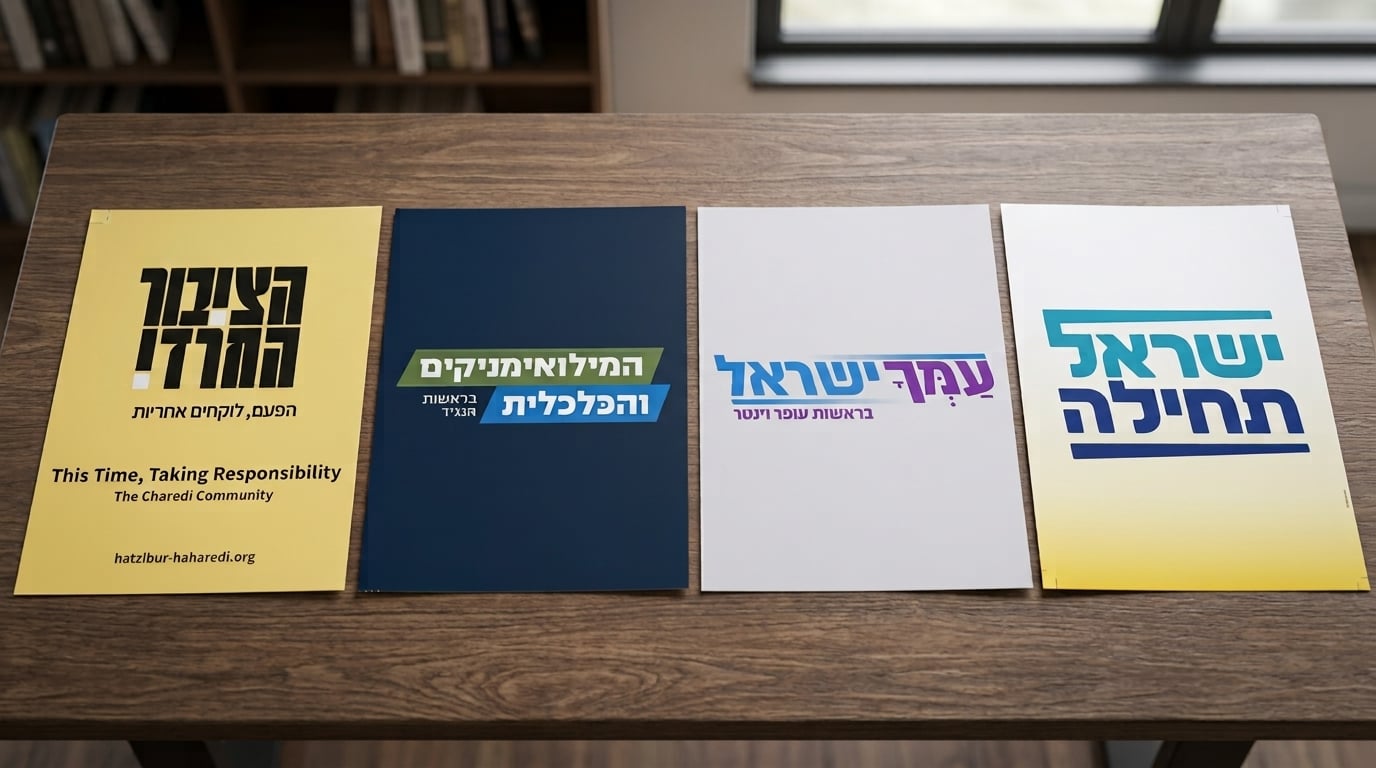
Every election season in Israel, the same warning starts making the rounds. Don’t vote for the small party. They won’t pass the threshold. You’ll be wasting your vote, burning it, handing seats to the right or to the left, to the big parties you claim to oppose. I have heard it at Shabbat tables, in WhatsApp groups and from people whose judgment I generally trust. To my mind, it gets democracy exactly backwards.
Democracy was built on a simple premise: every citizen has a voice. When the Athenian assembly gathered on the Pnyx some twenty-five centuries ago, the herald opened the session with a single question: “Who wishes to speak?” The invitation went to every citizen present, whatever faction he belonged to and whatever his odds of carrying the day. Pericles, in his famous funeral oration as recorded by Thucydides, described Athens as a democracy because power rested “in the hands not of a minority but of the whole people.” He went further, saying that a man who takes no interest in public affairs has no business in the city at all. Aristotle put it plainly in his Politics: “if liberty and equality are to be found anywhere, they will be found where all persons share in government to the utmost.”
“To the utmost.” The Greeks had no conception of a citizen whose voice counted less because he held an unpopular view.
I grew up in Canada, where we vote by riding. Each district sends one Member of Parliament to Ottawa, and whoever gets the most votes wins. If you vote for a candidate who loses, your choice of representative never sits in Parliament. Was that vote wasted? Did you burn it? Try telling that to a Conservative voter in a downtown Toronto riding that has gone Liberal for a generation, or to a Liberal voter in rural Alberta where the Conservative Party wins every election. Look south and ask the same of a Republican in a deep blue district in Massachusetts. Are those people burning their votes every few years? Or are they doing exactly what citizens are supposed to do, standing up and saying what they believe, regardless of who is likely to win?
Canada also shows what happens in a system with many parties. We have had minority governments several times in recent decades, and some parties have sat in Parliament for years without ever forming a government. The Bloc Québécois has held seats for more than three decades and has never governed. The Green Party has often sent one or two members to Ottawa. The NDP has never formed a federal government, yet in 2022 it used its leverage over a minority Liberal government to push through a national dental care program. Millions of Canadians now have coverage because people kept voting for a party that “couldn’t win.”
Israel, of course, works differently. We have never had a single party govern alone. Every government here is a coalition, assembled from many lists, some large and some quite small. There is also the threshold: any list that falls below 3.25 percent gets no seats. I won’t pretend otherwise. Those ballots do not translate directly into Knesset members.
But consider what the alternative really looks like. Suppose you vote for a large party you do not believe in, because it is the least bad option that will safely pass the threshold. You don’t like its positions. You didn’t like its coalition agreements. You watched what it did with its last term, or its last several terms, or in some cases its last several decades. So why are you voting for it? Seriously, why? You are handing your voice back to people who have already shown you what they will do with it, and telling them to go do it again.
Here is where the Israeli system makes the problem worse. In Canada, even if my candidate lost, I could still call or write to the MP who won my riding. That person represents me whether I voted for them or not, and if they answer or assist me, they may win my vote next time. It doesn’t always work that way in practice, but the accountability exists on paper.
In Israel, it doesn’t exist at all. We vote for party lists. No Knesset member represents my neighborhood or my city. Once a party is elected, it owes nothing to any particular voter for up to four years. Its members answer to party leaders and party committees. They can do whatever they like with the power we gave them, and the only moment we have to respond is on election day.
When voters decide in advance that new parties are off the table, that only the established names are “safe,” they are surrendering the one tool they actually have. The big parties know they will pass the threshold. They know a large share of the public will hold its nose and vote for them anyway. Why would they change? Generating fear of new parties among the voters is exactly what keeps the old ones comfortable. This is a tool used by larger established parties to make it extremely difficult for new parties such as The Reservists Economic Party, Amcha Yisrael, Israel First, and HaTzibur HaCharedi, and others like them, to be the voice of change.
If we want to talk about wasted votes, let’s talk honestly. In Israel, if a party does not pass the threshold, all of the votes for that party are thrown out, and they have no representation in the Knesset. However, a vote for a new party that reflects what you actually think, one that wants to do things differently, is a statement of conscience. It tells everyone, including the parties that win, where a portion of the public stands and what issues are burgeoning in public discourse. Small parties grow because people take that risk, and even if a party loses one election, the next time around they may very well win. Every established party in the Knesset today was once a new name on the ballot. Hence, I argue that these are not wasted or burned votes.
Rather, a wasted vote is one cast for a party you don’t believe in, which will cross the threshold easily, with or without your vote, and then spend four more years doing exactly what it did before, without ever having to answer to you.
The herald in Athens asked who wished to speak. On election day in Israel, the question is put to each of us. Answer it honestly. Vote for what you believe in.