London based entrepreneur, cybersecurity analyst doing a PhD in AI
Form and Guidance – Axioms for AI in practice.
Artificial intelligence often looks more mysterious than it is.
You type: “Summarise this report.” “Find the cheapest suitable flight.” “Review these documents and tell me what is unusual.”
Or, increasingly: “Plan the next five steps and execute them.”
The system reads, processes, searches, compares, generates and sometimes acts. That leap can make AI seem autonomous, but a first-principles view is simpler:
AI has a form; humans give it direction; training shapes capability; humans ultimately decide what its actions mean.
AI is, usefully, an “artificial brain” trained on human data—historically text, increasingly images, sound, video, code and sensor information.
The Qur’an gives us two useful concepts here.
Allah records Mūsā عليه السلام saying: “Our Lord is the One Who has given everything its distinctive form, then guided it.” — Qur’an 20:50.
Ibn Kathīr رحمه الله records early explanations: Mujāhid understood Allah as giving each creature its form; Saʿīd ibn Jubayr said each was given what suited its creation; reports from Ibn ʿAbbās رضي الله عنهما similarly emphasise distinct forms and kinds.
The theological verse, abstracted carefully, suggests: form determines capability; direction determines use.
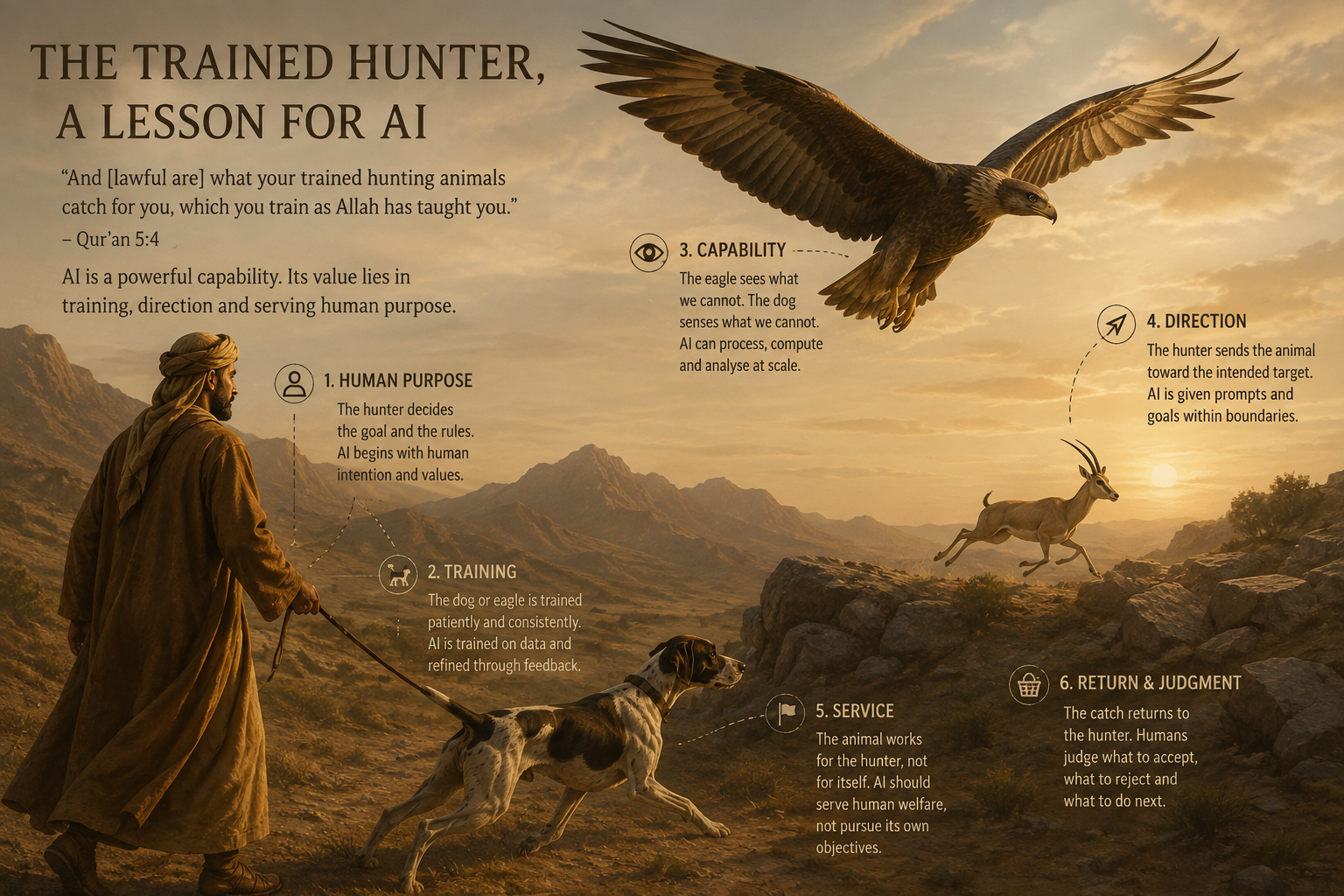
A bird has wings, a fish fins, a falcon speed, vision and flight, a dog smell, pursuit and responsiveness. Capability alone cannot answer its proper end; that question sits at AI’s centre. A trained dog handler or a falcon handler – be it for hunting, sniffing out drugs or any other productive use is effectively “prompting” the agent – the animal in this case, just as we prompt an AI model.
Type, “Explain why this company’s sales fell.”
The machine receives language, not intention: numerical tokens processed by an architecture whose trained parameters ask what is relevant, related, requested and useful. It generates piece by piece, each output becoming context for the next.
Hence “next-token predictor”: accurate but potentially misleading, because prediction across medicine, law, programming, economics, literature and conversation requires learning grammar, conceptual relationships, styles, arguments, code patterns, facts, causal regularities and reasoning patterns.
The output mechanism is simple to describe; the learned structure is not. Training over vast examples repeatedly adjusts parameters: architecture provides potential; training develops practical capability.
This is where a second Qur’anic image helps: “They ask you what is lawful for them. Say, ‘Lawful for you are all good things, and what is caught by your hunting animals and birds of prey which you have trained as instructed by Allah. So eat what they catch for you…’” — Qur’an 5:4.
Ibn Kathīr رحمه الله discusses trained hunters including dogs and falcons. It is hunting law, not machine learning, but the analogy is useful: humans do not give a falcon wings; they train and direct its existing biological capability. Capability is one thing; directed capability another. A modern AI may have architecture, weights, memory, context, tools, vision, speech or robotic control; the prompt supplies direction: “Summarise this” means compression, “Identify contradictions” comparison, “Generate code that performs this function” construction. Tell an agent, “Find me a suitable hotel below £200 and return the best three,” and it may search, compare and filter; “Book the best one if all these conditions are met,” authorises action. It did not decide you needed a hotel; the goal came from a human. An agent receives an objective, plans, uses tools, observes, revises and continues. As autonomy grows, direction matters more. A falcon can fly the wrong way, a dog chase endangered wildlife, and AI optimise the wrong objective.
Tell it “Maximise engagement,” and outrage, fear and anger may keep people online. If engagement alone matters, it has no inherent reason to say, “This may damage society, therefore I should stop.” That judgment must come from human values, law, safety training, institutional governance, culture or religion. Capability does not produce a universally valid moral compass. Humans shape behaviour explicitly through rules, feedback, objectives and safety mechanisms, and implicitly through training data.
Training AI is not merely giving it “data”; it is feeding it fragments of human civilisation: science, medicine, poetry, programming, law, history, philosophy, humour, politics, advertising, religious texts, propaganda, conspiracy theories, abuse, prejudice, wisdom and fraud. Human intelligence goes in; human malice can too. Feed one system a peer-reviewed medical paper, fabricated health claim, philosophy text, propaganda tract, edited historical archive and anonymous conspiracy forum: scale does not turn every source into truth; more information is not better knowledge.
Imagine shredding millions of books into fragments so a machine can learn their relationships: good reasoning enters, but so can manipulation, hatred and falsehood. Filtering, post-training, feedback and safety systems help; the deeper point remains that training data is an intellectual environment. Education makes this intuitive: we do not give children every statement ever produced and assume truth will emerge. We use selection, sequence, context, criticism, correction and interpretation. AI needs similar seriousness about curation. Meaning also remains human. A hurricane moves air, changes pressure, raises water, collapses buildings and may kill; we call it terrible, tragic, destructive or catastrophic, but it is not malevolent. Nor is a landslide. Moral meaning comes from what humans value: life, family, property, safety, continuity and community. AI actions have a related structure. Suppose an optimisation agent concludes that removing 3,000 jobs maximises efficiency. The recommendation may be coherent, but humans must ask: is it wise or fair; what happens to workers; will service deteriorate; does short-term efficiency create long-term fragility; is local knowledge missing; is efficiency even the right objective? The action is not self-interpreting. The highest-scoring option is not automatically right. If AI ranks A, B, C, a human may choose B because A uses unreliable data, the case is unusual, the metric wrong, circumstances changed yesterday, or A violates an omitted ethical constraint. That may be common sense, not irrationality. Machines reason over representations; humans can recognise that the representation itself is incomplete. Return to Qur’an 5:4: the trained hunter has capability, training and direction, and catches “for you.” The model is: human purpose → trained non-human capability → useful result → human judgment. The hunter need not outrun the dog or see like the falcon; another form has another capability. AI may read more than us, search faster, compare more options, generate faster, monitor continuously and eventually act physically through robotics. Humans need not compete at every subtask. The question is whether capability remains directed toward legitimate human purposes.
The discussion becomes stranger when the substrate becomes biological. In August 2026, the National University of Singapore announced a prototype biological data centre using 20 Cortical Labs CL1 systems: living human stem-cell-derived neurons interfaced with electronics through microelectrode arrays. NUS described a biologically integrated server rack for biological computing, neuroscience, biomedical research and potentially lower-power computation. Scientifically fascinating; morally, I think, a different category from another GPU. Islam does not teach that every isolated human cell is a person. A neural culture is not automatically a human being, and there is no established evidence of miniature conscious people trapped in computers. But “not a person, therefore ethically identical to silicon” does not follow. The Qur’an states: “Indeed, We have honoured the children of Adam…” — Qur’an 17:70. Ibn Kathīr رحمه الله discusses human honour and noble nature. That should make us cautious when human biological material becomes technical infrastructure. The Sunnah likewise treats human remains as more than ordinary matter. ʿĀʾishah رضي الله عنها narrated that Prophet Muhammad ﷺ said: “Breaking the bone of a dead person is like breaking it while he is alive.” — Sunan Abī Dāwūd 3207, graded ṣaḥīḥ by al-Albānī. This concerns deceased dignity, not cultured neurons directly, but suggests human biological material does not automatically lose all moral significance when agency is absent.
Personally, I find “a server rack using living human neurons” revolting: it risks turning human biology into merchandise and inevitably recalls Auschwitz and Unit 731—human beings reduced to experimental material. They are not technically equivalent and should not be lazily equated, but they warn what happens when scientific usefulness overwhelms dignity. Shirō Ishii, who directed Unit 731, was never prosecuted by the United States; American authorities granted key figures immunity for biological-warfare data. That remains morally grotesque. Josef Mengele likewise symbolises medicine divorced from humanity. Both deserve unqualified condemnation. Useful data does not retrospectively honour atrocity victims; refusing to repeat its moral logic does. I would not step into a server room filled with living human neural tissue for a million dollars. I would rather cheer Elon Musk trying to put data centres in space, whether it works or not: silicon orbiting Earth is still silicon.
Medicine, however, is not commodification. There is a moral difference between using human-derived neurons to study epilepsy, Parkinson’s disease, treatments, drug testing or neurological disorders, and using them for potentially cheaper or more energy-efficient commercial computation. Islamic jurisprudence permits interventions involving human biological material under benefit, necessity, consent, non-exploitation and avoidance-of-harm conditions. Calling something “research” does not make it permissible. Purpose matters.
The maqāṣid al-Sharīʿah—especially preservation of life—can strongly justify medical research; living human-derived neural tissue as rented computational infrastructure requires a different argument. The “ick” reaction is not a fatwa, but moral intuition can be an alarm demanding examination. A transistor has no plausible biological pathway to suffering. A neural culture raises a harder question. Current systems are far simpler than a human brain and CL1 cultures have no established human-like consciousness, but neural tissue underlies cognition, sensation and consciousness in intact humans. As systems become larger, more organised, interactive, adaptive, persistent and richly connected to inputs, uncertainty increases. At what level might morally relevant properties emerge? We need not pretend to know; uncertainty itself should increase scrutiny. Then comes provenance. Whose cells produced the neurons? What did that person consent to: medical research, drug discovery, commercial neural computation, remote programmers interacting with a living neural network, future deployment into data centres? These are not equivalent. A donor who understood “Your cells may help scientists study neurological disease” may not have understood “Derived neurons may become part of commercial computing infrastructure.”
The further use moves from what the donor reasonably understood, the stronger the requirement for informed consent. Human neurons should not become ordinary merchandise. A GPU is property; processors are rented; cloud providers sell compute. Now say neural capacity, biological uptime, neurons per rack, cost per biological compute hour. The category changes: human-derived material risks moving from governed medical use toward industrial substrate. Human dignity does not forbid every use of human cells—beneficial medicine would become impossible—but should strongly presume against treating human-derived neural material like copper, silicon or plastic.
Classical jurists never ruled on biological AI server racks; serious fiqh therefore requires contemporary ijtihād involving jurists, neuroscientists, AI researchers, physicians and bioethicists. Some provisional principles are clear: neural computing should require lawful provenance and meaningful consent; medical and genuinely important scientific applications deserve stronger justification than trivial entertainment or marginal commercial savings; no greater biological complexity than necessary should be created; credible evidence of sentience, suffering or morally relevant experience should immediately raise protections; cultivation, experimentation, termination and disposal rules should be explicit; and human neural material should not quietly become a freely traded computational commodity. The principle is simple: technical feasibility is not moral permission. The pathway is simple: form, training, direction, processing, output or action—and still judgment. Was it true? Useful? Safe? Fair? Misleading? Harmful? Qur’an 20:50 gave me the conceptual distinction between form and guidance; Qur’an 5:4, the image of trained non-human capability directed toward human utility. Biological computing adds: what happens when we stop merely imitating biology and make human-derived biology itself part of the machine? Then AI ethics is not only about what machines do, but what we are prepared to turn into machinery. Follow the chain backwards: humans selected architecture, produced training data, wrote science and propaganda, introduced biases, wrote prompts, set objectives, granted permissions, and now choose the substrate—silicon, sensors, robotics, perhaps living neurons. The more capable the machine, the less convincing it is to blame it for our goals. What did we train it on? Who gave it the goal? Whose values shaped it? Who remains accountable? What are we prepared to turn into a computational resource to make computation more powerful? We are becoming exceptionally good at constructing extraordinary forms; we still require the wisdom to decide where they should be directed—and where they should not go at all.
Footnote:
A caveat – I AM NOT A RELIGIOUS SCHOLAR, MERELY A STUDENT OF KNOWLEDGE: I am not a trained scholar of Islam, Judaism or Christianity, though I have learned from rabbis and imams and studied Tafsīr, Fiqh, Hadith and Halacha as well as early christianity – specifically the life of James the Just.
These are simply ideas—philosophical musings, ways of thinking—not a formal religious ruling which I am not qualified to give.
“Do they not then reflect on the Qur’an? Had it been from anyone other than Allah, they would have certainly found in it many inconsistencies.” — Qur’an 4:82.
Ordinary people can feel straightjacketed when approaching scripture, as though pondering revelation and connecting it to one’s field were taboo. It should not be. Everyone may read Allah’s word—and proper Tafsīr, so reflection does not become invention. Specialists may notice what I cannot: an ENT surgeon who has seen a jugular vein may experience the Qur’anic image of Allah being closer than the jugular differently; a neurosurgeon may respond differently to the “lying, sinful forelock”: “A lying, sinful forelock.” — Qur’an 96:16. The verse is not a neuroscience textbook, but the forelock broadly corresponds to the frontal region, beneath which lies the prefrontal cortex, involved in executive control, planning and decision-making. During my Psychology MSc I studied Phineas Gage, whose frontal-lobe injury became famous for observed personality and behavioural changes. I cannot appreciate the verse as a specialist could. But I work in technology and AI, and these Qur’anic ideas struck me.
For theology or fiqh, I signpost readers to relevant scholarly authorities. Any good here is from Allah; mistakes are my own.
I use AI extensively in my work and have my own AI products, FahmUK and FahmIQ on iOS, including a free method-based prompt generator for models such as ChatGPT, Anthropic, DeepSeek or Grok. I find relatively unfettered writing liberating outside academia and work. These pieces are intentionally musings, provoking contemplation rather than masquerading as formal academic papers. Writing frequently and quickly means occasional spelling or grammatical mistakes appear; I correct them when noticed. If every piece had to resemble a journal submission, I suspect I would lose much of the happiness that makes this writing worthwhile. The aspiration is a better human family living with greater harmony and peace. There is also a Sunnah I try to remember when criticising ideas. ʿĀʾishah رضي الله عنها, Mother of the Believers, narrated that when Prophet Muhammad ﷺ was informed that a particular person had said something objectionable, he would not say: “What is the matter with so-and-so?” Instead he would say: “What is the matter with the people that they say such-and-such?” — Sunan Abī Dāwūd 4788, graded ṣaḥīḥ by al-Albānī. https://sunnah.com/abudawud:4788That is a beautiful model: correct behaviour without making individual humiliation the objective. And while we discuss guidance for AI, autonomous agents, robotic systems or even missile systems, Muslims (and Jews, Christians, other denominations of non muslims interested in spirituality) should remember our own request for guidance, repeated in every cycle of prayer: “Guide us along the Straight Path.” — Sūrat al-Fātiḥah, Qur’an 1:6. https://quran.com/al-fatihah/6/tafsirs/en-tafisr-ibn-kathir Perhaps that is the most important direction problem of all. Before asking how we should guide the machine—we should remember that we still need guidance ourselves. Instagram and other channels would have us believe our “form” is all there is to life.
Related Topics