
Francesca Albanese’s soft-gloved embrace of terror
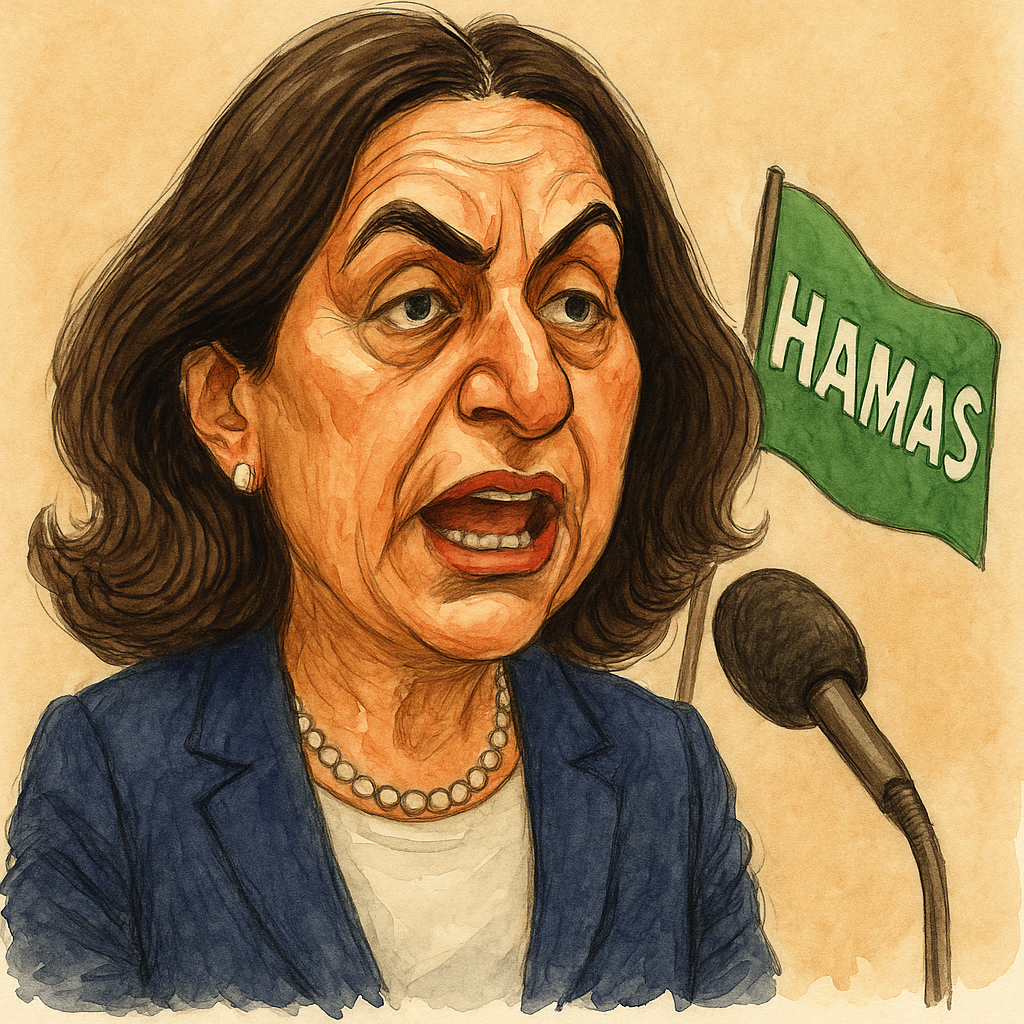
Ah, euphemism. That ancient art of replacing the unpalatable with the politely digestible. It has its place — in the kitchen when describing Aunt Maud’s “unorthodox” casserole, or in the office when a colleague has been “reassigned” (read: sacked). But there are places where euphemism is not merely misplaced but morally grotesque.
Francesca Albanese, the UN Special Rapporteur on the situation of human rights in the Palestinian Territories, has just provided us with a specimen worthy of the cabinet of horrors. In a recent address, she said:
People continue to say ‘But Hamas, Hamas, Hamas’… I don’t think people have any idea what Hamas is. Hamas is a political force that won the 2005 elections — whether we like it or not. Hamas built schools, public facilities, hospitals. It was simply the authority, the de facto authority. So it is critical that you understand, that when you think of Hamas, you should not necessarily think of cutthroats, people armed to the teeth, or fighters. It’s not like that.
Not like that? One wonders what parallel dimension Ms. Albanese inhabits, where Hamas is not “cutthroats,” but merely a quaint local authority with a flair for civic infrastructure. Perhaps in her world, the 7th of October never happened; perhaps the massacres, the rapes, the hostage-taking — the deliberate butchery of civilians — are simply ugly rumors concocted by those wretched “hasbara” merchants.
Let us be brutally honest: Hamas is not the local parish council with a sideline in pothole repairs. It is an organization proscribed in its entirety by the United Kingdom, the United States, the European Union, and a good many other countries who know a terrorist group when they see one. Its charter — for those who can be bothered to read it — is not coy about its intentions. The annihilation of Israel is not merely on the to-do list; it IS the to-do list. The Jews, as per their rhetoric, are to be eradicated from the river to the sea.
Yes, Hamas builds schools — in which children are taught that Jews are subhuman and martyrdom is the pinnacle of human achievement. Yes, it builds hospitals — beneath which it stores rockets, ammunition, and hostages. Yes, it constructs “public facilities” — often used to conceal command posts and weapons caches. A hospital wing is no less sinister for the tunnels under its foundations.
When Ms. Albanese reframes Hamas as something not to be associated with violence — indeed, as an entity unfairly reduced to a gang of armed thugs — she is not merely softening the truth. She is participating in its erasure. She is laundering the image of a group whose record of civilian slaughter would make the most jaded warlord blanche.
Let us dwell for a moment on what “de facto authority” has meant in Gaza since Hamas seized power in 2007, not through polite electoral continuity, but through a coup drenched in blood. It has meant the suppression of all political opposition, the imprisonment and torture of dissenters, the crushing of women’s rights, the persecution of LGBTQ people, and the creation of a society where boys are indoctrinated in military camps while girls are schooled in the virtues of self-sacrifice — preferably via explosive belts.
By choosing to focus on the concrete poured rather than the blood spilled, Ms. Albanese indulges in the most dangerous of illusions: that one can separate Hamas’s “civil” face from its militant core. But they are one and the same. The hospitals are built to mask the bunkers. The playgrounds are photo opportunities for Western journalists, mere yards from where rockets are assembled.
It is not difficult to imagine the reaction if a Western official had described the Taliban in similar terms circa 2001: “Don’t think of them as fighters, think of them as a governing authority that runs schools and clinics.” Or al-Qaeda: “They built roads, you know.” The world would (rightly) recoil in disbelief. Yet somehow, when it comes to Hamas, such absurdities pass in the genteel conference halls of Geneva without a single wine glass shattering in protest.
What lies beneath such rhetoric is not mere ignorance — though there may be a great deal of that — but the pernicious glamour of the “resistance” narrative. In this telling, Hamas is not a death cult but an authentic voice of an oppressed people, rough around the edges perhaps, but ultimately the product of injustice rather than its perpetrator. The Israelis are recast as the sole authors of misery; Hamas becomes Robin Hood of Gaza.
This is precisely the inversion of reality that allows atrocities to be excused, mitigated, or, in some circles, outright celebrated. It is the narrative that turns slaughtered festival-goers into acceptable collateral, that renders kidnapped children invisible, that reduces mass rape to an inconvenient allegation to be doubted or dismissed.
One might forgive such delusion if it came from a fevered activist in a keffiyeh on a street corner. But from a UN official — one tasked with upholding the dignity of human rights law — it is nothing short of a scandal. For the UN system, already struggling under the weight of accusations of bias and moral incoherence, Albanese’s words are not an aberration; they are a symptom.
Language matters. To strip Hamas of its reality as an armed terrorist group, to portray it as simply “the authority” with a penchant for school-building, is to participate in a project of moral disarmament. It prepares the ground for the next massacre by ensuring the world is already numbed to the nature of its perpetrators.
So let us dispense with the euphemisms. Let us look squarely at what Hamas is and does. It is not a misunderstood municipal administration. It is a movement that glories in death — not only the deaths of its enemies but those of its own people, cynically paraded before the cameras to serve its cause. It governs by fear, indoctrinates by force, and wages war without conscience.
To pretend otherwise is to become, wittingly or unwittingly, a partner in its enterprise. And that, Ms. Albanese, is not a role befitting anyone who claims to serve the cause of human rights.