Russian-American-Israeli Palestinian. Palestine is Israel.
Free, Free Palestine. Long Live Palestine.
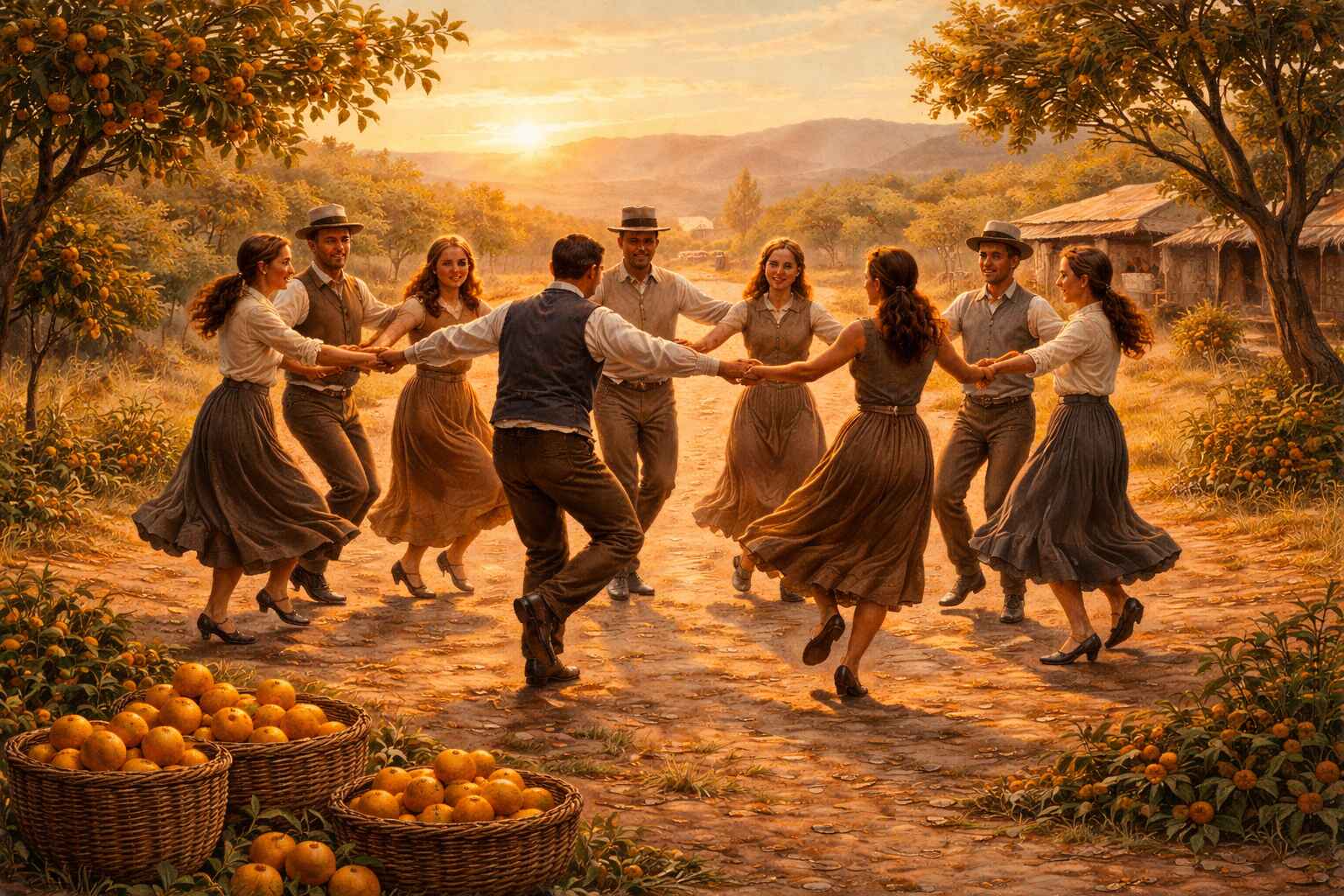
We will eat oranges and dance the hora. Free, free Palestine. Long live Palestine. — Yiddish folk refrain, early 20th century. Image © Ivan Bassov, 2026. Licensed under CC BY 4.0.
A Forgotten Yiddish Chorus We Must Reclaim
Some stories don’t argue — they remember.
In my previous article, Sarah, I Am a Palestinian Jew, I introduced a simple Yiddish lullaby sung by the mother of Willy Lipschutz:
Yiddish:
Mir vellen essen pomeranzen
und dabei a hora tanzen,
frei frei Palestina
frei frei.
English translation:
We will eat oranges
and dance the hora,
free free Palestine
free free.
At first glance, it sounds almost childlike. Playful. Even naïve.
But that is precisely why it matters.
Because this is not an argument about Palestine.
It is a use of the word.
Songs as Evidence
Long before slogans were debated, institutionalized, and weaponized, they were simply sung.
These Yiddish lines are not political theory. They are not retrospective justification. They are not crafted messaging.
They are primary-source cultural evidence.
They show how ordinary Jews — in homes, in youth circles, in everyday life — understood and used the word Palestine without hesitation, without qualification, and without explanation.
And that makes them more historically reliable than any later attempt to redefine the term.
A Whole World in Four Lines
Those four lines are not an isolated curiosity. They belong to a broader, historically traceable tradition:
Yiddish Zionist popular song (early 20th century, especially 1910s–1930s)
A form of mass cultural expression — not elite literature, but something lived, shared, and repeated.
These songs followed a recognizable pattern:
- Oranges — the emblem of Jewish agricultural renewal in Palestine
- Hora — the collective dance of return and belonging
- Repetition — built for memory, for movement, for community
No manifestos. No theory.
Just a people already speaking — and singing — in the language of return.
From Warsaw to the Kitchen Table
This was not an isolated phenomenon. These songs circulated widely:
- in youth movements preparing for Aliyah
- in Yiddish theaters and cabarets
- in immigrant neighborhoods from Eastern Europe to New York
They formed a shared cultural vocabulary.
A testimony preserved by JewishGen captures just how deeply this vocabulary penetrated everyday life:
Even the gentile maid knew how to sing… ‘Frei, Frei, Palestina Frei…’ This was the era of Zionist awakening in Poland.
Not a leader. Not an ideologue.
A maid — repeating what she heard daily in a Jewish home.
That is what real cultural presence looks like.
Not a Song — A Pattern
The lullaby I cited is one example among many.
In songs like “Ikh fur keyn Palestine” (“I’m going to Palestine”), the destination is concrete, lived, and anticipated.
In “Khalutsim, gikher!” (“Pioneers, faster!”), the movement is collective and urgent.
In tunes like “Lebn zol Palestina” (“Long live Palestine”), the name itself becomes a shared affirmation.
And in fragments like:
We will eat oranges
We will dance the hora
Free, free Palestine
we see the same structure repeated — simple, rhythmic, communal.
This is not coincidence.
It is a cultural pattern.
A preserved example of this broader musical culture can be found in the Smithsonian Institution’s 1947 recording collection Palestine Dances and Songs, a set of Yiddish and related musical pieces arranged and conducted by Max Goberman.
What “Free Palestine” Meant — Before It Was Redefined
When Jews sang “Free, free Palestine,” no explanation was needed.
The meaning was internal, lived, and shared.
It referred to their own condition — a life constrained by exile, by limitation, by inherited vulnerability — and to a future in which those constraints would no longer define them.
“Free Palestine” meant a place where Jews would live freely as a people in their own land.
Not as a slogan directed outward.
But as a condition reclaimed from within.
Not Reinvention — Inversion
What we are witnessing today is often presented as the emergence of a new language.
It is not.
It is the inversion of an existing one.
The words are the same.
The phrases are the same.
Even the emotional cadence — chant, repetition, simplicity — remains recognizable.
But the meaning has been reversed.
What once expressed return is now framed as exclusion.
What once described liberation is now detached from its original subject.
This is not organic evolution.
It is semantic replacement.
A Cultural Record That Still Exists
The record, however, has not disappeared.
It survives in songs, in testimonies, in fragments like the one passed from mother to child in the home of Willy Lipschutz.
It survives in memory — not abstract, but specific, documented, repeatable.
A chorus once widely known, widely sung, widely understood.
From Memory to Articulation
This cultural record does not exist in isolation.
It raises a question that extends beyond songs, beyond memory, beyond fragments preserved in archives.
If these words — Palestine, Palestinian, Free Palestine — already existed within a clearly defined Jewish cultural and historical context, what follows from that?
One attempt to answer that question is articulated in The Palestinian Identity Manifesto.
Not as an invention of something new, but as a clarification of something long present — a recognition of how these terms were originally used, understood, and lived.
It does not begin with theory.
It begins with the same kind of material we have seen here: language, culture, and continuity.
The Question Now
The question is no longer what these words meant.
The record already answers that.
The question is whether we are willing to say them again —
in their original sense,
without hesitation,
without apology.
Not as something new —
but as something remembered.
Free, free Palestine.
Long live Palestine.
—
See Also
Related Topics
Related Posts