Free Palestine Now—from its own damaged aspirations
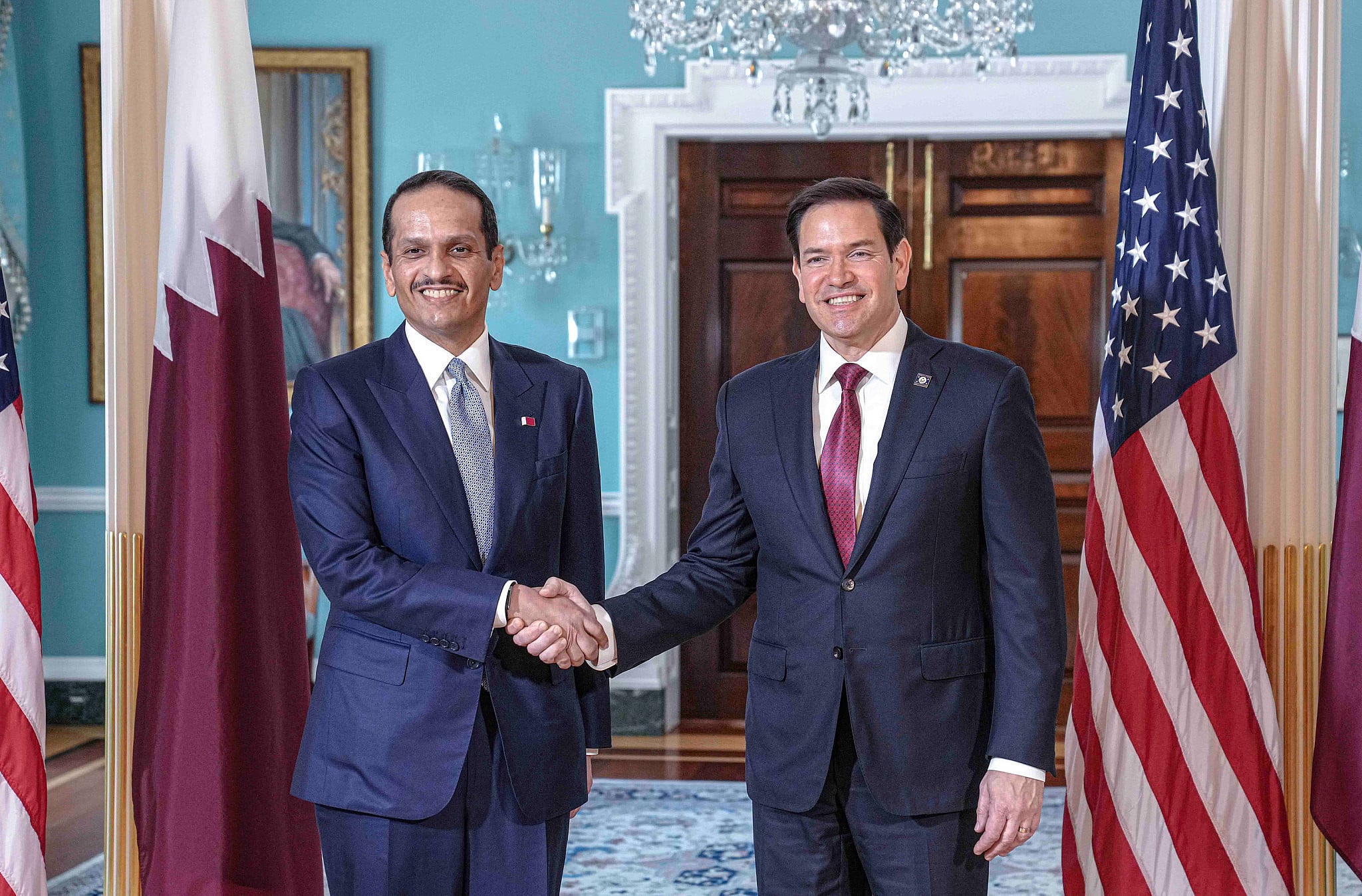
With a failed opportunistic strike on the Hamas leaders in Doha, Hamas reportedly more popular than ever in Gaza, and Marco Rubio visiting Jerusalem to complain about the damage done to Donald Trump’s empire-building ambitions in the Middle East, what can Israel do to secure its own safety and the prospects for the region?
For years, and not just since October 7, its strategy has been defensive and unconstructive, built on nothing more than opposing those who oppose it.
That kneejerk is understandable, given the threats that it faces, but it has achieved nothing other than to build itself into a bubble of self-righteous isolation. This is reinforced by seeking to make the Palestinians’ aspirations to nationhood conditional on their accepting their own suppression or, now increasingly, by denying such aspirations altogether.
Given how very clever Israel is, the attraction of this dead-end policy makes no sense—which is why it baffles and angers the rest of the world. If Israel wants a secure future, it has to offer the Palestinians something substantial and positive—otherwise, what’s their incentive to play ball?
The problem is that what the world wants to offer is the nonsense of the Two State Solution, as understood by the United Nations: the formalized splitting of Zionist Israel into three splinters, with the long, thin sliver of Israel-proper trapped between the two discontented fragments of Gaza and the West Bank.
For reasons that have all to do with equity but nothing else, the world—and Israel’s own Left—have clutched at this inadequate straw as a last desperate compromise, one that deprives Israel of the ultimate supremacy it once hoped for, and (for those who care about such things) that corresponds to its Biblical self-definition.
The stupidity of the Two State vision is that what makes it virtuous—that is unsatisfactory to both sides—makes it also unworkable. Neither Israel nor Palestine could grow and thrive in such cramped conditions. This is not 1948: the populations of both communities are growing and will grow further.
Israel needs to recognize this. Instead of digging in and offering Palestinians nothing in return for its own expansion, it needs to adopt a new narrative that sees the Palestinians as also deserving a decent home to grow into.
Underlying such recognition is the fundamental fact that Gaza and the West Bank don’t offer the Palestinians anything, except the satisfaction of being a fly in the Zionist ointment. Rather than simply resisting this, Israel—with the help of the Trump administration and a coalition of the willing—needs to construct a solution that’s way better than putting up with two disconnected fragments that preserve the Palestinians’ cultural and political disunity.
What our intransigent cousins require is a land that will knit them together in a unity that has been denied to them ever since the creation of Israel, and that the fatuous Two State Solution aims to perpetuate.
Many Israelis, critical of the political shenanigans that led up to 14 May 1948, argue that the Palestinians already have such a land, that that land is Jordan, and that the Hashemite leadership should simply absorb Gazans and Palestinian West Bankers into that third of the country made up of non-Jordanian nationals.
For critics of Palestinian national rhetoric, that would be a simple and elegant historical corrective, in the face of the inflammatory arguments that continue to rage about the intentions of the Balfour Declaration and Britain’s contradictory promises to Jews and Arabs.
But Jordan is already made up of 3.4 million Palestinians, Circassians and Chechens, Armenians, Druze, Iraqi and Syrian refugees and other migrants (mostly Egyptians, Filipinos and South Asian domestic workers). Its ingesting of another 3.4 million West Bankers and East Jerusalemites and 2.2 million Gazans would mean that Palestinians outnumbered the country’s Jordanian population, overturning the stability of the country’s politics, and leaving the Hashemite dynasty vulnerable to a takeover.
What Israel and a more enlightened consortium of other countries—Western and Arab, at the very least—need to adopt is a policy that promotes the idea of a new country that will have space for the Palestinians to achieve national self-definition: somewhere they can grow and thrive economically in a way that they will never be able to in Gaza and the West Bank, where there just isn’t enough room.
These are very tricky arguments of course. Any opponent of them will immediately flag up parallels with the Nazis’ demand for Lebensraum, and conclude that anyone arguing for them in the Middle East of today must, therefore, also be acting out of fascistic motives.
That idea needs to be dismantled. When Hitler came to power in 1933, the idea of Lebensraum was introduced as a formal ideology of the German state, having earlier been promoted in Mein Kampf in 1925–26. Its goal was the displacing or eliminating of local populations in Eastern Europe (especially Poland, Ukraine, and Russia) in order to provide resources and farmland for ethnic Germans.
The idea pre-existed the Nazis, however. It was first coined by the German geographer Friedrich Ratzel in 1897 and served to translate politics into a quasi-scientific type of demographics that adopted biology as a metaphor, in a manner that was common at the time. Ratzel held that human societies need space to grow, just as organisms do. His focus allowed for migration and even colonization—that is to say, the natural and unconstrained movement of populations into areas they had not previously inhabited—but not Nazi-type extermination.
In the case of the Middle East, Israel can legitimately say that as it grows, it needs more space than its present borders allow for—hence the ugly and aggressive behavior of the settler community in the West Bank. That, indeed, has unfortunate overtones of Lebensraum ideology.
The difference is that Israel should be advocating a Lebensraum policy for the Palestinians: one that recognizes that Palestinian population also needs the room to grow, as well as the opportunity to discover a territorial unity and a cultural harmony that it has lacked for the last eighty years.
The bottom line is that Palestinians need better than they themselves aspire to. Being told by the United Nations that they should be forever locked into two discontiguous pockets of land ought to be anathema to them, and to anyone who wants to see a people achieve its full potential. To tie the Palestinians to the Two State Solution is to constrain them into exactly what they have always, rightly, complained is a prison—or two little prisons.
Israel ought to be able to rise above its legitimate existential fears and, while doing all it can to secure its best future, work also to securing a future for the Palestinians that they are too blinkered—by time, by hatred, by ideology, by calcified patterns of thought—to contemplate: a state of their own on a piece of land that can better accommodate them.
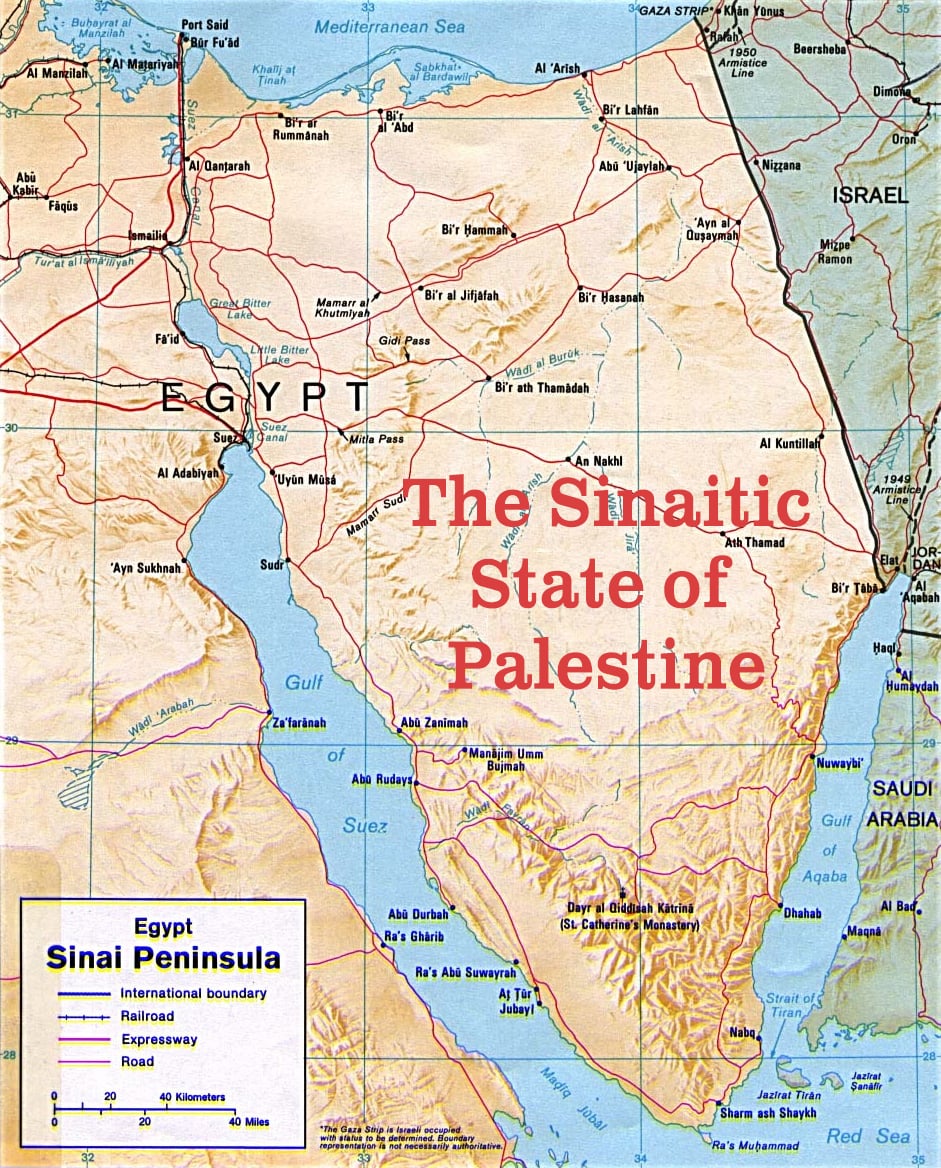
That is why, during his talks with Netanyahu today and tomorrow, Marco Rubio must discuss the logistics of acquiring the Sinai Peninsula from Egypt and, in partnership with the Arab League, plan for a Sinaitic Republic of Palestine that will provide the Palestinian people with a single piece of land that at 60,000 square kilometers (or 23,000 square miles) is ten times the area of Gaza and the West Bank combined.
True: it’s not self-determination; and true: it’s we-know-betterism—but for good reasons. Palestinian self-determination and they-know-betterism are both damaged and have both failed. Sometimes, when things fail, it’s justifiable for a third party to intervene and offer a helping hand. Palestinians have never been shy of accepting outside help when it comes delivered by UN agencies, the World Bank and NGOs, so there’s no reason why they should write off as unprincipled another kind of intervention that is so obviously intended for their greater good.
Work towards that and we will all be able to join in the call for a Free Palestine—free from the ridiculous constraints that a brain-dead international community wishes to lock it, and Israel, into.