
Free the Palestinians: The Questions We Avoid That Could Lead to Regional Peace
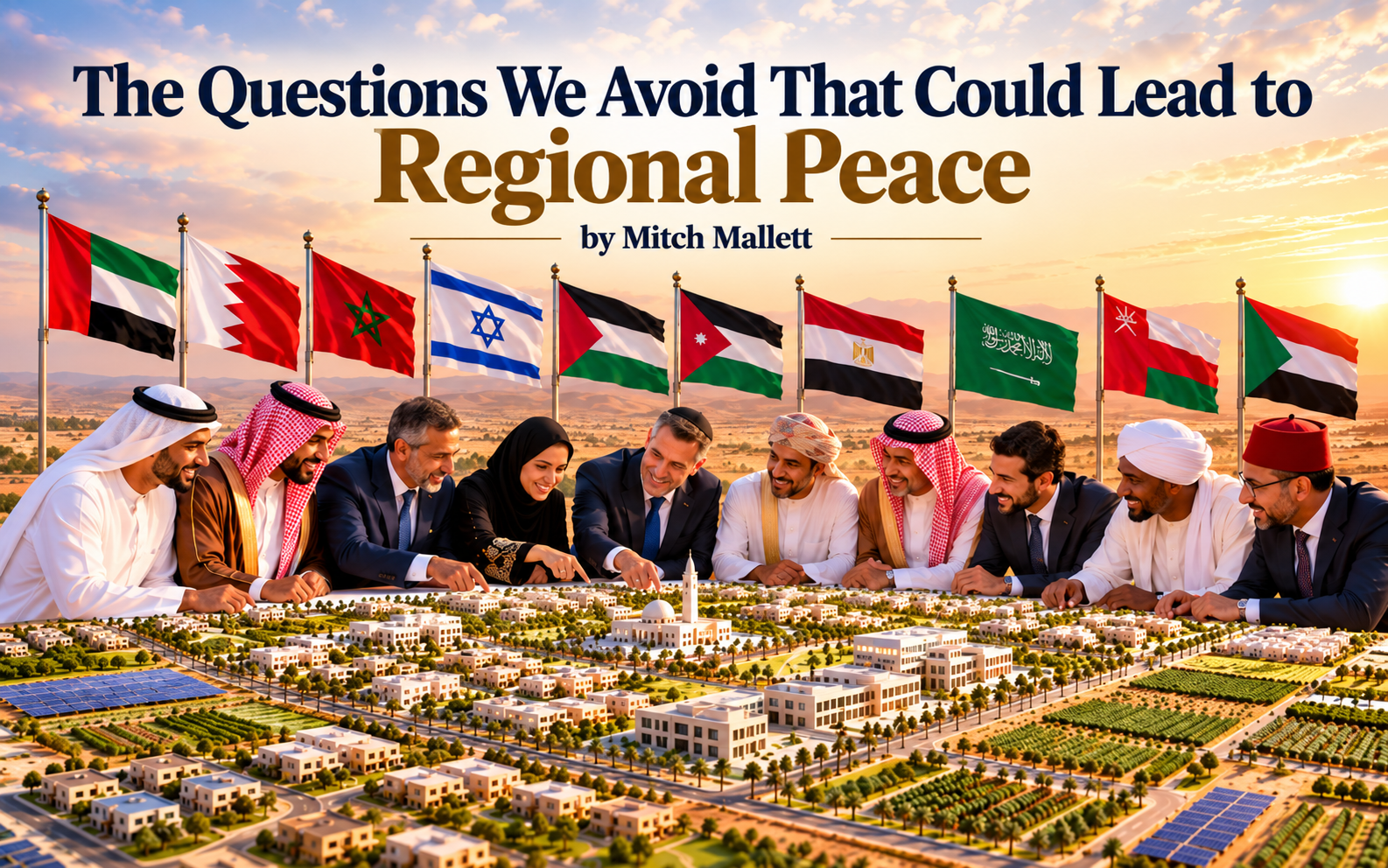
After a recent discussion about Palestinian statehood, I found myself thinking about a bigger goal, a regional peace that gives Israelis and Palestinians alike a genuinely peaceful future.
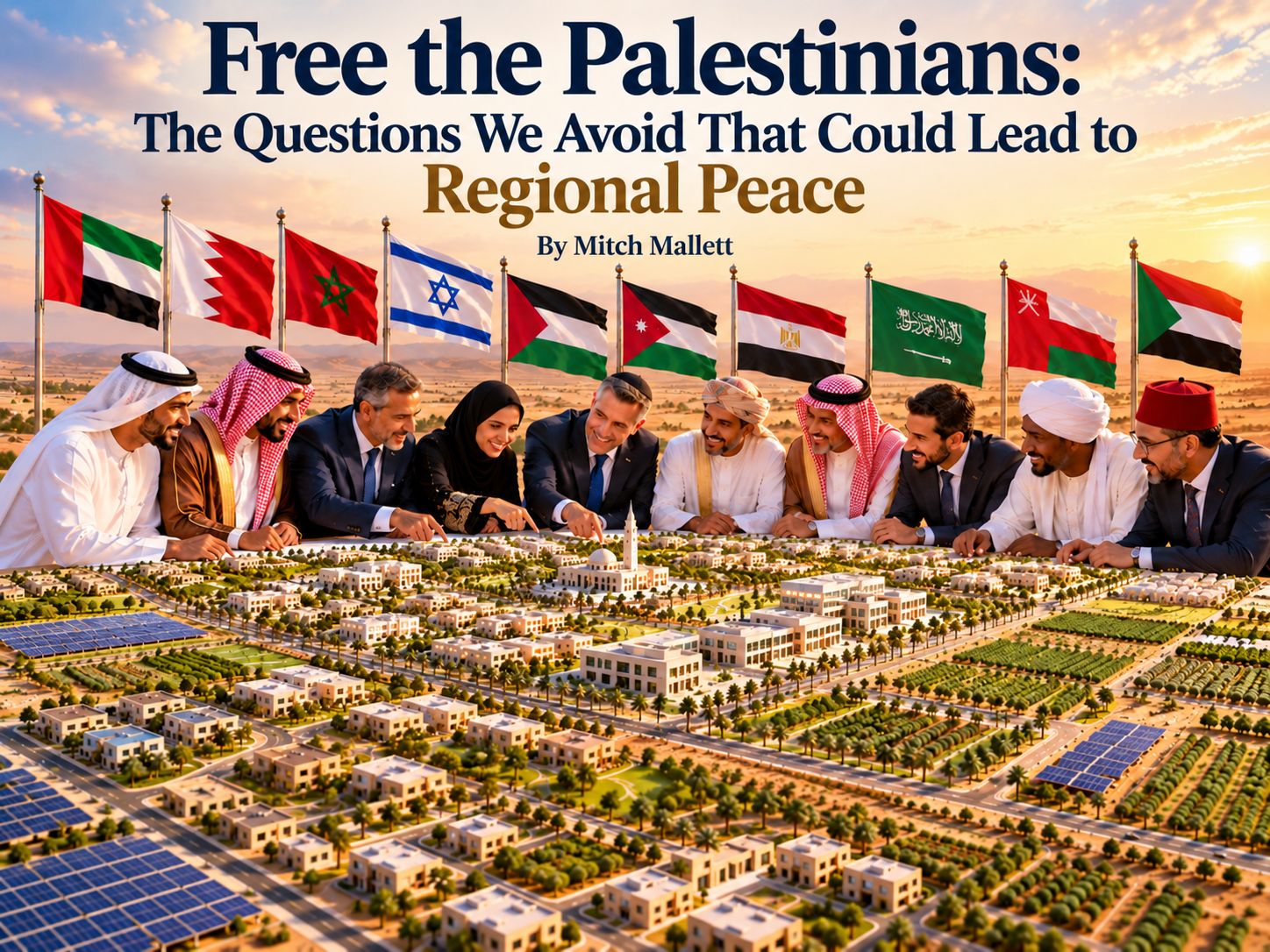
For decades, the Israeli-Palestinian debate has revolved around a familiar set of questions. How much territory should Israel give up? Where should the borders be drawn? What happens in Jerusalem? What concessions should Israel make?
Those are legitimate questions.
But why are they so often treated as though they are the only questions?
If we genuinely want to improve the lives of Palestinians and create a lasting peace between Palestinians and Israelis, perhaps we need to widen the conversation.
I believe Palestinians are human beings entitled to dignity, civil rights, economic opportunity and a future in which their children are not condemned to another generation of war.
But acknowledging Palestinian humanity does not require us to pretend that the history since 1948, and particularly since October 7, 2023, has not profoundly changed what Israelis can reasonably be expected to risk.
Israel evacuated its settlements and permanent military presence from inside Gaza in 2005. Hamas eventually seized control. Rockets continued to be fired at Israeli communities, and on October 7 Israelis experienced the deadliest attack in their country’s history.
The nature of that attack matters.
A United Nations mission subsequently found reasonable grounds to believe that rape and gang rape occurred at several locations and found clear and convincing information that some hostages were subjected to sexual violence in captivity.
That does not erase Palestinian suffering in Gaza.
It does help explain why so many Israelis now ask a question that cannot simply be dismissed.
If Israel relinquishes strategically important territory, what assurance does it have that the result will be peace rather than another armed base from which Israelis are attacked?
That question has to be part of any serious discussion.
But there are others.
Why is almost every proposed solution framed around what Israel must give up?
Why is so little attention paid to the responsibilities of the surrounding Arab world?
Jordan deserves recognition. It granted nationality to large numbers of Palestinian refugees and has carried an enormous regional burden.
But across the broader region, the refugee problem has remained unresolved for generations.
That leads to a question I almost never hear asked directly of Palestinians themselves.
If another country offered you permanent legal status, housing, employment, citizenship or a genuine path toward it, and an opportunity to build a secure future for your family, would you voluntarily choose to go?
Some Palestinians would unquestionably say no.
They regard Gaza, the West Bank or Israel itself as their ancestral homeland. That decision should be respected.
But would everyone say no?
We do not really know, because the question itself is treated as unacceptable.
Why?
Giving people an additional choice does not eliminate any existing choice.
And to be absolutely clear, no Palestinian should be forced to leave.
Forced population transfer is not what I am proposing.
I am talking about expanding voluntary choice.
If individual Palestinians conclude that their family would have a better future somewhere else, why should the international community make that option virtually impossible?
Where could those opportunities exist?
In principle, anywhere governments were willing to welcome Palestinians who freely chose to relocate.
That could include willing parts of the Arab world or other countries.
But why not also ask whether entirely new development areas could be created if host governments chose to participate?
Jordan could consider portions of its less populated regions.
Egypt could consider appropriate areas of northern Sinai as part of its own development strategy.
Nothing like this could or should occur without the full sovereign consent of the host country involved. Nor should such an option ever become a substitute for the rights and opportunities of Palestinians who choose to remain in Gaza or the West Bank. Participation would have to be entirely voluntary, without coercion or pressure designed to induce people to leave.
This is not about moving people into tents in a desert.
It is about asking whether the region and the world are willing to help build modern, prosperous communities that people would choose because they offer something better.
Imagine new communities with housing, schools, universities, hospitals, businesses, agriculture, transportation, cultural institutions and green spaces.
Wealthy Arab states could provide much of the capital.
Israel could become an active partner by making available expertise it has developed over nearly eight decades in desalination, water recycling, drip irrigation, desert agriculture, renewable energy, infrastructure, technology and urban planning.
Not as control, but as collaboration.
The Arab world could contribute political support and financing.
Israel could contribute technical knowledge and expertise.
And Palestinians themselves could be central to building and managing the communities that become their future.
Why should Palestinians simply be handed a future when they could help build it themselves?
They could be trained and employed at good wages to construct the homes, roads, schools, hospitals, farms, factories and businesses that would become part of their own communities.
Few things could be more inspiring than earning a strong wage while literally building the homes, schools, businesses and infrastructure that will become your own community and your children’s future.
Buildings alone, however, do not create peace.
Neither do desalination plants, factories or highways.
A different future also depends on education.
Why could new communities not emphasize education for peaceful coexistence, preparing children to live as neighbors rather than permanent enemies?
Peace requires cultural change as well as material change.
It also requires political change.
Palestinian leaders would have to confront terrorism, political incitement and the glorification of violence.
Israelis would have to hold their own extremists accountable when they attack innocent Palestinians.
Peace requires change on both sides.
And perhaps it also requires us to reconsider the refugee structure itself.
In its early years, the United Nations explicitly discussed reintegrating Palestinian refugees into the economic life of the region through repatriation or resettlement and created a reintegration fund intended to help accomplish that goal.
Those efforts largely failed, and UNRWA ultimately evolved primarily into a provider of humanitarian, educational and health services.
After more than seven decades, should we not at least ask whether that structure deserves reconsideration?
Why should Palestinians who want to remain where they are be denied investment in peaceful and prosperous communities?
And why should Palestinians who voluntarily want to build lives somewhere else be denied meaningful opportunities to do so?
These questions also point toward something larger.
Could this become the next chapter of the Abraham Accords?
The Abraham Accords demonstrated that Israel and Arab governments do not have to remain permanent enemies.
They created new opportunities for diplomacy, commerce, investment, technology and regional cooperation.
But the Palestinian question remains.
Why not ask whether addressing it could become part of the next chapter of that regional transformation?
An expanded Abraham Accords framework could go beyond diplomatic recognition and become a vehicle for creating real economic interdependence among Israelis, Palestinians and participating Arab states.
Imagine those societies trading with one another, investing in one another and sharing infrastructure, technology, water, agriculture and industry.
Their economies, and therefore their futures, would increasingly become connected.
That would not guarantee peace. Nothing does.
But shared prosperity can create powerful incentives to preserve cooperation rather than destroy it.
Palestinians could gain access to investment, jobs and regional markets.
Israel could gain more stable neighbors and deeper economic ties throughout the Arab world.
Participating Arab states could benefit from new trade, technology, infrastructure and development.
Peace would then be reinforced not only by treaties and promises, but by thousands of ordinary economic relationships that people on all sides have a stake in protecting.
In that sense, an expanded Abraham Accords could become more than a diplomatic agreement.
It could become part of the economic foundation for a lasting regional peace.
Perhaps the greatest promise of such a vision is that it offers something more powerful than another argument over borders.
It offers people on all sides a future they could help build.
Palestinians could see opportunity, dignity, mobility and ownership of their own future.
Israelis could see a path toward greater security and regional acceptance.
Arab governments could see economic development and a more stable Middle East.
If enough people on all sides could see themselves benefiting from that future, perhaps enthusiasm for cooperation could begin to replace resignation to permanent conflict.
That may be the real question.
Can Israelis and Palestinians be offered a vision compelling enough that they want to build it together?
I do not pretend that this essay is a complete peace plan.
There would be enormous questions of sovereignty, citizenship, security, financing, governance and law.
Engineers can work out water.
Urban planners can design communities.
Economists can model sustainability.
Governments can negotiate agreements.
And Palestinians themselves would decide whether they want to participate.
But none of those details can even be explored if we refuse to ask the larger questions in the first place.
After nearly eight decades of conflict, perhaps we should stop assuming that the same narrow set of questions will eventually produce a different answer.
If we genuinely want to free Palestinians from poverty, fear, extremism and permanent refugee status, while also protecting Israelis from another generation of violence, maybe the first step is simply this:
Start asking the questions we have been avoiding.