
Freedom, Mastery, and Joseph: Whom Do You Serve?
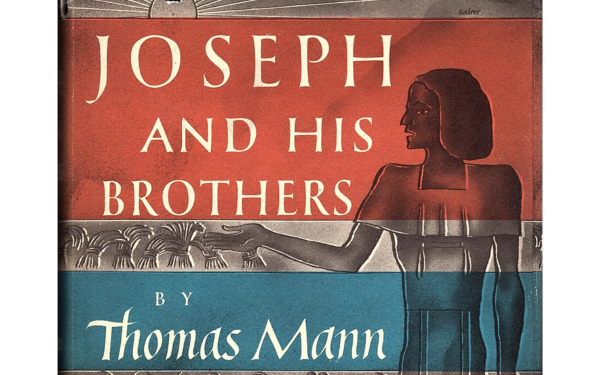
Thomas Mann’s magnificent retelling of the Joseph saga captures something the Torah hints at but never states explicitly.
In one unforgettable scene, Mann imagines Joseph asking the Ishmaelite slave trader a question that seems, at first, absurd coming from a newly enslaved seventeen-year-old. After the Ishmaelite informs Joseph that he will deliver him to a noble household, Joseph asks:
“And to whom belongeth the house?”
“Yea, to whom? To a man—and a man he is, or rather a lord. A great among the great, gilded with gold of favour, a man good, stern, and holy, for whom his grave waits in the West, a shepherd of men, the living image of a god. Fan-bearer on the right hand of the king is his title…”
“What king is that,” asked Joseph, “whose golden rewards the master beareth?”
Mann explains or really explicates his own version of the story:
[Joseph] wanted to learn whither he was being taken, and where the house lay for which the old man destined him; but it was not this alone made him ask. He did not know it; but his thinking and asking were controlled by traditions which worked hither from the beginnings and the times of the forefathers. Abraham spoke out of him; he who in his arrogance toward man held the view that he could serve the Highest and Him alone, and whose thinking and doing had excluded with contempt all lower and lesser gods to address itself to the Most High. The grandson’s voice was pitched in a lower, more worldly key; yet the question was Abraham’s question. Joseph heard with indifference of the house steward, on whom after all, according to the old man, his immediate fate depended. For the Midianite he felt contempt because he knew only the steward and not even the nobleman to whom the house belonged. But even about the latter he troubled himself little. Above him was a higher, a highest, of whom the old man spoke; and he was a king. Toward him alone and urgently went Joseph’s thoughts and the speech of his tongue, unaware that it was guided not by chance or choice but by inheritance and tradition. (Joseph and His Brothers pp. 457-9)
Joseph, in Mann’s profound retelling, wants to understand the chain of authority all the way up.
Why?
Because in Joseph’s worldview, every human being is already serving someone. The only real question is whether you choose the highest possible master.
This echoes Abraham’s journey. Avraham was surrounded by idols — physical and symbolic — competing for his loyalty. Mann imagines that Joseph, though exiled from his father’s home, still carries Avraham’s question in his heart: If one must serve, then serve the Source of all life. If one must submit, then submit to the Highest.
Most of us hear the word “freedom” and imagine escape from servitude. Mann suggests the opposite: Freedom is not the absence of servitude but the right to choose the worthiest master.
Joseph the slave is, paradoxically, more free than many free men because he is clear about whom he serves.
This reframes the Joseph story entirely.
Joseph’s rise in Egypt is not luck, cunning, or talent alone. At each moment — in Potiphar’s house, in prison, before Pharaoh — Joseph refuses to be mastered by the immediate authority in front of him. He works for Potiphar, but he serves God. He interprets dreams for the ministers, but he attributes wisdom to God. He stands before Pharaoh at the height of royal pomp, and still speaks in the same quiet theological key:
“Not I — God will answer the welfare of Pharaoh.” (Genesis 41:16)
Joseph’s dignity comes not from escaping servitude but from elevating it.
In our modern world, we like to imagine we are independent. But if we are honest, all of us serve something: achievement, reputation, ideology, financial pressure, communal expectations. Mann’s Joseph reminds us that the real question is not whether we are slaves, but to what.
Choose poorly, and your life becomes fragmented — pulled in a thousand directions by forces that never deserved your loyalty.
Choose well, and you gain Joseph’s steadiness — a moral coherence that carries him from pit to palace.
Even Pharaoh recognizes this. When Joseph interprets the dreams and proposes a national rescue plan, Pharaoh senses something unusual. Here is a young Hebrew slave who appears to belong to no one… because he belongs entirely to God. Pharaoh elevates him precisely because Joseph is un-enslaved by Pharaoh.
That is the paradox: Only the person who serves the Highest can never be truly owned by the world.
We live with pressures — professional, communal, family, financial — that make it easy to feel overmastered. Joseph teaches a remarkably modern spiritual psychology: You will always have masters. To be free is to choose the highest one.
I want to thank Rabbi Herzl Hefter and Rabbanit Batya Hefter for introducing me to Mann and this passage 30 odd years ago!