Featured Post
From Auschwitz to Gaza: The unbroken thread of survival
Survivors encourage freed hostages to tell their stories and choose creation over despair
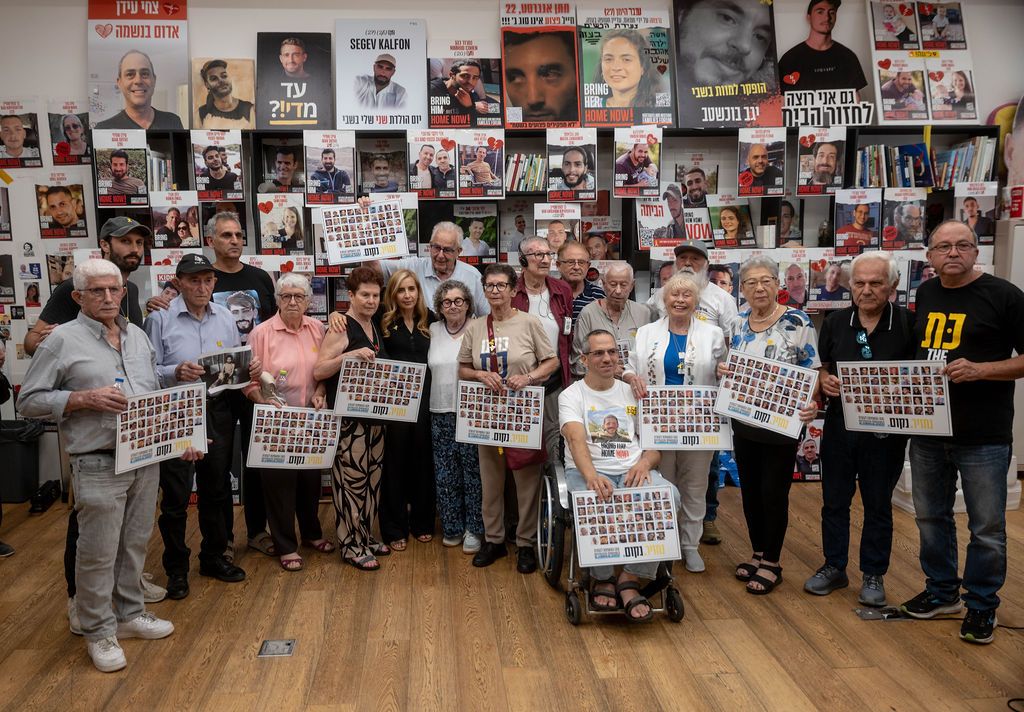
Holocaust survivors meet with released hostages and families of those still held captive (Credit: Chen G. Schimmel)
Last week, as hostages returned from Gaza, the country held its breath. Every homecoming brought relief mixed with sorrow. We saw embraces we had prayed for, and at the same time, we felt the weight of what these people have endured and what now lies ahead. Their return is not the end of a story; it is the beginning of a long and fragile process of recovery, a journey back to life.
The experience of Holocaust survivors can offer quiet guidance for this moment.
After the Holocaust, survivors arrived in Israel broken in body and spirit. Most came alone, leaving behind the memories of their once-happy families. Many did not speak about what they had endured — not for years, and some not even for decades.
At the March of the Living this year, Holocaust survivor Rosette Goldstein said to the October 7 survivors who shared their experiences with the March’s students: “After the Holocaust, we were told to stay silent. No one wanted to hear us, and we stayed quiet. I am telling you today — don’t stop talking. Speaking is part of healing.”
These words hold deep truth. The silence that surrounded many Holocaust survivors only deepened their isolation. Today, we must do better. Speaking with professionals, with family, with friends, is not a weakness but a necessary step on the path to strength. Pain must be named so that it can begin to lose its grip.
Survivor’s guilt — then and now
Holocaust survivor Irene Shashar, who was a hidden child in Warsaw, marched this year to honor the one and a half million children murdered in the Shoah. “I could have been one of them — but I survived. And I often ask myself: Why me?”
This question echoes among many Holocaust survivors, as well as the October 7 survivors. Former hostage Ohad Ben Ami has spoken about the unbearable weight of knowing that others remain in captivity, and the difficulty of rebuilding his life until every hostage comes home. Many freed hostages have felt the same, thinking about their friends who were murdered on October 7 or left behind in Gaza.
This feeling, known as survivor’s guilt, is a well-documented phenomenon. It can consume those who return from tragedy. But as Holocaust survivors taught us, it can also be transformed into purpose; a call to live fully in honor of those who cannot. Recognizing this guilt, naming it, and learning to live with it is an essential part of healing. One way of coping with this heavy burden is by using one’s voice to share the stories of those who were silenced forever.
What ultimately saved the survivors of the Shoah was not forgetting, but rebuilding. They threw themselves into the creation of the State of Israel in education, in agriculture, in factories, and in building communities. They did not have the privilege of doing nothing. Their healing came through action — through building new life.
When 80-year-old released hostage Gadi Moses returned from captivity, he said: “I will rebuild Nir Oz.”
Today, he oversees the kibbutz’s agricultural fields, the ultimate symbol of renewal. Like the survivors who plowed, planted, and educated after the Shoah, he has chosen creation over despair. For many of those returning from Gaza, this model of rebuilding after recovery and care may one day become a source of strength.
The unbreakable Jewish spirit
From the survivors of Auschwitz to the survivors of captivity in Gaza, one thread endures: the Jewish spirit cannot be broken. We saw it again this week when Matan Angrest, exhausted and grieving, attended the funeral of his fallen commander Daniel Peretz, who was killed fighting beside him on October 7. We saw it in Rom Breslavsky, who withstood both physical and psychological torment and refused to surrender his humanity. We saw it in Keith Siegel, whose faith and resilience only grew stronger through his ordeal.
These moments remind us of what Holocaust survivors taught the world: that even when everything is taken away, dignity and faith can remain.
What we can learn from the generation of survivors is the importance of patience from the people themselves, and from their families and the society around them. Healing happens slowly, unevenly, sometimes invisibly. It depends on safety, on the ability to speak when one is ready, and on being heard without pressure.
Survivors have said that for years after their liberation, they struggled to find listeners. Many stopped trying. It took decades for Israeli society to learn to hear them, to create space for their memories without fear. We must not repeat that mistake, and we must not rush the process.
The legacy of the survivors
We also carry a collective responsibility. The trauma of captivity belongs to those who lived it, but its echoes reach all of us. When we look at the survivors’ path, we see that personal healing and national resilience are intertwined. The strength of a society is measured by how it treats those who return from the dark.
A 90-year-old Holocaust survivor, Sara Weinstein, recently wrote to the hostages who have just returned: “I know that the heart is capable of healing. The soul is stronger than we imagine. There is within you a strength that cannot be broken. I am asking you to look at me. I am a happy woman.”
Her words are not about forgetting or moving on. They come from someone who knows that pain never truly leaves, it becomes part of who we are. The survivors showed us that recovery means learning to carry pain differently, while still seeking joy and connection.
As we embrace the freed hostages, we must remember that redemption is not a single moment. It is a shared effort — to hold those who return, to listen to their silences, and to help them find light again, understanding that they will never forget the shadows. The survivors did not teach us how to erase pain. They taught us how to live beside it. They proved that even after the deepest darkness, the human spirit can rise again.
Related Topics
Related Posts