
CFO | Empower Society for Good I Author
From Balak to TikTok: Why the World Still Hates a Blessed People
Put on your saddle. We’re going on a ride.
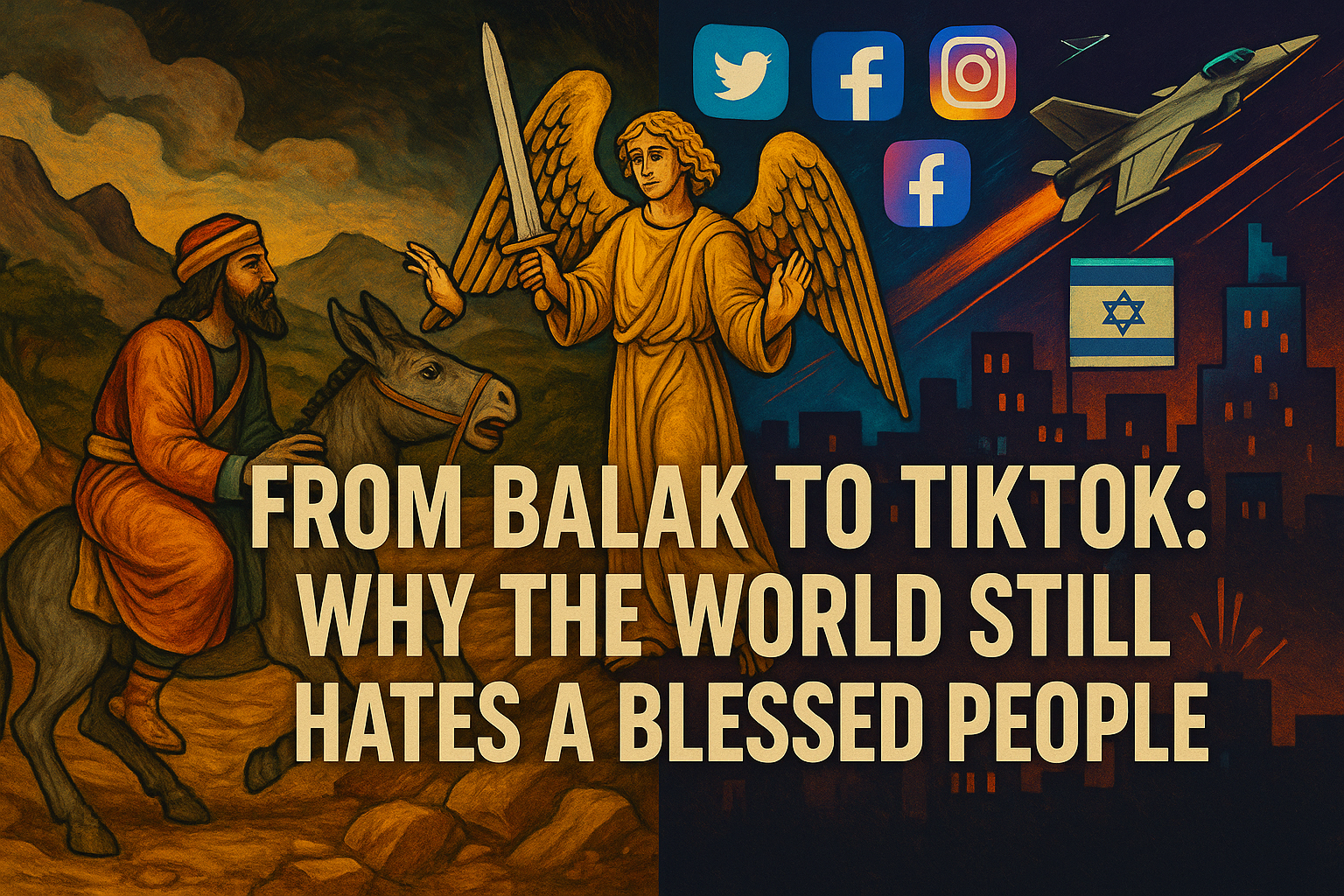
This week’s Torah portion, Parashat Balak, unfolds with eerie familiarity. It begins with the Moabite king Balak trembling in fear at the sight of a numerous and vibrant Israelite people. His disgust mirrors a disturbing trend we recognize today: a world increasingly repulsed by the existence of a single Jewish state. Balak’s reaction is to send for the notorious prophet-for-hire, Balaam—a man who could twist words like daggers—and ask him to curse the Israelites.
Balak, the ancient king of Moab, could be imagined today as the king of social media, unleashing influencers, bots, and propaganda instead of prophets. TikTok, Twitter, the United Nations—so many tools in today’s arsenal—target Israel with slander and curses, trying to bring down a people they don’t truly understand.
But something miraculous happens in the story. Balaam sets out on a mission of destruction, but his donkey sees what he cannot. Three times the donkey halts, seeing an angel blocking the way, and eventually—miraculously—speaks. A talking donkey! A symbol of divine truth that even beasts perceive when blinded men cannot.
In the end, Balaam cannot curse the Jews. Instead, he delivers a vision so holy it lives on in Jewish prayer every morning:
“How goodly are your tents, O Jacob, your dwelling places, O Israel.”
What’s remarkable is this: the Israelites were unaware of the conspiracy against them. They went about their lives, oblivious to the plots being crafted in the shadows. How true this feels today. Even as Israel builds, creates, and survives, it faces ceaseless threats—spiritual, political, and physical—from Hamas, Hezbollah, Iran, and radical ideologues online.
Blessings from Outsiders: Recognizing the Miracle of Israel
Throughout history, those outside the Jewish world have occasionally pierced the veil and seen the miracle that is Israel. Consider these examples:
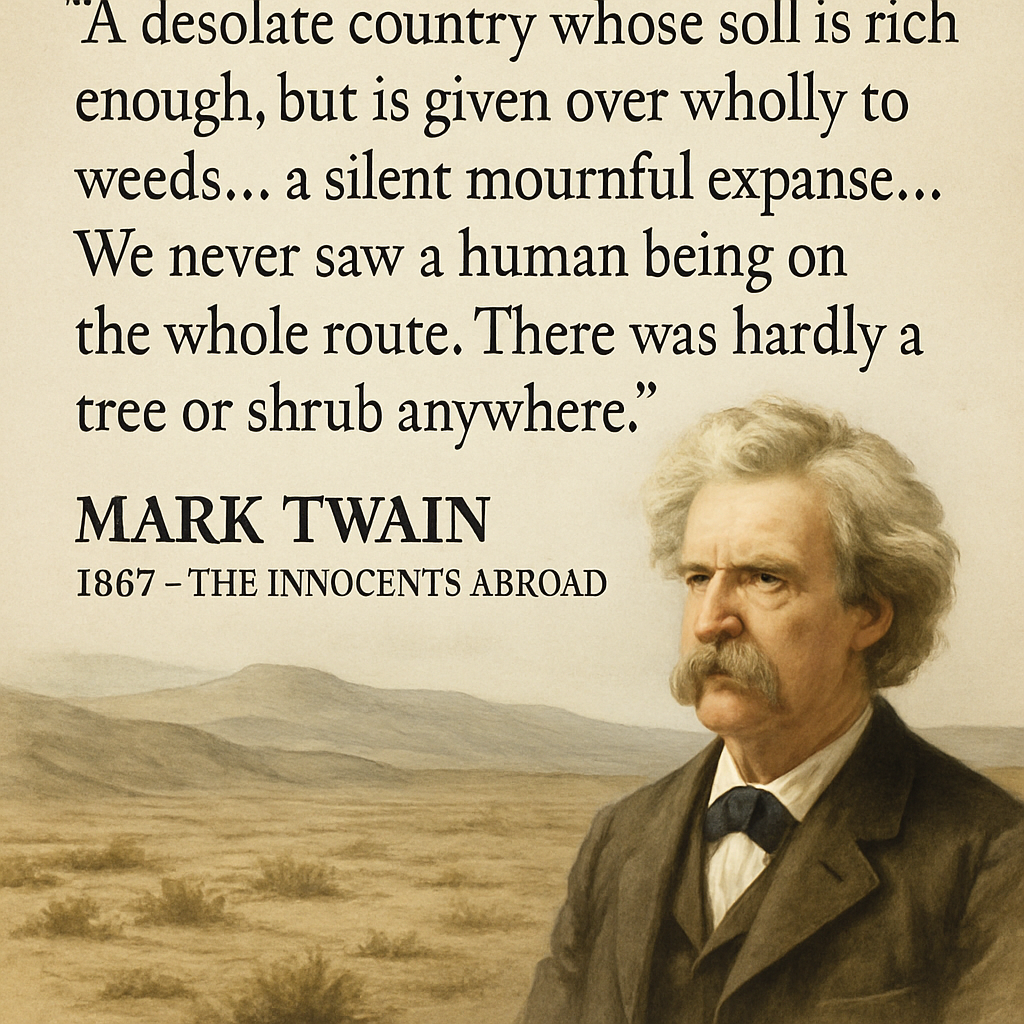
Mark Twain – “Innocents Abroad” (1869)
After visiting the Holy Land in the 1860s, Mark Twain wrote in The Innocents Abroad:
“Of all the lands there are for dismal scenery, I think Palestine must be the prince… Palestine sits in sackcloth and ashes… desolate and unlovely.”
Twain’s words capture the desolation of the land under centuries of neglect and foreign rule. To him, it was a forgotten and barren landscape, stripped of vitality and purpose.
And yet, that very barrenness would become part of a divine setup. For thousands of years, Jewish prayers, hopes, and identity remained tied to this land. The desolation Twain witnessed was not the end of the story—but a pause before the return.
The barren land, waiting like a slumbering seed, would soon be awakened. With the return of the Jewish people, drawn by history and prophecy, the desert was transformed into fertile farmland, kibbutzim, cities, and centers of Torah study. As the prophet Isaiah said, “The wilderness and the parched land shall be glad; the desert shall rejoice and blossom like the rose” (Isaiah 35:1).
Today, Israel is vibrant, blooming—literally and spiritually—exporting agricultural innovation, cutting-edge technology, and the teachings of Torah to the world.
Twain’s disbelief underscores the scale of the miracle. What seemed cursed and lifeless has become a living testament to Jewish resilience, vision, and faith. The land awaited its people, and when they returned, it responded.
Martin Luther King Jr. – Speech to the Rabbinical Assembly, 1968
“Peace for Israel means security, and we must stand with all our might to protect its right to exist, its territorial integrity… I see Israel as one of the great outposts of democracy in the world, and a marvellous example of what can be done—how desert land almost can be transformed into an oasis of brotherhood and democracy.”
Nelson Mandela – Pretoria, 1993
“We insist on the right of the State of Israel to exist within secure borders… We know too well that our freedom is incomplete without the freedom of the Palestinians—but that does not detract from Israel’s right to exist in peace and security.”
Alistair Heath – The Daily Telegraph, May 2024
A modern voice capturing the spiritual upheaval:
“Once you admit that Israel’s survival is divine, your moral compass has to reset. Your secular assumptions about history, power, and justice collapse. If the ancient hated nation of Israel is somehow still chosen, protected and thriving, then maybe God isn’t a myth after all.”
Heath’s reflection doesn’t just praise Israel—it questions the entire secular worldview. If Israel’s endurance is miraculous, maybe miracles themselves are real.
This shakes the foundations of secular ideologies. If Israel lives because God wills it, then we must confront an uncomfortable truth: maybe God exists.
Science, Atheism, and Superstition
While pondering this, I spent Shabbat reading God Exists: New Light on Science and Creation by Joseph Davydoff. A Soviet-era scientist, Davidoff shares how “scientific atheism” in the USSR was no more than state-enforced superstition. He writes:
“Atheism is scientific only in form, on its cover and in its name. In essence, atheism is a scientific superstition because it is based on blind faith. Such faith has infinite density but zero volume.”
He continues:
“A purposeful program of development without an intelligent programmer? A law-abiding universe without a lawmaker? Creativity without a Creator? Why is it shouted so loudly that science has discredited the Bible? Because it has nothing else—it cannot prove its claims, so it resorts to louder and more frequent propaganda to compensate for the lack of scientific evidence.”
In other words, the louder the lie, the greater the emptiness behind it. Sound like today’s headlines?
How familiar that sounds today.
The loudest voices online often mask the emptiest truths. Whether from modern atheists, radical Islamists, or woke ideologues, they all share one goal: to shout over the voice of God, deny Israel’s truth, and erase the memory of our history.
History’s Repeated Pattern: From Darkness to Light
The world swings in a divine rhythm—darkness followed by light.
- The flood of Noah was followed by Abraham.
- Slavery in Egypt was followed by Exodus and revelation.
- The Holocaust was followed by the birth of modern Israel.
- The War of Attrition and borders of 1967 were followed by the miraculous Six-Day War.
- October 7th’s horrors are perhaps being answered now by Israeli resilience and even miracles like the recent strike deep into Iran.
One podcast I heard said it well: Where were the jets on October 7th? And yet, how did they all appear for the Iran strike? It’s as if God steps back… then steps in again. This recurring divine rhythm should awaken us.
The Fall Before Redemption
In the Torah, Moses loses patience. He calls the Israelites “rebels” and hits the rock in anger. For this, he is barred from entering the Land. Is this a warning to us? Before October 7th, we too were losing our patience with each other. The internal divisions, protests, and rage tore at our national soul.
And what does Rav Kook teach us?
“Redemption will come through endless love.”
Not protests. Not anger. Not divisiveness. Love.
The Seduction of Moab, the Distraction of TikTok
At the end of Parashat Balak, Israel falls into sin—not from war, but from seduction. Moabite women draw them away from their values. And today, what do we face? A different kind of seduction: the constant pull of social media, nihilism, and distraction.
We must ask ourselves:
Are we on the side of good or evil? Light or darkness? God or silence?
Conclusion: A Call to Choose
This Torah portion is not a fairy tale. It is a mirror. The story of Balaam, the talking donkey, and the blindness of man is playing out again. We are surrounded by noise, threats, and curses. But like then, God may be guiding us. The question is, will we see it? Will we choose blessing over curse, unity over division, truth over distortion?
The battle still rages. But so does the promise.
Let us rise.
Further thoughts – I Know I Sound Like a Stuck Record…
But I can’t stay silent.
This week, instead of writing about ESG, AI, or innovation, I found myself—again—writing about hostages, hatred, and the war on moral clarity.
Yes, I know. It feels repetitive.
But how can I move on when our people are still in captivity?
When lies are louder than truth?
When Israel—the only nation fighting with a conscience—is condemned for surviving? When our holy soldiers continue to die and sacrifice their lives in this fight against evil.
In “Hostages, Hatred, and the Battle for Moral Clarity”, I unpack:
- This week’s Torah portion that eerily mirrors today’s hostage crisis
- How Hamas and Iran still play by medieval rules
- Why only Israel is expected to bleed ethically—and suffer quietly
- And why moral silence from the world is not just hypocrisy—it’s dangerous
With a heart torn between grief and hope, I invite you to read and reflect.
Read it here: “Hostages, Hatred, and the Battle for Moral Clarity”
https://upgradingesg.substack.com/p/hostages-hatred-and-the-battle-for
Share if you’re also tired of silence.
—
Images created by Chat GPT
Related Topics
Related Posts