From Casals to Cage Fights
From JFK and Pablo Casals to Trump and UFC, the White House guest list has become a revealing measure of presidential taste, national dignity and America’s idea of greatness.
There was a time when the White House knew the difference between a national stage and a television set.
That may sound nostalgic, even unfair. Every generation believes standards have fallen since its own golden age. The past always looks better when viewed through a chandelier. But sometimes the contrast is too sharp to ignore.
I remember when, in November 1961, President John F. Kennedy and Jacqueline Kennedy welcomed Pablo Casals to the White House. Casals was not merely a famous cellist. He was one of the great musicians of the twentieth century, a man whose art was inseparable from conscience. His presence in the East Room carried the dignity of music, exile, politics and moral seriousness.
A year later, Kennedy hosted Nobel Prize winners at the White House and famously observed that it was perhaps the greatest gathering of talent and human knowledge ever assembled there, “with the possible exception of when Thomas Jefferson dined alone.”
It was a clever line, but it was more than that. It revealed a presidential understanding of the White House as a place where the country displayed not only power, but aspiration. America was not merely rich, strong or loud. It was capable of honoring intellect, beauty, science, literature and achievement.
And then came Donald Trump, who looked at the South Lawn — that green ceremonial space of state arrivals, Easter egg rolls, Marine One departures and solemn presidential moments — and apparently thought: this place needs a cage.
The problem is not that mixed martial arts fighters came to the White House. Athletes have been welcomed there for generations. Champions visit presidents. Teams pose for photographs. Olympic medalists are honored. Sports are part of American life, and no serious person should pretend otherwise.
Nor is the point that MMA fighters lack discipline. Quite the opposite. They train, sacrifice, endure pain, accept risk and compete at an elite level. Many of them have earned more through work and self-denial than the average Washington commentator has earned by typing the word “norms.”
The problem is not the fighters.
The problem is the presidency behaving like a promoter.
Every president decorates the national stage with his own idea of greatness. Kennedy chose Casals and Nobel laureates. Nixon, for all his flaws, honored Duke Ellington at the White House and awarded him the Presidential Medal of Freedom. Reagan, the old Hollywood man, understood performance, polish and ceremony. Obama opened the White House to musicians, poets and performers from different parts of the American story.
Trump chose the octagon.
Again, that is not an attack on the sport. It is an observation about the setting. A cage fight in Las Vegas is one thing. A cage fight on the White House lawn is something else. The South Lawn is not Madison Square Garden, not a casino ballroom, not a campaign rally, not a streaming platform, and not a Trump-branded venue waiting for a sponsor package.
That is the point. Trump has never seemed to understand the difference.
To him, the presidency is not an office to inhabit with restraint. It is a platform to dominate. The White House is not a national inheritance temporarily entrusted to one elected official. It is a backdrop. A prop. A set. A place where the cameras are better, the lighting is more dramatic and the brand value is unmatched.
Kennedy’s White House asked: what does a great republic honor?
Trump’s White House asks: what will rate?
There is something almost too perfect about the image. The home of presidents starting with John Adams, becomes the site of a pay-per-view spectacle dressed up in patriotic language. The republic gets bunting, fighter entrances, corporate branding, celebrity guests and a cage on the lawn.
Somewhere, Thomas Jefferson is asking whether the dinner invitation still stands.
One can already hear the defense. Trump is a man of the people. He understands popular culture. He does not bow before elite taste. The old White House was stuffy. This one is alive.
But that misses the point. The White House need not be stuffy to be dignified. Popular culture can be honored without turning the presidency into a carnival barker’s booth. Jazz was once popular culture. So was Broadway. So was film. So was much of the music that eventually found its way into official rooms and presidential ceremonies.
The issue is not high culture versus low culture. It is culture versus spectacle.
There is a difference between inviting artists, athletes or performers to the White House and turning the White House itself into the event. There is a difference between honoring achievement and renting out the symbolism of the presidency to the logic of entertainment. There is a difference between opening the people’s house and converting it into a branded arena.
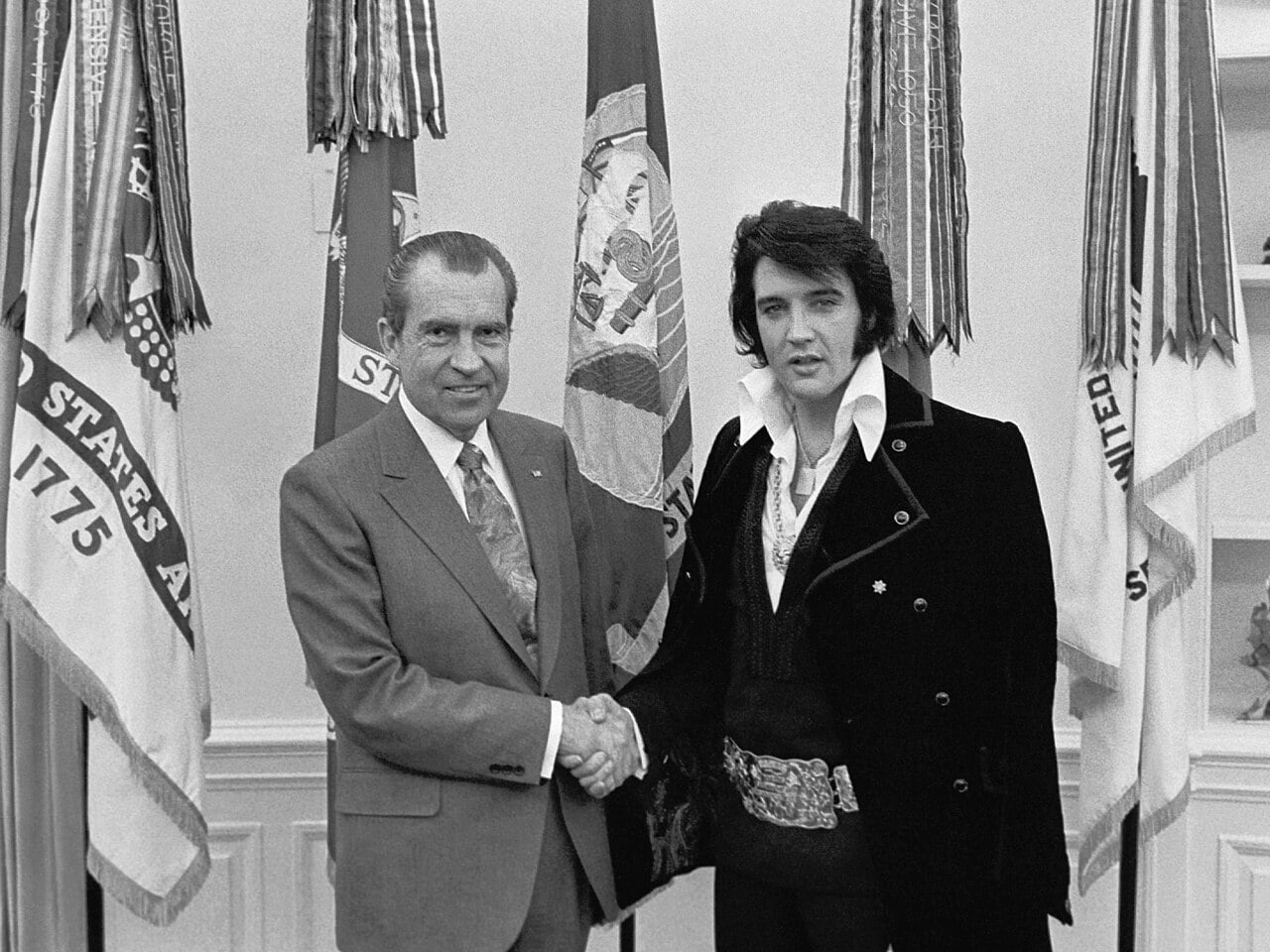
The White House has seen plenty of odd moments. Elvis visited Nixon. That photograph remains one of the great surreal artifacts of American political life. But even the Nixon-Elvis meeting, strange as it was, now seems almost quaint. Elvis wanted a badge. Nixon wanted a photo. Nobody thought to install a cage on the South Lawn and call it national renewal.
That is what makes the Trump era so exhausting. It is not only the policies, the insults, the feuds or the constant noise. It is the flattening of everything. The solemn becomes theatrical. The ceremonial becomes commercial. The national becomes personal. The public house becomes another Trump stage.
And the country, after a while, is expected to stop noticing.
But we should notice.
We should notice when the symbols of the republic are treated as scenery. We should notice when presidential taste becomes indistinguishable from cable programming. We should notice when the White House no longer elevates the event, but is lowered to fit it.
A president cannot control every cultural current in the country. But he can choose what he honors. He can choose whether the White House points Americans upward, outward and forward, or whether it simply reflects back the loudest parts of the moment.
Kennedy did not make America cultured by inviting Casals. Nixon did not redeem his presidency by honoring Duke Ellington. Reagan did not solve the country’s problems by hosting entertainers. Obama did not heal every division by widening the cultural guest list.
But each, in his way, understood that the White House was not just real estate. It was a symbol, and symbols require care.
Trump sees the same symbol and thinks: great location.
That is the difference between Casals and cage fights.
And it is not a small one.