
Intergalactic Zionism
From Catastrophe to Holiday
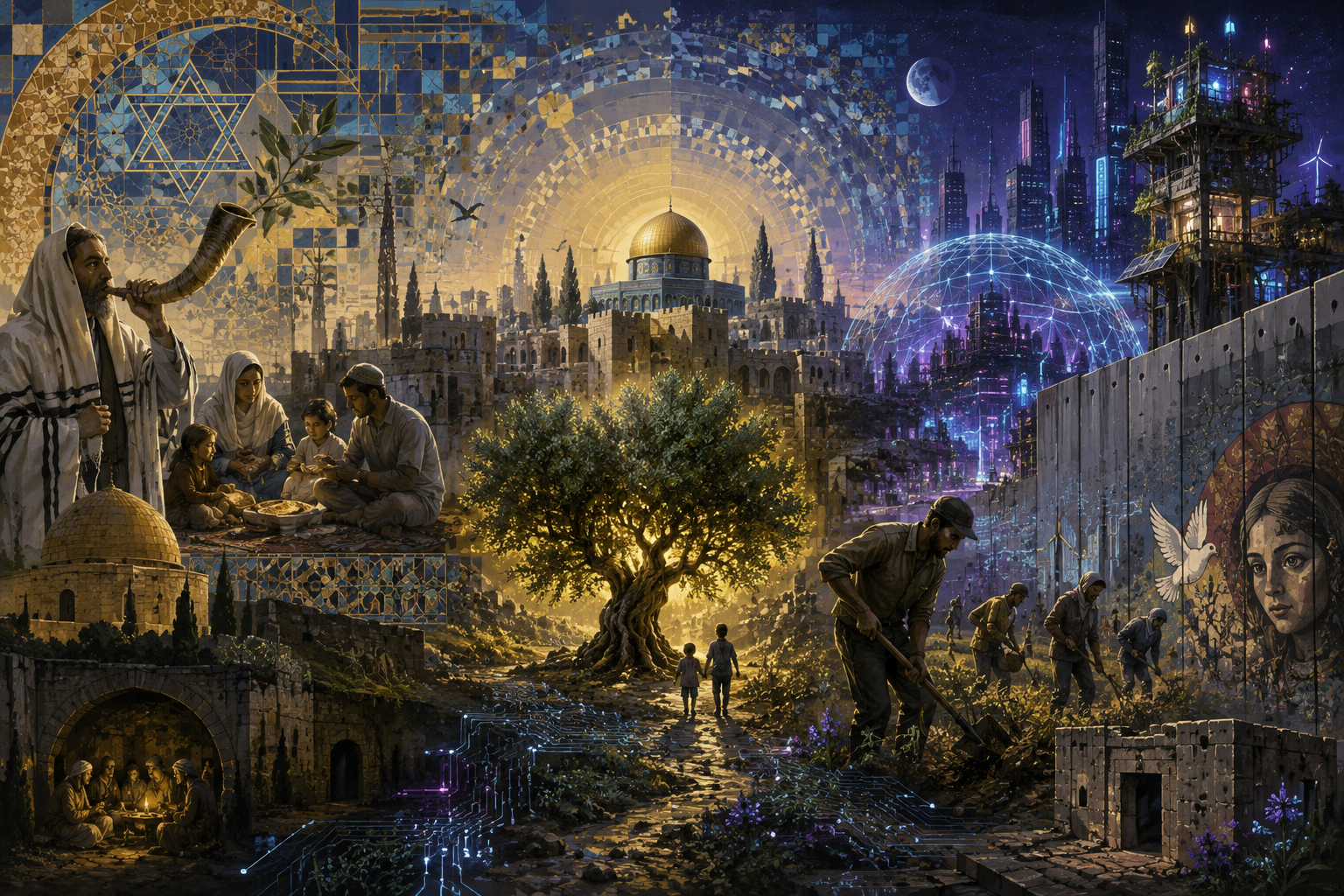
Visions of transformation from catastrophe to celebration. Image created with the assistance of agentic artificial intelligence.
Tisha be-Ab cannot become a festival merely because Jews recovered power. It changes when mourning teaches a sovereign society what to do with that power.
Yesterday was Tisha be-Ab. Today is Ereb Shabbath.
The fast is over. The shoes are back on, the chairs are upright again, and the choreography of mourning has been completed for another year.
This is precisely the moment when I want to ask what, exactly, we completed.
We know how to do Tisha be-Ab. We know when to stop eating. We know where to sit. We know which pleasures to suspend, which greetings to avoid, which texts to recite, and approximately how miserable we are expected to look while reciting them. We have inherited a remarkably detailed behavioral language of grief.
But I am not persuaded that performing the behavior of mourning is the same thing as mourning.
Mourning ordinarily has an object. It is a human response to a loss that remains alive inside us. What we often perform on Tisha be-Ab is the inherited appearance of that response: an annual completion of the actions associated with grief, whether or not we are actually confronting the loss, its causes, or what the loss now demands of us.
That may be worse than forgetting.
Forgetting at least leaves an absence that can be discovered. Performative mourning gives us the moral satisfaction of remembering without requiring memory to produce anything.
The Rambam’s account of the destruction fasts is almost aggressively practical. The point is not fasting for its own sake. The fast is supposed to awaken the heart, open the paths of repentance, confront us with the resemblance between the failures of our ancestors and our own conduct, and lead us to do better. If the behavior does not open into changed conduct, then the means has detached itself from its purpose.
The strange thing is that our tradition does not describe Tisha be-Ab as an eternal monument to Jewish suffering. Zekharya says that the fasts commemorating the destruction will become occasions of joy and gladness. And the promise does not float alone in a vague messianic mist. It appears beside commands to speak truth, administer true justice, reject schemes against one another, and love truth and peace.
The transformation of the fast is tied to the transformation of society.
The Gemara makes the historical contingency explicit. When there is peace, the fasts become days of joy. Under persecution, they remain obligatory fasts. In the condition between persecution and peace, the lesser fasts are treated differently; Tisha be-Ab remains especially severe because catastrophes were multiplied upon it.
But what is peace?
The commentators do not give us one simple definition. Rashi describes it as a condition in which the nations no longer exercise dominion over Israel. Rabbenu Hananel ties it to the standing sanctuary. The Rashba speaks of Israel dwelling on its land. Elsewhere on the same page, the Gemara describes the biblical fasts as contingent upon the building of the sanctuary.
These are not interchangeable definitions. Their disagreement places present Jewish life in an awkward category.
We are not where we were.
Millions of Jews live in an autonomous Judaean society. We possess institutions, an army, a government, courts, universities, infrastructure, and enormous technological and economic power. Foreign empires do not appoint our governors. Jewish public life is no longer merely a memory or a tolerated minority arrangement inside somebody else’s civilization.
We are also not where the prophetic promise points.
There is no sanctuary. There is no comprehensive peace. And there is no honest way to describe our society as having fulfilled the demands for truth, justice, and human welfare that surround the promise that mourning will become celebration.
This is why static inheritance of traditional mourning forms is inadequate. Tisha be-Ab cannot mean exactly the same thing in a powerless dispersed community and in a sovereign society exercising military, legal, economic, and administrative power. The dead do not become less dead because the state was established. Exile, persecution, dispossession, and civilizational loss are not retroactively cancelled.
But power changes obligation.
A people can be the victim of history and an agent within history. Most peoples that survive long enough become both. The moral danger begins when we preserve victimhood as our permanent self-understanding after recovering the capacity to act: when the memory of powerlessness becomes a shield against examining what we do with power.
Tisha be-Ab can then become a fetishization of Jewish suffering. Not the honest preservation of pain, but the ritual production of an identity in which suffering always happens to us and moral agency always belongs to somebody else.
That construction is especially intolerable while Palestinian civilians in the West Bank continue to live under an Israeli military administration that regulates substantial parts of movement, planning, construction, employment, legal process, infrastructure, and access to land and services.
I am not primarily interested here in resolving the legal argument over which national collective owns the land. I do not think land can really be owned. Human beings can inhabit land, care for it, use it, inherit relationships to it, establish rights within it, and negotiate responsibilities toward one another upon it. But the earth is not a chair that can finally belong to one person while everybody else is removed from the room.
International norms are important because shared restraints on power are important. But the immediate moral problem does not depend on winning an abstract argument about title. It is concrete: civilians are administered by military authority without equal participation in the power that governs important dimensions of their lives.
Palestinians are presently a people distinct from Israelis. Their self-determination matters to me as a natural extension of every person’s right to individual autonomy and to meaningful participation in the communities that organize their life. But I do not therefore dream primarily of two cleaner, more exclusive national enclosures facing one another across a harder border.
My dream is a shared society.
I understand Jews and Palestinians not as unrelated claimants who accidentally collided on the same parcel, but as peoples formed in and from the same country and descended, in substantial part, from the same ancient Israelite population: the people of the Judaean and Samaritan commonwealths, after centuries of migration, conversion, exile, return, and mixture. Contemporary genetics cannot hand us a complete family tree or assign modern political identities to ancient remains. It can establish substantial shared Levantine ancestry, and its findings are consistent with the much less exotic fact that populations do not simply vanish whenever rulers, religions, and languages change. That common descent does not erase the reality of distinct peoples now. It makes our estrangement more tragic, and the possibility of shared political life more intimate.
We cannot spend a day mourning the destruction of Jewish autonomy while refusing to examine what Jewish autonomy is doing.
That is not a contemporary political issue awkwardly stapled onto an ancient religious day. It is the issue Tisha be-Ab places in front of us: What destroyed the commonwealth? What corrupted its institutions? What did its leaders refuse to see? What happens when religious performance becomes detached from human life?
A recent essay by Rabbi Eli Clark complicates the familiar claim that the Second Sanctuary was destroyed simply because ordinary Jews did not like one another enough. Returning to earlier rabbinic material, he emphasizes priestly corruption, love of money, institutional violence, and failed leadership. In one horrifying tradition, a priest is stabbed during a competition to reach the altar, and the concern of those present turns toward preserving the ritual purity of the knife while the victim is still alive. In the story of Qamtsa and Bar Qamtsa, the decisive failure is not merely private hatred, but rabbinic leadership unable or unwilling to act for the larger public good – and, in one telling, a sage who watches a person being publicly humiliated and cannot bring himself to protest.
This is not a story about insufficient niceness.
It is a story about institutions whose religious values have become grotesquely separated from the welfare of actual human beings.
It is very easy to say that the sanctuary was destroyed because of baseless hatred. The lesson is pleasant, portable, and almost completely nonthreatening. Be nicer. Smile at another Jew. Avoid an argument in the synagogue parking lot. Perhaps sponsor refreshments.
Fine. We should be nicer.
But if the traditions of the Sanctuary’s destruction are also indictments of religious leadership, concentrated wealth, public humiliation, legal formalism, cowardice, and the failure to protect human life, then Tisha be-Ab is not merely a day for correcting private character. It is a national and institutional audit.
And audits require outputs.
This is where liturgy matters. Human beings do not sustain collective action through good intentions alone. We need recurring forms, language, calendars, gatherings, symbols, and stories. Liturgy is a technology for turning a one-off insight into a human system. It can carry a truth across generations after the original emotional intensity has vanished.
But liturgy can also become a machine for producing the appearance of moral seriousness.
The answer is not to discard it. The answer is to reconnect it to consequences.
What if Tisha be-Ab became an annual accounting of the condition of the society we have rebuilt? Not a government public-relations presentation, and not a partisan scorecard written in advance to prove that our own tribe is righteous. A real accounting.
Who is hungry?
Who is homeless?
Who is unsafe in a home, a school, a workplace, a yeshiva, a prison, a Palestinian village, or an unrecognized Bedouin community?
Whose humiliation did our leaders witness and decide not to interrupt?
Where has religious law protected the institution while abandoning the person?
Where are authority and resources concentrated, and what are they producing?
What happened during the previous year because we mourned – and what remained exactly as broken as before?
Acts of justice, communal service, mutual solidarity, and kindness should not be decorative additions to the fast. They are the beginnings of its transformation. The day could move gradually from passive lament toward collective action: communities naming their failures publicly, institutions reporting concrete outcomes, people gathering across political identities to argue safely about causes and solutions, and resources being mobilized toward repair.
I do not have the program.
That matters. I am proposing a framework for discussion, not appointing myself national director of redemption.
We have a real problem talking about our problems. We hide them, minimize them, quarantine them inside professional organizations, or convert them into ammunition for a culture war. Public vulnerability feels dangerous because every admission may be seized by somebody who does not want repair but victory.
Still, a society that cannot speak honestly about its failures cannot correct them. We need spaces that are public and safe at the same time – not safe from disagreement, but safe enough for disagreement to become collaborative intelligence rather than tribal combat. Tisha be-Ab could provide liturgical structure for that kind of national vulnerability.
The predictable objection is that this would politicize the day.
Yes. It would.
Everything is political in the basic sense that the organization of authority and resources affects the people who live under it. The Hebrew Bible is an intensely political anthology. It argues about kings, judges, land, debt, labor, war, taxation, corruption, refugees, the concentration of wealth, and the obligations of a society toward those with the least power. Jewish discourse does not become more religious by pretending politics is an alien contamination.
The problem is not politics. The problem is that politics has been reduced to a tribal performance of identification and affiliation.
We no longer encounter disagreement primarily as a means of testing proposals and discovering better solutions. We encounter it as evidence that somebody belongs to the wrong camp. The political position becomes a costume worn by the social self. Under those conditions, bringing politics into Tisha be-Ab sounds like bringing a fistfight into a funeral.
But the answer cannot be to remove public responsibility from Jewish religious discourse. It must be to recover politics as a group project of becoming better: organizing our shared world, challenging one another’s analysis, exposing tradeoffs, crowdsourcing solutions, and measuring whether anybody’s life actually improves.
And then there is the sanctuary.
I do not mean that justice is a symbolic sanctuary and therefore we no longer need an actual one. Symbols matter because human beings are embodied, spatial creatures. Art and architecture shape identity, memory, security, permanence, and the horizons of what a culture imagines itself to be. A lasting building intended to integrate the sacred, the social, the artistic, and the national can provide real human benefit. A civilization needs active monuments – not dead objects admired from behind a rope, but places where its deepest ideas are made inhabitable.
There is a beautiful story, apparently a relatively late Jewish and Arab folk legend rather than an ancient rabbinic source, that the sanctuary was built where two brothers secretly carried grain to one another, each convinced that the other needed it more. Its provenance is complicated. Its moral clarity is not. The place becomes sacred because solidarity occurred there.
I want an actual sanctuary.
But a sanctuary cannot be a safe space for one people constructed through the endangerment, exclusion, or domination of another. If the building represents brotherly love while the society surrounding it reproduces military administration, inequality, humiliation, and institutional indifference, the architecture does not redeem the contradiction. It monumentalizes it.
That would be farcical.
Before we can build the sanctuary, we have to rectify the society. Not perfect it – no society has ever earned a building permit from heaven by eliminating every injustice – but orient it toward the human purpose the building claims to embody. Truth. Peace. Justice. Mutual responsibility. A house whose safety does not depend on somebody else remaining permanently unsafe.
This is where the particular and the universal meet.
Tisha be-Ab is irreducibly Jewish. It remembers specific sanctuaries, a specific city, a specific people, specific defeats and exiles, and the long interruption of Jewish public life. Universalizing it must not mean dissolving all of that into the bland observation that suffering is sad.
But inside this intensely particular history is a universal human problem: What does a people do after catastrophe? How does inherited grief become agency? How does a community preserve the memory of being victimized without building its permanent identity around victimhood? And what happens when a dispossessed indigenous people succeeds – partially, dangerously, experimentally – in rebuilding an autonomous national society alongside another indigenous people whose freedom remains constrained by that reconstruction?
There may be no adequate precedent. The scale and duration of Jewish disenfranchisement, return, and social reconstruction make this a strange human experiment. That does not make Israel exempt from comparison or criticism. It makes our responsibility more interesting and more severe.
We are discovering, in real time, whether a people can turn mourning into a civilization without turning suffering into a title deed, trauma into an ideology, or survival into sufficient proof of righteousness.
Zekharya does not tell us simply to wait until the fast becomes a festival. He places truth and peace beside the promise.
The transformation is not hidden on the far side of history. The agency is hidden inside the mourning.
Yesterday we fasted. Today is Ereb Shabbath. The question is not whether we successfully completed Tisha be-Ab.
The question is what is less broken today because we remembered.
–
Further Reading
[1] Moshe ben Maimon (Rambam), Mishne Torah, Hilkhoth Ta’aniyoth 5:1, on the purpose of the destruction fasts as awakening the heart and opening paths of repentance. Sefaria: https://www.sefaria.org/Mishneh_Torah%2C_Fasts.5.1-2
[2] Zekharya 8:16-19, especially the connection among truth, justice, peace, and the transformation of the fasts into festivals. Sefaria: https://www.sefaria.org/Zechariah.8.16-19?lang=en
[3] Babylonian Talmud, Rosh ha-Shana 18b, on peace, persecution, the intermediate condition, and the distinctive severity of Tisha be-Ab. Sefaria: https://www.sefaria.org/Rosh_Hashanah.18b.1-3
[4] Rashi on Rosh ha-Shana 18b, defining peace as the absence of foreign dominion, and the discussion connecting the fasts to rebuilding the sanctuary. Chabad text page: https://www.chabad.org/torah-texts/5447450/The-Talmud/Rosh-Hashanah/Chapter-1/18b. For Rabbenu Hananel and the Rashba’s formulations, see the collected primary quotations at Sefaria: https://www.sefaria.org.il/sheets/93144
[5] Israel’s Coordination of Government Activities in the Territories, official Civil Administration descriptions of its population-registry, planning, supervision, employment, welfare, and related authorities in the West Bank: https://www.gov.il/en/departments/units/population_registrar_unit ; https://www.gov.il/en/departments/units/planning_bureau_unit ; https://www.gov.il/en/departments/Units/supervision_unit ; https://www.gov.il/en/departments/units/employment_unit. For a current account of movement restrictions and their civilian effects, United Nations OCHA, “Movement and Access in the West Bank,” April 2026: https://www.ochaopt.org/content/movement-and-access-west-bank-april-2026
[6] Lily Agranat-Tamir et al., “The Genomic History of the Bronze Age Southern Levant,” Cell 181, no. 5 (2020): 1146-1157.e11, doi:10.1016/j.cell.2020.04.024. The study finds substantial ancestry in present-day Jewish and Arabic-speaking Levantine populations from populations related to the Bronze Age southern Levant while emphasizing later migration and admixture. PubMed: https://pubmed.ncbi.nlm.nih.gov/32470400/
[7] Rabbi Eli Clark, “The (Real) Reason the Temple Was Destroyed,” guest post published by Natan Slifkin, Rationalist Judaism, July 22, 2026. https://www.rationalistjudaism.com/p/the-real-reason-the-temple-was-destroyed
[8] Vered Tohar, “The Loyal Brothers: A Folk Legend in Transition,” Fabula 58, nos. 3-4 (2017): 256-270, doi:10.1515/fabula-2017-0025. The article documents the legend as a nineteenth-century Jewish and Arab tradition rather than a classical rabbinic text. https://cris.iucc.ac.il/en/publications/the-loyal-brothers-a-folk-legend-in-transition-2/
Related Topics