
From Coexistence to Co-Elevation: Jewish–Muslim Fraternity in Faith
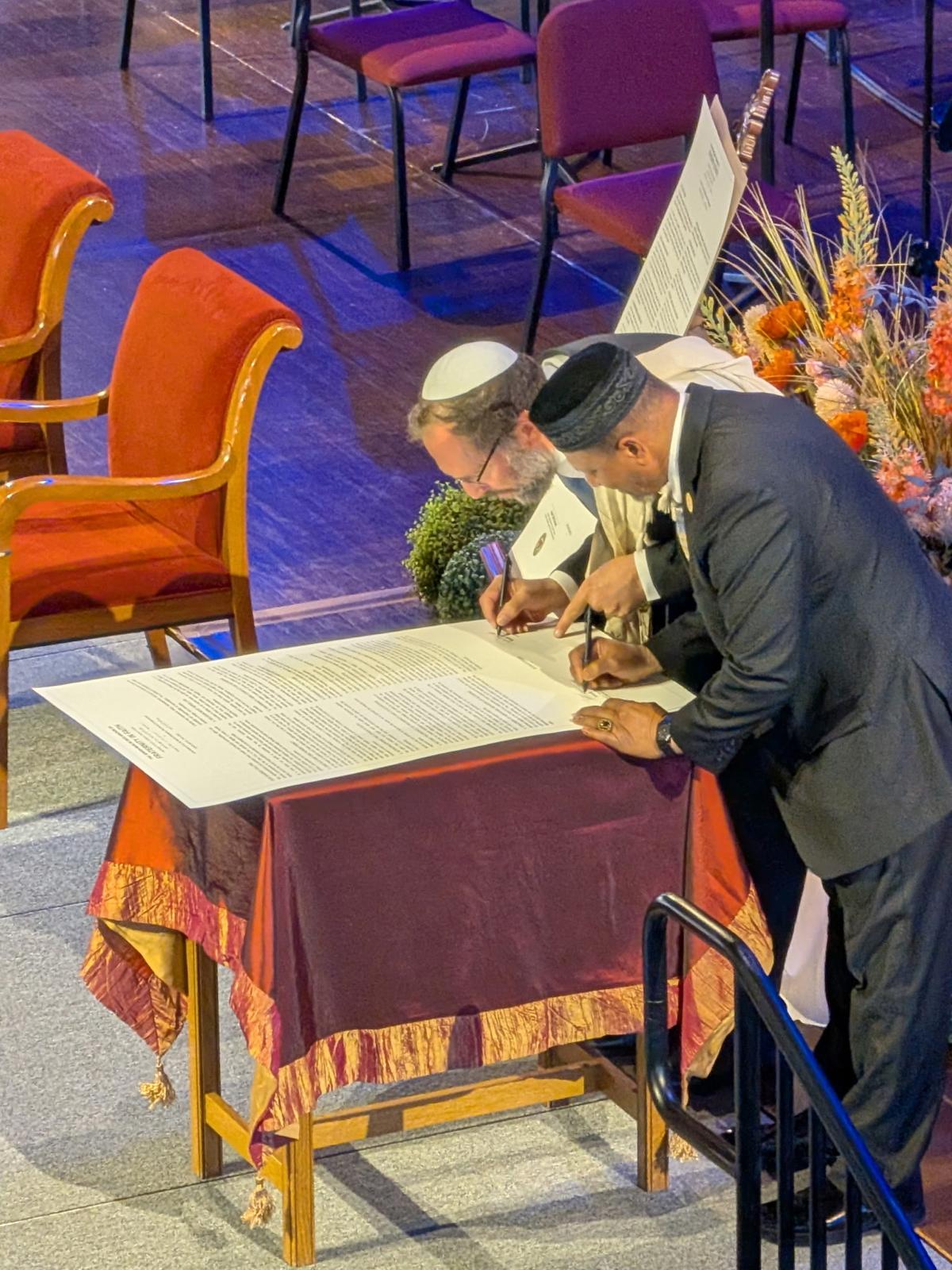
Last week, at the opening session of the G20 Interfaith Forum in Salt Lake City, Utah, Imam Talib Shareef and I signed the Jewish–Muslim Declaration of Fraternity in Faith. The signing marked a milestone in a journey of many years: friendship, joint study, and cooperation between our organizations, the Jerusalem Interfaith Center and the International Coalition for Peace and Reconciliation, and dialogue with Jewish and Muslim religious leaders worldwide.
We undertook this journey against the backdrop of a painful reality. Religion has too often been weaponized, turning sacred commitments into instruments of fear, hostility, and division. Yet those same commitments hold resources for healing. We believe religious leaders have a responsibility to draw upon them, helping religion become part of the solution to conflicts it has too often been used to deepen.
At the heart of this effort is a question of identity. Do our religious identities set us against one another, or can they bring us together in a shared story? Can we tell that story in a way that acknowledges and values the place of the other, as family, with a distinctive voice and a contribution we need?
Earlier Jewish–Muslim accords have affirmed peace and cooperation. Our declaration seeks to build upon those achievements by offering a comprehensive, scripturally grounded theology of Jewish–Muslim fraternity. It recognizes the distinct religious identity of each community as a potential source of partnership and mutual blessing.
This is the movement from coexistence to what Imam Talib calls co-elevation: helping one another rise through the encounter between our faiths. We can remain faithful to our own traditions while learning from one another, strengthening one another’s moral commitments, and discovering dimensions of our own faith through the questions and insights of the other. Fraternity makes room for difference and asks what blessings it can bring.
Another component of the opening session was devoted to “Disagreeing Better.” A memorable formulation offered there was captured in three letters: I.C.U. “I see you.” Before we can disagree constructively, we must learn to see the person before us.
In that spirit, our contribution might be described as “agreeing better.” Here, too, “I see you” is essential. General statements about peace and shared values can leave the actual person, community, and religious tradition unseen. Meaningful agreement requires attention to who the other is: what they hold sacred, how they understand their place in the world, and what they can contribute to our shared life. To seek fraternity is to become willing to receive a blessing from the other.
A declaration, however, must become more than a signed document. Its promise will be measured in relationships, education, and action. We hope to advance this vision worldwide through grassroots initiatives and by inviting religious leaders to join through their signatures and their work within their communities. Joint study, encounters between congregations, and cooperation in service can give fraternity a tangible presence in everyday life.
The declaration is accompanied by a monograph grounding its affirmations in our respective sacred sources. We hope continued study and scholarship will deepen and broaden that foundation, enabling more Jews and Muslims to discover this possibility within their own traditions.
The text that follows is an invitation to join that work, to help turn a shared vision of fraternity in faith into a lived reality:
THE JEWISH–MUSLIM DECLARATION OF FRATERNITY IN FAITH
OUR SHARED CALLING
We, representatives and partners from Jewish and Muslim communities, affirm our shared commitment to the One G‑d, to the sanctity and dignity of every human being, and to the moral responsibility entrusted to us as people of faith.
At a time when our world is wounded by war, hatred, injustice, and the dehumanization of peoples, we believe that faith must summon humanity toward its highest possibilities. Our religious identities must not become barriers separating us from one another, but sources of moral courage through which we encounter, serve, protect, and elevate one another.
1. ONE G‑D AND ONE HUMAN FAMILY
At the heart of Judaism and Islam stands the affirmation of the One G‑d, Creator and Sustainer of heaven and earth. Our traditions are distinct, yet both call us to worship the One Creator and to live in accountability before G‑d. This shared belief in the One G‑d can and must be transformative. It must not remain only in our minds or on our lips, but be planted deeply in our hearts, our souls, and our deeds.
Our sacred texts teach that humanity shares a common origin and an inherent dignity bestowed by G‑d. The Torah declares that the human being was created in the image of G‑d; the Qur’an teaches that humanity was created from a single soul and that G‑d has honored the children of Adam. Human dignity is not bestowed by race, nation, religion, wealth, power, or government. It comes from G‑d and must be honored in every person.
2. ACKNOWLEDGING THE OTHER’S FAITH
We affirm that Judaism and Islam each stand within the Abrahamic tradition, grounded in G‑d’s revelation, and that both communities are called to worship the One G‑d faithfully.
We do not ask one another to become the same, nor to diminish the integrity of our respective faiths.
3. BEYOND TOLERANCE TO FRATERNITY AND CO‑ELEVATION
Inspired by our shared Abrahamic spiritual heritage, and called by our traditions to encounter religious difference with faithfulness, wisdom, and responsibility, we declare that our relationship must move beyond mutual tolerance toward genuine fraternity, and beyond coexistence toward co‑elevation. This fraternity is expressed through deep connection, mutual responsibility, shared hope, and mutual growth.
We are partners in the great story of Creation, jointly entrusted by G‑d to sanctify life and advance justice, compassion, and faith. Our fraternity carries a sacred responsibility: rooted in shared accountability before G-d and a common calling to work together for our communities, our children, and the future of humanity.
We acknowledge and proclaim that the world is more blessed because of the presence of the other and because of the gifts of faith that each tradition brings to humanity. Our shared future is not diminished by our differences but enriched by them. Unity does not require uniformity.
4. CHILDREN OF ABRAHAM, BEARERS OF BLESSING
Abraham stands at the heart of our relationship. Both scriptures call him the friend of G‑d and a source of blessing. The Torah testifies to G‑d’s blessing upon Ishmael, and the Qur’an to G‑d’s blessing upon Isaac. We are called to recognize not only the blessing upon our own branch of Abraham’s family, but also G‑d’s blessing upon the other.
A family may experience rivalry, estrangement, and pain, but family also carries the possibility and responsibility of reconciliation. The children of Abraham must make Abraham a bridge, not a boundary.
5. RELIGION MUST SERVE LIFE
Grounded in fidelity to our sacred texts, we affirm that the deepest teachings of our traditions direct us toward justice, mercy, peace, and the protection of life. Difficult passages must be interpreted with integrity and responsibility according to our respective scholarly traditions.
We stand together against those who invoke G‑d’s name to divide, dehumanize, oppress, or destroy. The weaponization of religion betrays our sacred responsibility. Religion must be a source of guidance, healing, and life, not an instrument of hatred and death.
6. FRATERNITY AMID CONFLICT AND SUFFERING
Our fraternity neither erases nor ignores the suffering of any people. Jews and Muslims carry different histories, wounds, fears, and narratives. Genuine fraternity requires us to listen across them, to grieve innocent life without first asking the victim’s nationality or religion, and to reject collective blame.
We oppose antisemitism, Islamophobia, racism, and every form of religious or ethnic hatred. We affirm the sanctity of sacred places and the right of communities to worship in safety. We seek justice without surrendering compassion, peace without abandoning truth, and reconciliation without erasing legitimate difference.
A COVENANT FOR THE FUTURE
The challenge before us is not to abandon our differences, but to sanctify them; not to weaken our religious identities, but to allow them to become sources of blessing for one another. Therefore, we pledge together:
- To defend the sanctity of every human life.
- To reject antisemitism, Islamophobia, racism, xenophobia, and every form of religious or ethnic hatred and dehumanization.
- To protect houses of worship.
- To educate future generations in mutual respect and truthful understanding.
- To cooperate in works of justice, compassion, service, and peace.
- To stand together whenever religion is manipulated to justify violence or oppression.
- To encourage our communities to know one another, serve one another, and work together for the common good.
- To reject collective blame and the dehumanization of any people, especially in times of conflict.
We undertake these commitments not because Judaism and Islam are the same, but because fidelity to the One G‑d calls us to recognize the dignity and blessing G‑d has bestowed upon one another. We draw inspiration from the Constitution of Medina, which demonstrated that Jews and Muslims, while remaining faithful to their distinct religious commitments, could form a community of mutual responsibility and shared concern. We do not abandon our differences; we refuse to weaponize them. We do not weaken our religious identities; we seek to make them sources of blessing for one another and for all humanity.
May the G‑d of Abraham, the Creator and Sustainer of us all, guide our hearts toward truth, our hands toward service, and our communities toward peace. May our fraternity become a blessing—not for Jews and Muslims alone, but for all the families of the earth.