
From Cyrus to the Mullahs
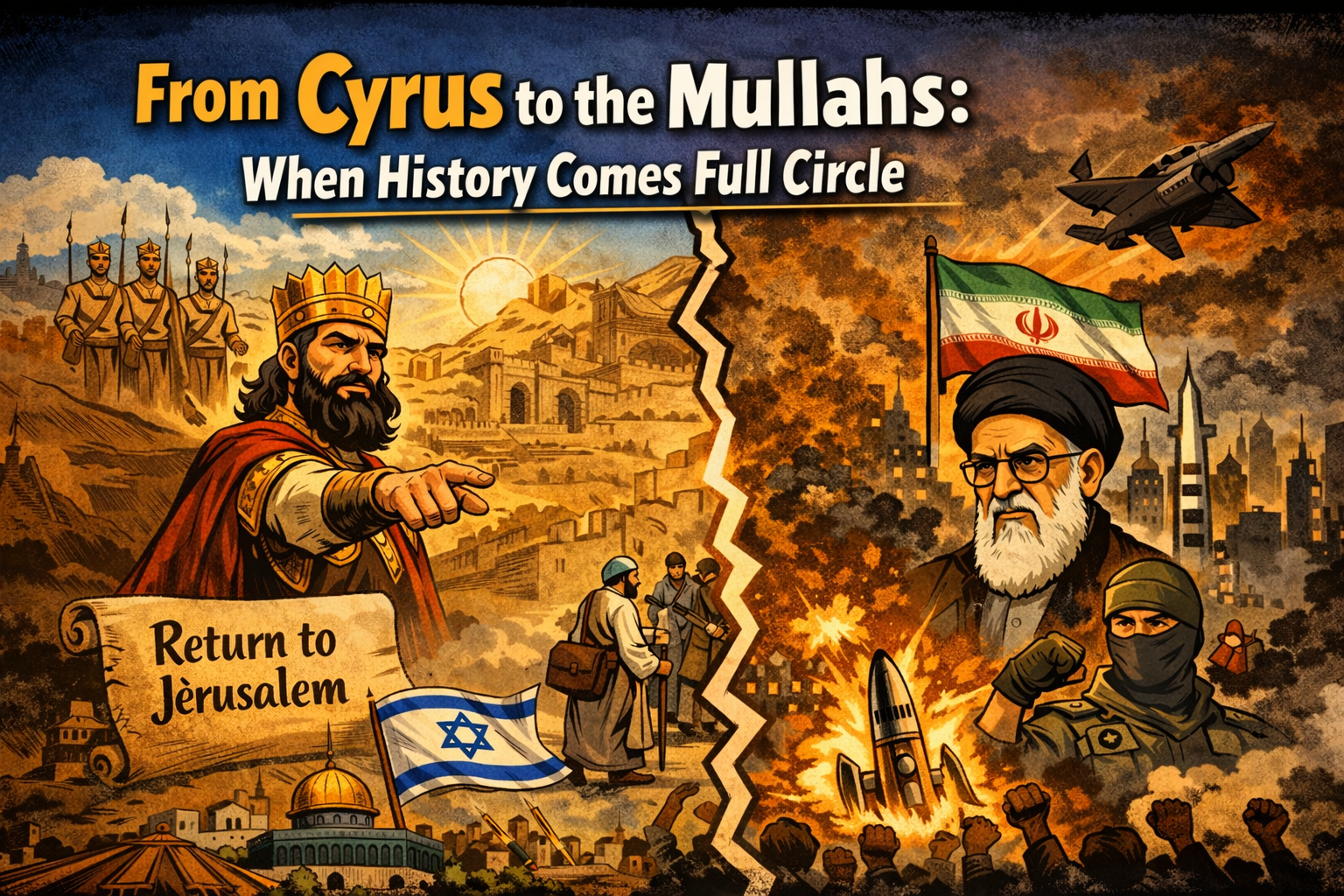
The final words of the Hebrew Bible do not come from a prophet of Israel but from the mouth of a Persian sovereign:
“Thus says Cyrus, king of Persia: The Lord, the God of heaven, has given me all the kingdoms of the earth, and He has charged me to build Him a house in Jerusalem, which is in Judah. Whoever among you belongs to His people—may the Lord his God be with him, and let him go up.” (1)
These verses close the Book of Chronicles, which is the last book of the Tanakh, the Hebrew Bible. (2) They therefore carry particular significance.
In the sixth century BCE, the Persian Empire overthrew Babylon and opened the way for the return of the Jewish exiles to Jerusalem. Cyrus became the instrument of the return of the Judeans and enabled the rebuilding of the Temple.
His injunction, “let him go up,” is still used twenty-five centuries later to designate the migration of Jews from around the world to Israel, since one speaks of making one’s “aliyah.” (3)
But half a century after Cyrus, Haman appears—whom Jewish tradition sees as a descendant of Amalek—who conceives a plan to exterminate the Jewish people, as recounted in the story of Purim.
It is not insignificant to note that the operations “Roaring Lion” and “Epic Fury” began precisely on Saturday, February 28, the day when Jewish tradition recalls the obligation to remember this very project of extermination. (4)
This war does not aim only at the destruction of Iran’s nuclear and ballistic capabilities, but also at the fall of the Mullahs’ dictatorship.
Cyrus remains a deeply respected figure in Iran. For many Iranians, he embodies an imperial, pluralistic, and tolerant Iran, far removed from the totalitarian ideology of the Islamic Republic.
In the sixth century BCE, Persia—through the Edict of Cyrus—allowed the Jews to return to Jerusalem.
In the twenty-first century, the Jewish state contributes to reopening the horizon of contemporary Persia.
History thus offers an unexpected loop: the people whom Cyrus helped return to Jerusalem contribute, millennia later, to restoring Persia’s own freedom.
Iran may rediscover a national horizon that is older, more open, and more faithful to its millennial heritage.
It is a strange interplay in which civilizations answer one another across centuries—and in which the final words of the Bible receive an unexpected response.
(1) 2 Chronicles 36:23
(2) Unlike the Christian Bible, which ends with the prophecy of Malachi.
(3) Literally, “ascent.”
(4) Shabbat Zachor, recalling the command: “You shall blot out the memory of Amalek from under heaven. Do not forget.” Deut. 25:17–19.