
From Kibbutz to the global stage
From Davos to Delhi: How the EU–India FTA Signals a Global Shift
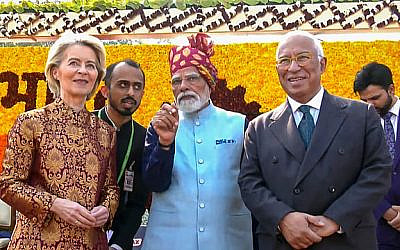
From Davos to Delhi: How the EU–India FTA Signals a Global Shift
Trade, democracy, and the emergence of a new economic axis.
The seven days that began in Davos and ended in New Delhi will likely be remembered as a formative moment in the shaping of a new geopolitical, political, and economic framework.
In Davos, the Peace Council declaration aimed at ending the war in Gaza was formally signed. For me, this marked an interim conclusion — not of a single article, but of a consistent analytical line developed over many months.
As early as September 12, 2025, just four days after the Israeli strike in Doha, I wrote here in The Times of Israel Blogs that the war in Gaza was likely to end — precisely when the international consensus was moving in the opposite direction. The argument at the time was that the unusual event in Qatar did not signal escalation, but could instead become a catalyst for political resolution.
In retrospect, that article was not a guess, but a strategic reading of the regional system: Qatar, Washington, the moderate Muslim axis, and mounting international pressure on all parties to reach an exit point.
One symbolic but critical stage now remains: a direct meeting between Israel’s prime minister and Muslim leaders from the Peace Council. It is no coincidence that this is expected to take place in Washington — around the AIPAC conference in February — rather than in Davos. Political and legal constraints narrow the range of possible venues, but they also clarify the arena: the closure will occur at the American center of gravity, not at the margins.
Davos, however, revealed something else. While representatives of centralized regimes and monarchies took center stage, most of the world’s leading democracies were absent — Europe, Japan, Canada, Australia, and India, the world’s largest democracy.
And once the ceremony ended and participants returned home for the weekend, the real move began. Senior EU officials, led by the President of the European Commission and the President of the European Council, arrived in New Delhi with a high-level delegation to advance negotiations on a free trade agreement between the European Union and India.
Today it was announced that the framework agreement — which we discussed here in TOI just a week ago — is expected to be signed on January 27, 2026. This comes against the backdrop of rising tariffs between India and the United States, the German chancellor’s recent visit to India, and the expected visit of French President Emmanuel Macron in early February. The trade volume covered by the agreement is estimated at approximately €180 billion.
If Davos represented a political framework surrounding the end of the Gaza war under an American umbrella, the India–EU move points in the opposite direction. Against the backdrop of tensions over Greenland, regime change in Venezuela, and the growing use of tariffs as a geopolitical pressure tool, India and the European Union are advancing tariff reductions, deeper economic integration, and the formation of a democratic axis grounded in shared values and interests.
Cooperation between nearly two billion citizens in India and the EU would create a young, digital, and technologically capable consumer market, with advanced space agencies, expanding academic systems, growing investments in defense, science, and AI, and a cultural and social synergy that fosters innovation.
Such a shift may also reshape global human capital flows. Hundreds of thousands of Indian engineers and professionals currently working in Western countries and the Gulf may begin to reconsider returning home as living standards rise and long-term educational and economic prospects improve — echoing earlier patterns seen in Taiwan, South Korea, and more recently China.
Additional countries — including the UK, Japan, Canada, and Australia — are likely to gravitate toward an India–EU axis, which could also attract African states that were notably absent from Davos. This alignment would reinvigorate strategic trade corridors through the Middle East and the Horn of Africa, including IMEC and VICMED, linking India and Europe via the Gulf, East Africa, and Nile routes.
And finally, there is the unavoidable question of China.
Although this is a distinctly democratic axis in its values, it cannot be ruled out that China may eventually seek to participate — not as a full value-based partner, but as a pragmatic actor in large-scale infrastructure, technology, and AI initiatives. Economic history suggests that China often joins frameworks built without it once they become global standards. A broad, rule-based India–EU initiative may therefore present Beijing with a strategic choice: prolonged isolation, or adaptation to a new set of rules no longer defined by Washington alone.
As Henry Ford understood in the early twentieth century, markets are built by investing in people. If India and the European Union were to advance an “AI for every boy and girl” initiative, they would not only lead morally — but also economically, technologically, and geopolitically.
Time will tell.
Related Topics
Related Posts