London based entrepreneur, cybersecurity analyst doing a PhD in AI
USPI Part 2 – Mind as a Public Good and Pathways.
Author’s note: In the previous article, the index was referred to as both UPSI and USPI while the naming was being refined. The final name used here is USPI — the ʿUmar Stewardship Performance Index. The underlying idea has not changed; the terminology has simply been standardised however both names remain valid and can be used by authors, academics, public policy think tanks, governments as they deem fit. A note on provenance, for any academic papers emanating from this and the previous article (same as GLP), please refer to this originating article and credit it as Ibrahim Mukherjee (ORCID- https://orcid.org/0009-0003-0067-3715) from this article on the Times of Israel.
This article highlights two key concepts :-
- Mental Health as a “public good” is currently underrated.
- Pathways to execute USPI.
Al-ʿAql is a public good
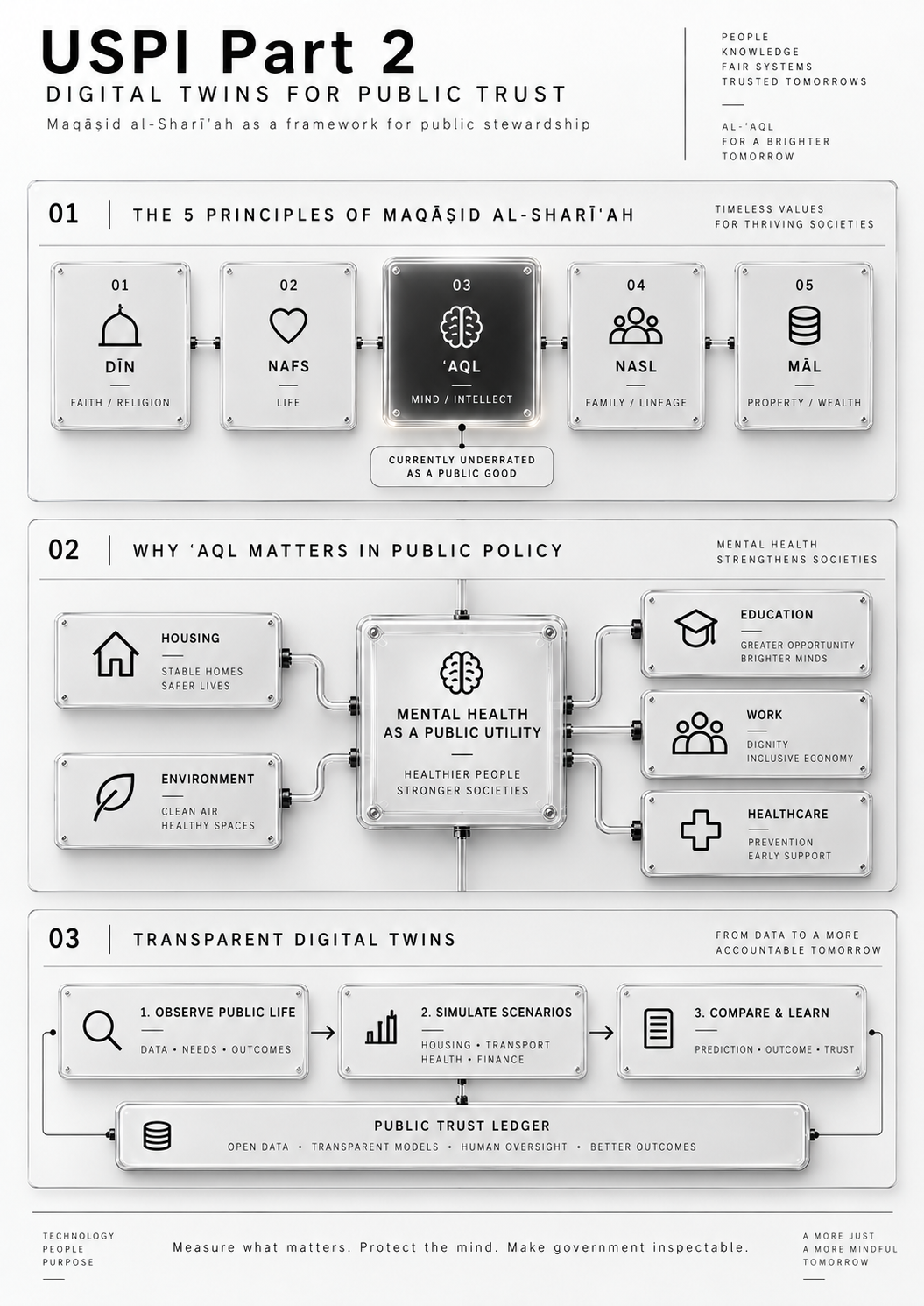
The classical necessities associated with Maqāṣid al-Sharīʿah include preservation of religion, life, intellect, lineage or family, and property.
One is ḥifẓ al-ʿaql — protection of the intellect or reason.
We should not lazily translate al-ʿaql as though classical jurists meant the modern diagnostic category “mental health.” They did not.
But its contemporary application necessarily reaches into mental well-being.
A damaged mind cannot reason properly.
A chronically overwhelmed person struggles to flourish.
Severe psychological distress can impair work, learning, family relationships, physical health and participation in society.
WHO now estimates that nearly one in seven people globally lives with a mental disorder, while many still cannot obtain effective treatment. It defines mental health more broadly as a state enabling people to cope with life, realise abilities, learn, work and contribute to their communities. (World Health Organization)
Mental health therefore cannot be treated merely as a hospital problem.
It is simultaneously a housing problem.
An employment problem.
An education problem.
A transport problem.
An environmental problem.
A family problem.
A justice problem.
And sometimes a war problem.
WHO itself has now moved explicitly toward this whole-of-government view, publishing guidance in 2025 calling for mental health to be integrated across education, employment, social protection, justice, urban development, health and other sectors. (World Health Organization)
USPI simply takes the logic one step further:
if different departments can damage or improve the same human mind, model those effects together before policy is implemented.
We already know what happens when we do not
The argument for digital twins is not that previous governments possessed no data.
Often they possessed enormous amounts of data.
The failure was different.
They optimised one objective while failing to model the system around it.
They built the road without modelling the neighbourhood.
Changed the water source without adequately modelling corrosion and trust.
Moved people out of institutions without always building the community system around them.
Allowed housing policy to operate separately from child health.
In other words:
they modelled the project, not the human consequence.
Consider four cases.
Case Study One: the road that cut through a society
The Cross Bronx Expressway was supposed to solve a transport problem.
Move vehicles.
Connect routes.
Increase metropolitan efficiency.
On those terms, a highway appears almost entirely to be an engineering object.
But neighbourhoods are not engineering objects.
New York City’s own contemporary review says construction displaced tens of thousands of people, demolished thousands of homes and divided densely populated communities. The city now describes the expressway as having imposed generations of noise, air pollution, poor health and neighbourhood disconnection. (New York City Government)
The irony is profound.
Decades later, government is spending money to study how to reconnect the communities that infrastructure disconnected.
Recent quantitative research also supports the wider phenomenon: urban highways act as barriers to local social ties and are associated with reduced social connectivity across the communities they divide. (PubMed Central (PMC))
A conventional transport model might have optimised:
travel time;
vehicle capacity;
construction cost.
A Public Life Twin would have also asked:
How many families are displaced?
What happens to social networks?
What happens to air quality?
Childhood asthma?
Noise?
Local commerce?
Walkability?
Green space?
Loneliness?
Property values?
Mental well-being?
The error was not simply “building a road.”
It was optimising the road independently of the life around it.
Case Study Two: Flint — when an infrastructure decision becomes psychological
The Flint water crisis demonstrates something even more important.
A decision about water infrastructure did not remain a water problem.
It became a trust problem.
A health problem.
And eventually a mental-health problem.
Five years after the crisis began, a population-representative study of Flint residents found high levels of presumptive depression and PTSD: 22.1% met criteria for past-year depression and 24.4% for PTSD. Low confidence in official information was itself associated with greater PTSD risk. (JAMA Network)
That last finding matters for USPI.
Government normally treats trust as a communications variable.
Issue a statement.
Hold a press conference.
Employ better public relations.
But trust is an outcome of system behaviour.
A digital twin for public life would model not merely:
water chemistry;
infrastructure cost;
operational savings.
It would include:
population exposure;
health uncertainty;
communications reliability;
vulnerable households;
replacement cost;
future medical demand;
and the consequences of official credibility collapsing.
Once trust breaks, the cost is no longer confined to the original spreadsheet.
Case Study Three: England’s children in temporary accommodation
Housing demonstrates the same systems failure.
As of March 2025, more than 177,000 children were living in temporary accommodation in England. New government guidance states that poor temporary housing conditions, instability and frequent moves can affect both physical and mental health and disrupt children’s access to health services. (GOV.UK)
Think about how government accounts for this.
The housing department sees accommodation expenditure.
The NHS sees illness.
Schools see disrupted attendance.
Social services see vulnerable families.
Treasury sees costs.
Mental-health services see distress.
But the child experiences one life.
This is precisely why administrative silos are intellectually inadequate.
A Housing Twin connected to a Mental Health Twin could ask:
Does spending £100 million preventing homelessness save £40 million elsewhere?
Does stable housing reduce school absence?
Does reducing temporary accommodation lower emergency healthcare use?
What happens to parental mental health?
What happens to children after three address changes?
What is the ten-year cost of doing nothing?
The aim is not to reduce a child’s suffering to pounds.
It is to ensure that the pounds we spend can finally see the child.
Case Study Four: deinstitutionalisation — reform without the surrounding system
Mental-health policy itself offers a warning.
Moving people away from large psychiatric institutions was often morally and clinically necessary. Evidence shows that well-designed community care can produce better quality of life and satisfaction than long-term institutional care.
But implementation matters.
Reviews have repeatedly emphasised that where hospital closures become primarily cost-cutting exercises without adequate housing, treatment, rehabilitation and coordinated community services, people can fall into dangerous gaps between health, housing, social welfare and justice systems. (PubMed Central (PMC))
This case deserves nuance: a systematic review found that homelessness and imprisonment were not inevitable outcomes for people appropriately discharged from long-stay institutions. (PubMed)
That makes the lesson stronger, not weaker.
The problem was not necessarily the policy objective.
It was implementation without sufficient system architecture.
That is exactly what a digital twin should test.
Close 500 beds?
Fine.
Where do the people go?
How much supported housing exists?
How many community clinicians?
What happens to emergency departments?
Police?
Homelessness?
Families?
Medication continuity?
Employment?
Run the scenario before reality runs it for you.
The purpose of government cannot be another small god
This returns us to worship.
The Qur’anic warning about taking desire as a god is relevant because societies also absolutise abstractions.
National power at any cost. We are seeing this with arbitrary detentions for political opposition.
Technology at any cost. We are seeing this with data centres.
The purpose of tawḥīd is partly to restore hierarchy.
Allāhu akbar.
God is greater.
Greater than the market.
Greater than government.
Greater than the model.
Greater than the politician.
That is why a Maqāṣid-based system should never become crude utilitarian arithmetic.
A government cannot say:
We raised GDP by 8%, therefore twenty thousand civilian deaths were mathematically worthwhile.
Some things are not prices.
They are constraints.
Life.
Conscience.
Justice.
Human dignity.
The digital twin must operate inside moral boundaries, not invent those boundaries itself.
Mental health as a systems variable
Now imagine implementing this properly.
A city has a Mental Health Twin.
It does not contain named individuals.
It does not secretly label citizens.
It does not scrape someone’s social-media feed and decide that person is unstable.
It models populations and systems.
Its inputs might include:
housing insecurity;
rent-to-income ratios;
unemployment;
income volatility;
commuting time;
air pollution;
noise;
green-space access;
loneliness;
school absence;
crime exposure;
treatment waiting times;
primary-care utilisation;
crisis presentations;
homelessness;
and socioeconomic deprivation.
WHO already notes that housing security, inclusive planning, pollution reduction, green space and community access are relevant to population mental health. (World Health Organization)
Now connect those variables.
Suppose the council proposes 10,000 new homes.
The Housing Twin predicts rents.
The Population Twin predicts movement.
The Transport Twin predicts commuting.
The Environment Twin estimates pollution and green-space access.
The Mental Health Twin estimates likely changes in stress, loneliness and service demand.
The Public Finance Twin estimates long-term costs.
USPI then asks:
What happened to stewardship overall?
From scorecard to simulation engine
given what we know, what public outcome should we expect if we implement this policy?
For the protection of al-ʿaql we could define a mental-well-being component Q:
USPI=100(0.18L+0.14Q+0.14B+0.14J+0.12A+0.12W+0.08R+0.08F)
where:
L = life and safety
Q = intellect and mental well-being
B = basic needs
J = justice
A = accessibility and transparency
W = public-wealth stewardship
R = responsiveness
F = future stewardship
These weights are hypotheses, not revelation.
Publish them.
Challenge them.
Run sensitivity analysis.
If moving one coefficient slightly makes the government’s success disappear, citizens should know.
And never hide uncertainty
Suppose a government proposal is predicted to reduce mental-health crisis admissions by 12%.
Do not publish:
12%.
Publish:
Expected reduction: 12%
90% interval: 4–18%
Evidence grade: B
Primary uncertainty: housing costs and service uptake
Model version: MH-0.3.1
A serious public model should occasionally say:
We do not know.
That is not weakness.
That is epistemic honesty.
The Digital Twin for Public Trust
The architecture should be modular.
Not one giant AI pretending to simulate civilisation.
Build components:
Population Twin
Housing Twin
Mental Health Twin
Transport Twin
Education Twin
Employment Twin
Energy Twin
Environment Twin
Public Finance Twin
Each module exposes inputs and outputs.
The graph might look like:
Housing→Financial Stress→Mental Health→Employment→Household Income→Housing
Another path:
Transport→Commute Time→Family Time→Wellbeing
Another:
Green Space→Physical Activity/Social Contact→Mental Health
This is far closer to human reality than government departments pretending each problem belongs to one ministry.
Build it in public
The first repository should therefore be open source.
Call it:
PublicLifeTwin
and begin with:
MentalHealthTwin
The mission:
An open-source, privacy-preserving framework for testing how public-policy interventions may affect population well-being, public services, public expenditure and USPI outcomes.
The initial repository could contain:
public-life-twin/
├── twins/
│   ├── population/
│   ├── housing/
│   ├── mental_health/
│   ├── transport/
│   ├── employment/
│   ├── environment/
│   └── public_finance/
├── simulation/
├── upsi/
├── evaluation/
├── ledger/
├── data/
├── apps/api/
├── apps/web/
├── tests/
└── docs/
Every twin should implement the same interface:
class TwinModule:
    def validate_inputs(self, inputs): ...
    def simulate(self, scenario): ...
    def calculate_indicators(self, simulation): ...
    def estimate_uncertainty(self, simulation): ...
    def explain(self, simulation): ...
The first engineering rule should be:
no unexplained number reaches the public dashboard.
Every result carries its data source, assumptions, model version, uncertainty and evidence quality.
Give the state a memory
Then create the Public Trust Ledger.
Every major decision records:
Problem → Data → Model → Alternatives → Prediction → Decision → Money → Actual Outcome → Learning
Suppose officials claim:
This £120 million programme will cut temporary accommodation by 30%, reduce school disruption and lower mental-health demand.
Record it.
Three years later, compare prediction with reality.
If temporary accommodation fell only 4%, do not bury the forecast.
Ask why.
If the model was wrong, update it.
If implementation failed, expose it.
If the programme worked only in certain neighbourhoods, learn which ones.
A state should possess memory.
Otherwise every generation of ministers can announce the same failed idea as though nobody has ever tried it before.
The cure is orientation
This is where the technical idea returns to the spiritual one.
Surah al-Fātiḥah repeatedly asks:
“Guide us to the straight path.”
The believer does not assume:
I was guided yesterday, therefore I need no guidance today.
Humans drift.
So do institutions.
So do algorithms.
So do governments.
A policy that begins with good intentions can drift into bureaucracy.
A metric becomes a target.
A target becomes an idol.
The system begins serving the number rather than the person.
USPI therefore needs its own equivalent of repeated correction:
measure, compare, admit error, recalibrate.
The religious principle and the data-science principle meet in humility.
You are not omniscient.
Your model is not omniscient.
Your political ideology is not omniscient.
Your ministry is not omniscient.
Ask again.
Measure again.
Correct again.
That is also why human accountability can never be outsourced to artificial intelligence.
The computer does not carry the amānah.
We do.
Start with the mind
The first USPI Digital Twin should therefore focus on mental health.
Because al-ʿaql reveals something important:
public goods are interconnected.
Housing affects the mind.
Work affects the mind.
War affects the mind.
Education affects the mind.
Environment affects the mind.
Family stability affects the mind.
And a government that waits until somebody reaches psychiatric crisis before recognising any of this has misunderstood the system.
We already have enough historical evidence of what happens when governments optimise one variable and leave everything else outside the model.
Highways that moved cars while cutting communities apart.
Infrastructure decisions whose psychological consequences survived for years.
Housing systems in which children live in unstable accommodation while different departments account for different fragments of the damage.
Mental-health reforms whose success depended upon services outside the mental-health department.
Digital twins will not make government infallible.
They can do something more realistic.
They can make assumptions visible before consequences become irreversible.
They can give the public a button marked:
Show me your working.
And perhaps that is the first step toward restoring trust.
The Qur’an says the purpose of human life is worship.
Tawḥīd places everything created back beneath the Creator.
Government included.
Technology included.
AI included.
USPI included.
The point is not to create a new god made from data.
It is to prevent our existing small gods — ideology, prestige, money, bureaucracy and political power — from quietly sacrificing human beings to themselves.
Start with al-ʿaql.
Build the twin.
Show the assumptions.
Follow the money.
Measure the consequence.
Remember the prediction.
Correct the mistake.
And keep the human being at the centre of public policy—
without ever placing the human ruler at the centre of the universe.
Footnote :-
Who came close and who are today best placed to execute this :-
- Angela Merkel, Lee Kuan Yew, Manmohan Singh, and Gordon Brown came close already in establishing some of the axioms of this model.
- Xi Jinping, Narendra Modi, Sanae Takaichi – have shown some aptitude already.
- China’s Social Credit System puts all the responsibility on the citizen and not government, but it really should be recalibrated to “remove the yoke” from the “worker” and “put responsibility” more towards “elected officials”.
- Narendra Modi has shown some penchant for this with demonetisation, Adhar Card, India’s payment system UPI is landmark and now being adopted across the world, and India’s Mughal Legacy which was India’s Golden Age controlling 24% of world GDP (USA’s status today) – shows some precedent in applying this in India.
- Sanae Takaichi’s Tax Relief system is genuinely good.
- Obamacare was also a good initiative and should be commended.
- People like “Trump”, “Netanyahu” are highly emotional – while it makes for good “cover stories” – this is not governance, this is theatrics. But everyone can improve.
- None of these countries come “even close” to the Nordics and Switzerland- which are still world leading in almost every metric imaginable yet their leaders are never “front page news” – precisely because their citizens “reward governance” and not “theatrics”, “populism” and “partisan politics”.
- Mamdani, for all the press covering him – is actually delivering on these in real time and should be commended. I won’t comment on his “politics” – as that is not my remit.
- Some Gulf countries also deliver – but are marred by the “Kafalah” system – where they don’t allow “people working in the gulf” really equal rights or opportunities. This is highly “primitive” and a sign of “Jahiliya” – Pre-Islam Arabia and not in line with Islamic practices I believe. Gulf countries are implored to remove “any trace” of the system and be more in line with the Sunnah of Prophet Muhammad
ﷺ as well as follow the examples of the “Golden Age” of “Islam” such as Abu Bakrرضي الله عنه Umar رضي الله عنه, Uthman رضي الله عنه, Ali رضي الله عنه, Salahuddin رَحِمَهُ ٱللَّٰهُ and others. A key thing to learn from the life of Salahuddin رَحِمَهُ ٱللَّٰهُ is the elevated status of one of the foremost scholars of Judaism, Maimonides (Rambam) in his governance, which shows really Islam applied correctly allows people of different faiths to live together and is meritocratic.
- Sadiq Khan has done some good work especially on Knife Crime but ULEZ again puts the “responsibility” on the “citizen” by creating “fines” and not on the “government” for finding sustainable solutions. While the results of ULEZ on air pollution in London is commendable, it “punishes citizens and businesses” rather than reduces the burden on them. For example, better roads, more green spaces, integrated solar panels on every building, green walls with moss, rainwater harvesting on roofs, as well as reducing congestion by simply banning a large amount of “unnecessary car use” would be a better solution – so ULEZ is a partial solution. I will write on urban planning with these later points later.
Related Topics
Related Posts