NAnews - Nikk.Agency Israel News
From Donbas to Jerusalem: Why Zelensky Thanked James Temerty
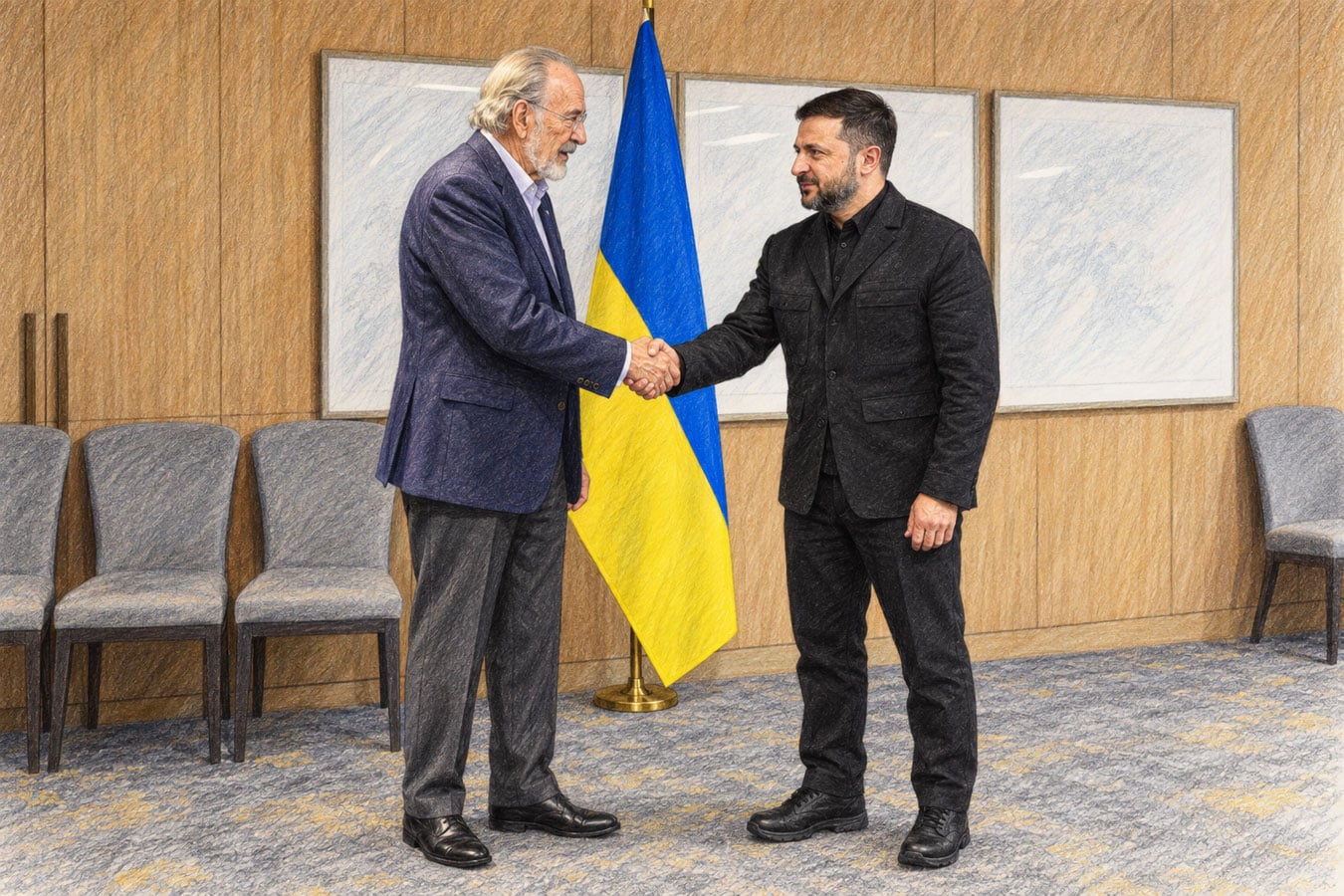
From Donbas to Jerusalem: Why Zelensky Thanked James Temerty. The image was created using AI.
On September 11, President Volodymyr Zelensky met in Toronto with Canadian entrepreneur and philanthropist James Temerty. Zelensky thanked him for his long-standing support for Ukrainians and spoke about one of Ukraine’s most urgent problems today: daily Russian air attacks, their impact on civilian life, and the need to keep Ukraine in the focus of international attention.
For many Israelis, the name James Temerty may not yet be familiar. Yet part of his story is already physically present in Jerusalem, between the Knesset and the Supreme Court.
Temerty was born in Donbas in 1941. His family history was marked by the Holodomor, Stalinist repression and the upheavals of World War II. The family eventually settled in Canada, where Temerty later built a remarkable business career — first in technology and then in energy.
He worked for IBM, developed ComputerLand in Canada and in 1987 founded Northland Power, which grew into a major international energy company.
Together with his wife Louise, he created the Temerty Foundation. The scale of their philanthropy is substantial: in 2020, James and Louise Temerty and their foundation donated C$250 million to the University of Toronto. Its medical faculty now bears the Temerty name.
But Ukraine had been part of Temerty’s work long before Russia’s full-scale invasion.
He supported Ukrainian education, Kyiv-Mohyla Academy, Holodomor research, community institutions and cultural projects. After February 2022, much of that support naturally became more practical: generators, humanitarian assistance, help for students and academics, and reconstruction.
According to the Office of the President of Ukraine, Temerty provided $500,000 through the Olena Zelenska Foundation for generators, critical infrastructure and assistance in liberated areas of the Kharkiv region, and donated $1 million toward rebuilding a children’s creative and sports center destroyed in Borodyanka.
In August 2025, Zelensky presented him with the National Legend of Ukraine award.
For an Israeli reader, however, another part of Temerty’s biography may be even more interesting.
The Ukrainian-Jewish conversation
James Temerty is one of the founders and a major supporter of Ukrainian Jewish Encounter, or UJE.
The initiative grew out of discussions in 2007–2008 involving Temerty, historian Alti Rodal, Berel Rodal and Adrian Karatnycky.
The idea behind the project was both simple and difficult: Ukrainians and Jews had lived on the same land for centuries, but they often inherited very different memories of that shared history.
For Jewish collective memory, central subjects include pogroms, antisemitism, the Holocaust and the destruction of the enormous Jewish world that once existed across Ukraine and Eastern Europe.
For Ukrainian memory, the Holodomor, Stalinist terror, Soviet repression, the destruction of the Ukrainian intelligentsia and the struggle for statehood occupy an equally important place.
These histories overlap, but they are not identical. The same historical figure or period can still produce completely different reactions in Ukrainian and Jewish communities.
Ukrainian Jewish Encounter did not try to solve this by creating a comfortable version of history in which nobody had anything to answer for.
Its approach was different: bring historians, researchers and community figures together, examine documents, acknowledge difficult episodes and try to build a conversation based on facts rather than inherited stereotypes.
I have followed Ukrainian Jewish Encounter for many years.
I am an Israeli of Ukrainian origin, and much of my own work at NAnews is connected with Israel, Ukraine and Ukrainian-Jewish relations. UJE publications have sometimes become a starting point for my own articles: I take a subject, look for additional sources, check the details and then try to explain it to a broader audience.
I do not pretend to be an academic historian. My work is closer to popular history and public education. A complicated subject should be researched seriously, but it should also be understandable to people who do not have a degree in history.
This is especially important with Ukrainian-Jewish history. When complicated subjects remain only inside universities and academic conferences, the empty space is very quickly filled by propaganda, myths and political manipulation.
Israel was never a side issue
The Israeli connection to this work did not appear after 2022.
Ukrainian Jewish Encounter has worked with Israeli scholars and institutions for many years. Conferences and discussions have addressed Ukrainian-Jewish cultural interaction, historical memory, the Holocaust and the role of Ukrainians who saved Jews.
One particularly complicated subject is Metropolitan Andrey Sheptytsky, head of the Ukrainian Greek Catholic Church during World War II.
Sheptytsky helped save Jews during the Nazi occupation, although Yad Vashem has never recognized him as Righteous Among the Nations.
Temerty was among those who worked to bring greater international attention to Sheptytsky’s actions. In 2013, the Jewish Confederation of Ukraine made Temerty the first recipient of the Metropolitan Andrey Sheptytsky Medal, created to recognize contributions to Ukrainian-Jewish understanding and cooperation.
This is an important detail.
Temerty’s involvement with Ukraine was never simply about financial assistance.
He also invested in the much more difficult work of dealing with history.
Then the story reached Jerusalem
In December 2025, Israel’s first monument dedicated to the victims of the Holodomor was officially opened in Jerusalem’s Wohl Rose Garden, between the Knesset and the Supreme Court.
The Temerty Foundation was among the organizations involved in the project.
I wrote in more detail about the monument and the people behind it in NAnews:
The first monument to the victims of the Holodomor of 1932–1933 in Ukraine was erected in Jerusalem — what is known?
One of the monument’s creators was Ludmilla Temertey, James Temerty’s sister, together with sculptor David Robinson.
That family connection changes the meaning of the Jerusalem memorial.
For the Temertey family, the Holodomor and Soviet repression were not distant chapters in a history book. Their own family history was shaped by that world.
Decades later, part of this memory received a permanent place near Israel’s parliament.
I have also written separately about the long and complicated history of Israel’s attitude toward recognition of the Holodomor:
History of Israel’s recognition of the Holodomor of 1932–1933 in Ukraine as genocide of the Ukrainian people
For me, this is where the story stops being simply Canadian or Ukrainian.
A man born in Donbas becomes one of Canada’s most successful entrepreneurs. His philanthropy supports Ukrainian education and historical research. He helps build an international organization devoted to dialogue between Ukrainians and Jews. His foundation later participates in bringing the memory of the Holodomor into Jerusalem itself.
Ukraine, Canada, Jewish history and Israel meet in the same biography.
What changed after 2022
Russia’s full-scale invasion added another dimension.
Temerty’s philanthropy began dealing not only with history, education and memory, but also with immediate survival.
Generators help hospitals continue working during blackouts. Educational programs help students and academics continue their work. Reconstruction projects return something to communities destroyed by war.
This also explains why Zelensky’s conversation with Temerty in Toronto focused on Russian air strikes.
A private philanthropist cannot provide a country with a national air-defense system. But Temerty has spent decades doing something that governments often struggle to do consistently: turning broad declarations of support into institutions, programs, buildings and practical assistance.
There is a connection between all of these things.
A university program preserves students and researchers.
A generator keeps a hospital functioning.
A historical project preserves evidence.
A dialogue initiative forces communities to confront difficult memories.
A monument ensures that a tragedy does not disappear into a footnote.
They may look like very different projects, but in many ways they are investments in continuity.
Why Israelis should know his name
Relations between Israel and Ukraine are often discussed here through the politics of the current week: Israeli votes at international organizations, Ukrainian statements, Russia, Iran, weapons, diplomatic disagreements and whatever argument happens to be exploding on social media.
Those issues matter.
But they are only one layer.
The relationship between Ukrainians and Jews is centuries old, emotionally complicated and full of both shared life and profound trauma. It cannot be understood through today’s political headlines alone.
James Temerty’s story is interesting precisely because it connects these different layers.
His family came from Ukraine and carried the memory of Soviet repression. He built his life in Canada. He invested heavily in medicine and education. He helped turn Ukrainian-Jewish dialogue into a permanent international project. His foundation supported practical assistance for Ukraine during the war.
And in Jerusalem, a monument created with the participation of his own family now stands only a short distance from the Knesset.
I recently wrote a more detailed profile of Temerty, his Ukrainian roots, philanthropy, support for Ukraine and connection to Israel:
So the photograph of Zelensky and Temerty in Toronto is not simply another meeting between a Ukrainian president and a wealthy member of the Ukrainian diaspora.
It is a meeting with a man who has spent decades investing in Ukraine, historical memory and the difficult conversation between Ukrainians and Jews.
Part of the bridge James Temerty helped build already stands in Israel.
Related Topics