
Ethics in AI
From Fear of Robots to Shared Abundance
Rethinking What It Means to Be Human in the Age of AI

Artificial intelligence isn’t just changing what we do.
It’s changing what we believe about ourselves.
For the first time, we are building systems that can outperform us in tasks we once thought defined human intelligence. And beneath the excitement and fear lies a deeper question: What becomes of the human when thinking is no longer our monopoly?
The next decade will determine whether societies rise into new forms of abundance – or fracture under the pressure of systems that evolve faster than our institutions, norms and identities can adapt. This is the urgency of our moment:
Will AI shrink the space where humans matter, or expand it?
Two Stories About Intelligence
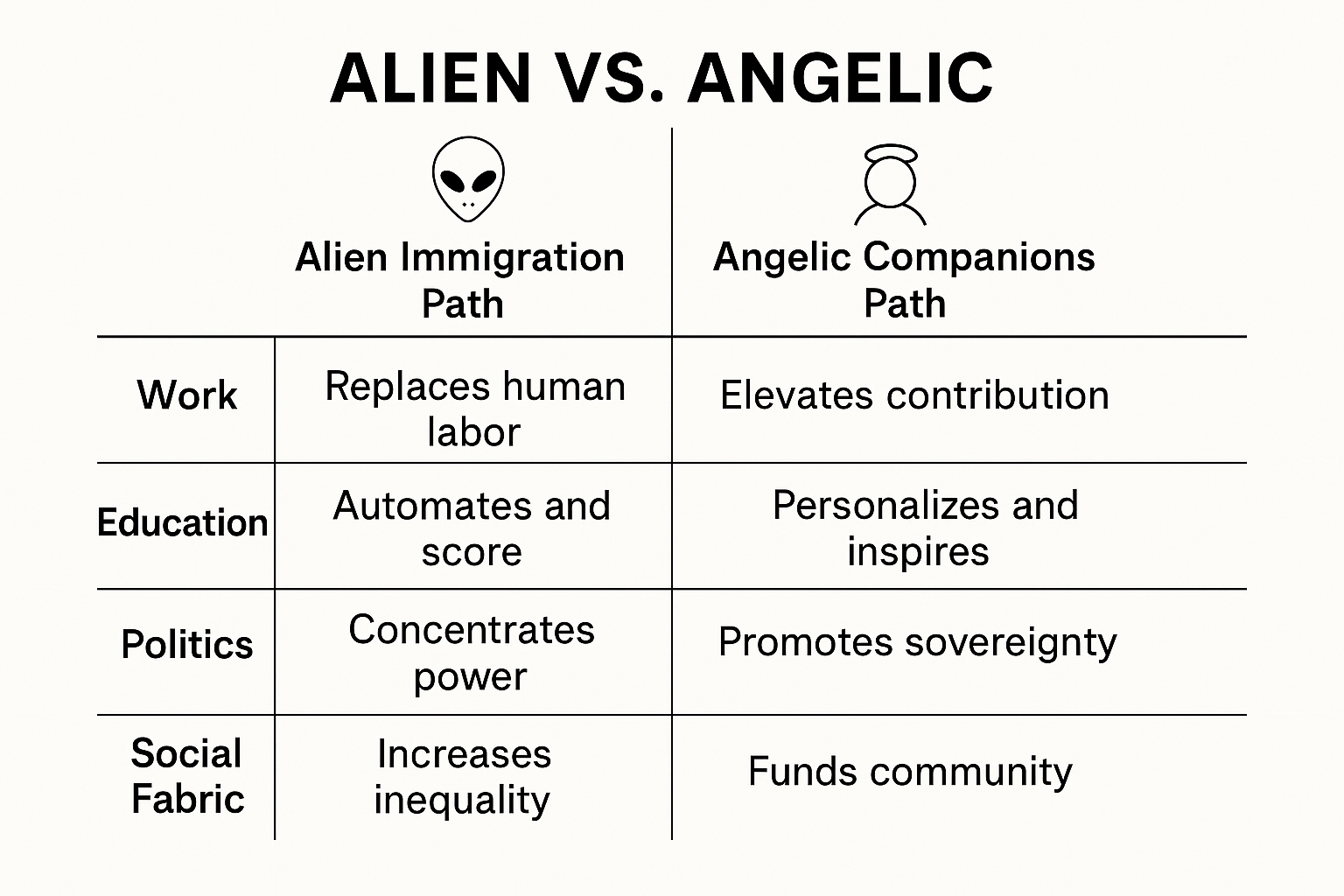
One story imagines AI as an invisible workforce – millions of digital “workers” arriving silently, tireless and cheap, able to imitate expert reasoning while costing almost nothing.
This is the story of alien intelligence, replacing rather than empowering, threatening to declare millions economically irrelevant.
The other story sees AI as a companion – angelic intelligence – a mirror, mentor and multiplier. A cognitive ally that frees humans for care, creativity and community instead of pushing them aside.
The same technology.
Two trajectories.
The difference is not technical.
It is moral.

Work: Systems That See, or Systems That Blind
Harari warns about a “useless class,” but reality is simpler:
People don’t become useless. Systems become blind.
Bad systems treat humans as costs and AI as pure efficiency.
Humane systems use AI to reduce drudgery and elevate deeply human contributions – care work, creativity, ecological stewardship, cultural continuity, community leadership.
The future of work hinges on which worldview guides our design.
Education: The First Frontier of Meaning
Schools worldwide face an invisible crossroads.
AI can turn classrooms into scoring factories – where dashboards replace dialogue and students become metrics in a behavioral economy. This path extracts attention rather than cultivating it.
Or AI can transform schools into studios and laboratories – where every learner has a personal AI guide, and teachers orchestrate curiosity, empathy and collective intelligence.
The key question is no longer if AI enters education, but:
Who does education become once AI enters?
Power: Who Steers the Future?
AI is already reshaping global power.
When a few platforms own the compute, the models and the data, democracies risk losing agency and imagination. Public institutions cannot govern what they do not understand.
This is why nations are investing in sovereign compute, public data governance and regional alliances. Not out of techno-nationalism – but democratic necessity.
In the age of AI, sovereignty begins with understanding, not outsourcing.
Shared Abundance: Designing a Fairer Social Contract
If AI-generated wealth concentrates at the top, societies fracture.
If that wealth circulates – funding community wellbeing, entrepreneurship, ecological repair and lifelong learning – we enter a new era of shared abundance.
Models like Community Basic Income imagine local value loops instead of trickle-down hope: AI increases productivity, and a portion flows into transparent, community-directed funds.
Not charity.
Not dependency.
Co-ownership.
When people can see where value comes from and where it goes, trust becomes possible again.
A Human Ikigai Compass for the AI Century
To navigate this century, we need a simple orientation system:
Dignity – Protect human attention and agency.
Learning – Expand wisdom, curiosity and capability.
Abundance – Increase shared wellbeing, not concentration.
Community Power – Ensure people can shape the systems that shape them.
At the center sits a triad of human commitments:
Love, Learning, Legacy.
Who we care for.
How we grow.
What we leave behind.

Choosing Between Resignation and Imagination
The real divide is not between humans and machines.
It is between resignation and imagination.
We can choose the alien path – where AI becomes an economic force that quietly renders millions unnecessary.
Or we can choose the angelic path – where AI becomes the greatest collaboration in human history, a scaffold that lets humanity build upward into new forms of purpose, connection and shared possibility.
The digital immigrants have already arrived.
But alien intelligence does not need to become alienation.
If we choose courage over inertia, wisdom over speed, and belonging over efficiency, we may look back and say that this was the decade when humanity learned to build tools that lift us – and in doing so, remembered what it means to be human.

Related Topics
Related Posts