
From Fear to Fixes: Why Israel Needs a Tikun Party
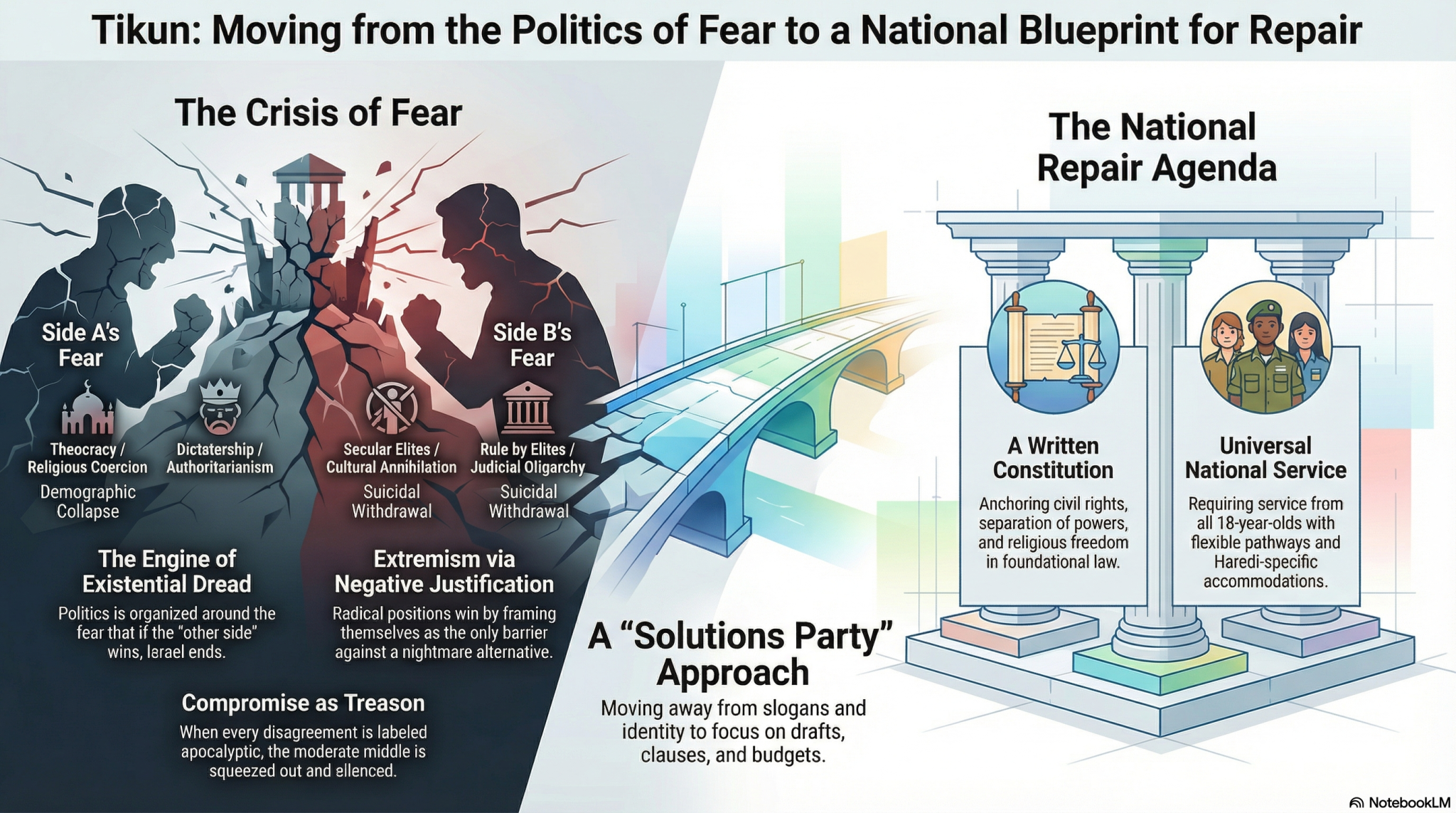
Israeli politics increasingly feels like a permanent emergency drill — not only because of rockets, hostages, or borders, but because our public arguments are built around a darker assumption: if the other side wins, Israel as we know it ends.
This fear has become the engine of our politics.
Not hope.
Not vision.
Not solutions.
Just dread.
One camp warns that religious influence will turn Israel into a theocracy.
The other warns that secular elites are dismantling Jewish civilization.
One side says judicial reform is essential or courts will rule forever.
The other says judicial reform means dictatorship.
One side fears demographic collapse.
The other fears cultural annihilation.
Every argument becomes existential. Every disagreement becomes apocalyptic.
And once politics is organized around apocalypse, compromise becomes treason.
Extremism survives by negative justification
Most extreme positions don’t win because people are persuaded by their positive merits. They win because they construct a nightmare alternative and present themselves as the only barrier against it.
- Religious maximalism is justified because the alternative is “total secularism.”
- Total secularism is justified because the alternative is “religious coercion.”
- Judicial overhaul is justified because the alternative is “rule by elites.”
- Blocking all reform is justified because the alternative is “authoritarianism.”
- Harsh anti-Haredi policies are justified because “they’ll be the majority in 20 years.”
- Total Haredi exemption is justified because “the state wants to destroy Torah.”
Each side says, in effect:
“My position may be flawed, but the other side is catastrophic.”
This is not moral reasoning.
It is hostage negotiation with fear.
The center exists — but fear starves it
Most Israelis actually hold mixed, moderate, workable views:
- Jewish public culture without religious coercion
- Judicial reform without gutting checks and balances
- Broad participation in national service with serious accommodations
- A secure Jewish state without permanent occupation or permanent war
- Strong identity and equal citizenship
But moderation doesn’t mobilize well.
Fear mobilizes.
So the middle gets squeezed not because it lacks ideas, but because it refuses to demonize.
A Call to Action: Build a Tikun Party (תיקון)
Tikun means repair. Not perfection. Not utopia. Repair.
Israel does not need another identity party.
It does not need another “against” party.
Israel needs a Solutions Party whose sole organizing principle is:
If an issue is tearing the country apart, we produce a concrete, legislated solution.
Not slogans.
Not vibes.
Bills.
Core Platform: National Repair Agenda
1. A Written Constitution
Israel cannot survive indefinitely with vague Basic Laws and ad-hoc power struggles.
A constitution should:
- Define separation of powers
- Anchor civil rights and minority protections
- Clarify judicial review limits and standards
- Establish formal amendment procedures
- Guarantee religious freedom and freedom from coercion
Not left-wing.
Not right-wing.
Foundational.
2. Universal National Service Law
Universal service is not punishment.
It is membership.
Every citizen at 18 must choose one of:
- IDF combat
- IDF support
- Civil defense
- Emergency medicine
- Education
- Welfare and disability services
- Community security
Haredi accommodations:
- Gender-separated frameworks
- Strict kosher and modesty standards
- Torah-study tracks combined with shortened service
- Non-combat options scaled nationally
Sanctions for non-participation:
- No draft dodging
- Loss of state stipends
- No public-sector employment eligibility
Equal obligation. Flexible pathways.
3. Hostages First Law
The return of hostages is elevated to a binding national priority.
- Cabinet must publish quarterly strategy reports
- Independent oversight committee
- Dedicated budget line
- Clear operational doctrine balancing military pressure and negotiations
Not a slogan.
A statutory obligation.
4. West Bank Governance Framework
End permanent ambiguity.
- Israeli civil law applies to settlers
- Palestinian civil administration strengthened
- Freeze on new outposts
- Infrastructure separation where necessary
- Long-term negotiation mandate with internationally backed parameters
No fantasies.
No annexationism.
No withdrawal illusions.
Management with horizon.
5. Gaza Post-War Authority Plan
Before the next war ends:
- Multinational Arab-led civil authority
- No Hamas governance
- Israeli security freedom of action
- Massive international reconstruction tied to demilitarization
Security first.
Civilians second.
Extremists last.
6. Religion and State Settlement
- Civil marriage and divorce
- Public transportation on Shabbat at municipal option
- National kashrut standards with private competition
- Guaranteed funding for pluralistic Jewish education
- Protection of Orthodox autonomy in their institutions
Live and let live — legally.
7. Education for Shared Citizenship
Mandatory curriculum for all schools:
- Hebrew
- English
- Math
- Civics
- Jewish history
- Democratic values
State funding conditioned on compliance.
No more parallel societies.
What makes the Tikun Party different
It does not ask:
“Which side are you on?”
It asks:
“What problem are you trying to solve?”
It does not trade in apocalypse.
It trades in drafts, clauses, budgets, and votes.
It does not promise paradise.
It promises progress.
The choice Israelis actually face
Not:
- Theocracy vs. secular annihilation
- Dictatorship vs. judicial oligarchy
- Messianic annexation vs. suicidal withdrawal
But:
Fear politics or repair politics.
Israel was built by people who argued fiercely — and still compromised.
They did not wait for perfect partners.
They did not demand ideological purity.
They built anyway.
That spirit is not dead.
It is politically homeless.
Let’s give it a home.
Not a party of Left.
Not a party of Right.
A party of Tikun.