
Foreign Policy Analyst | India, Israel & Middle East
From Gaza to Starlink: The New Strategic Message Behind Netanyahu’s UN Speech
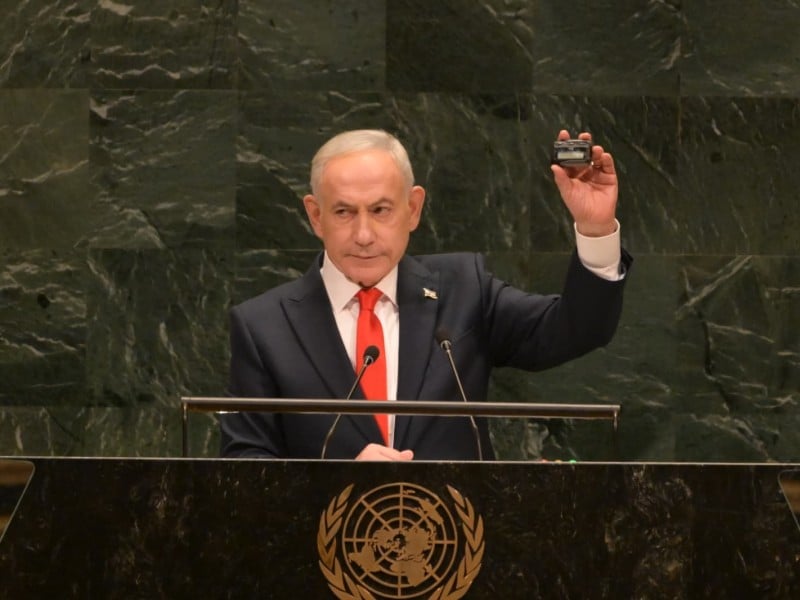
Prime Minister Benjamin Netanyahu addresses the 81st session of the United Nations General Assembly at UN headquarters in New York City, September 24, 2026. (Israel Prime Minister's Office)
There are UN speeches designed primarily for diplomacy, and there are speeches intended to establish a doctrine. Benjamin Netanyahu’s address to the 81st General Assembly on September 24 belonged to the second category. Its significance lay less in its confrontational tone than in the strategic architecture of the argument. Netanyahu presented Israel’s conflict not simply as a war against Hamas, Hezbollah or Iran, but as part of a much broader struggle over Israel’s survival, the future of the Middle East, and, ultimately, the values of the wider democratic world. He also argued that Israel increasingly finds itself confronting these threats with insufficient international support. The speech therefore functioned less as an appeal to the UN than as an attempt to redefine the strategic context in which Israel expects to operate.
From Territory to Indigeneity
One of the most consequential parts of the speech was Netanyahu’s return to the 1967 Six-Day War. His argument was straightforward but strategically important. On the eve of the war, Israel did not control the West Bank, Gaza, or the Golan Heights, yet he argued that the country still faced a threat to its very survival. From this historical reference, Netanyahu sought to challenge the idea that the Israeli-Palestinian conflict can be explained primarily through the question of territory. He instead presented it as a deeper dispute over the existence and legitimacy of a Jewish state.
That framing represents an important shift in emphasis. For years, Israel’s international argument often centred on security, borders and the need for defensible territory. Netanyahu’s speech placed greater weight on Jewish historical connection and indigeneity. His references to biblical history, the Jewish presence in the land, and Mark Twain were therefore not simply rhetorical additions. They formed part of a broader effort to establish historical legitimacy alongside the traditional security argument. Whether one accepts that framing or not, it indicates how Israel is increasingly seeking to contest the intellectual foundations of arguments portraying the state primarily through the lens of colonialism and occupation.
The Starlink Moment
The most unconventional moment of the speech came when Netanyahu held up a Starlink communications device while addressing the Iranian people. He argued that the Iranian regime fears its population and presented unrestricted access to information as a strategic vulnerability for Tehran. He then directly predicted that the Iranian regime would eventually fall.
The importance of the moment extends beyond the symbolism of the device. It demonstrated that Israel’s confrontation with Iran is being framed not only around missiles, nuclear capabilities, and military infrastructure but also around information access and political legitimacy. Netanyahu was effectively speaking past the Iranian government and directly to its population. That is a different form of strategic communication from traditional state-to-state signaling.
It would be premature, however, to describe this as a fully developed Israeli regime change strategy solely based on one speech. What can be said with greater confidence is that Netanyahu publicly connected technology, information freedom, and political change in Iran. The Starlink episode therefore offered a glimpse into how information operations could become an increasingly important component of the broader confrontation with Tehran.
The Eighth Front
Netanyahu’s description of an “eighth front” was perhaps the clearest doctrinal element of the speech. After describing Israel as fighting a seven front war, he identified a separate battlefield for truth, located primarily in international media and social media. He specifically accused Qatar and Turkey of contributing to what he described as an international campaign against Israel.
This is significant because it shows that Israel increasingly treats the information environment as part of national security rather than as a secondary diplomatic problem. Military operations can destroy infrastructure and degrade armed groups, but they do not automatically determine how those operations are interpreted internationally. In a prolonged conflict, legitimacy, public opinion and access to information can influence diplomatic support, sanctions, military partnerships and domestic political resilience.
The references to Qatar and Turkey also reflected a broader Israeli concern with actors that occupy complicated positions within the regional order. Netanyahu’s criticism of Turkey was particularly significant because Ankara is simultaneously a NATO member and an increasingly assertive regional actor. His decision to place Turkey within the same narrative framework as Qatar demonstrates how Israel is widening its conception of the political environment surrounding the conflict.
The Warning to the West
Another important theme was Netanyahu’s criticism of Western governments and the international response to Israel. His argument was that Israel cannot assume that traditional diplomatic partners will consistently support its security position. The practical implication is a greater emphasis on strategic self reliance.
This does not necessarily mean that Israel is abandoning its Western alliances. In fact, Netanyahu explicitly presented Israel and the United States as having fought together against Iran and described their cooperation as part of a broader effort to protect what he called civilisation. What is changing is the degree to which Israel appears willing to distinguish between military cooperation with major allies and political dependence on international institutions.
That distinction matters. Israel can remain deeply integrated with the United States and other Western partners while simultaneously becoming more skeptical of multilateral institutions. Netanyahu’s speech reflected precisely that tension. The UN remains an important platform, but the speech treated it less as an institution capable of resolving Israel’s security problems and more as a venue in which Israel would contest the narrative surrounding them.
What Comes Next
The broader significance of Netanyahu’s speech lies in the way these themes fit together. The historical argument about Jewish indigeneity, the direct appeal to Iranians through Starlink, the identification of information warfare as an eighth front and the criticism of Western political responses are not isolated elements. Together they suggest a more expansive conception of national security in which territory, military power, information, historical legitimacy and international diplomacy are increasingly interconnected.
The Iran component may prove particularly important. Netanyahu did not merely describe Iran as a military threat. He presented the Iranian population as a potential force for political transformation and explicitly predicted the eventual fall of the regime. At the same time, his emphasis on information access suggests that future competition with Tehran could increasingly involve communications infrastructure, digital influence and efforts to shape public perceptions alongside conventional military pressure.
The speech therefore deserves to be read less as another confrontational appearance at the UN and more as a statement about how Israel understands the changing character of its war. Netanyahu’s central message was that Israel cannot separate military security from the information environment, historical legitimacy and the international political order. The battlefield, in this conception, extends from Gaza and Iran to social media, diplomatic institutions and the perceptions of foreign publics.
That may ultimately be the most important takeaway from the address. Israel is no longer presenting its security challenge solely as a series of regional conflicts. Netanyahu is attempting to frame it as a prolonged struggle over Israel’s ability to define its own security, defend its legitimacy and shape the strategic environment around it. Whether that framing succeeds internationally remains contested, but the speech made clear that Jerusalem intends to fight that battle on multiple fronts rather than leave the narrative space to its adversaries.
Related Topics
Related Posts