
From Getaway to Gateway: When Jewish Travel Becomes a Journey
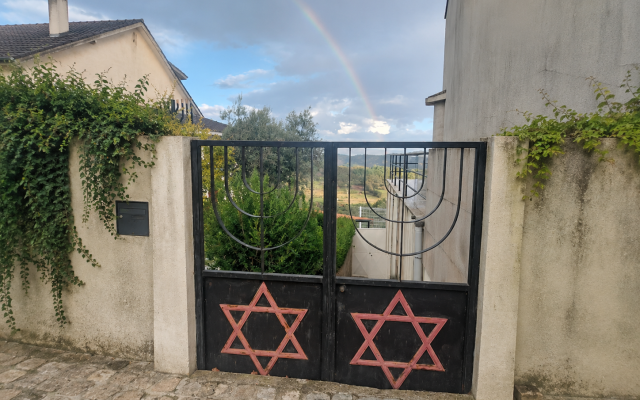
There is a moment on every journey when ordinary life begins to loosen its grip.
Packing, getting to the airport, checking in, and navigating security lines can be hectic and stressful even in the best of circumstances. For me, there is a distinct moment when my travel tension fades. Once I am onboard, settled into my seat, and organized for the flight ahead, I usually fall asleep as the plane takes off. I like to think it is my body’s way of recognizing the transition: ordinary life begins to relax its hold, and the journey truly begins.
For you, that moment may arrive while gazing out an airplane window at the world below. It may come during a long train ride through unfamiliar countryside, or when you hear the creak and lock of landing gear and the pilot announces, “Welcome to…” Whenever it happens, emails become less urgent. Meetings fade into the background. The demands of work, family, and communal responsibility begin to recede.
Most of us travel seeking exactly that feeling of diversion. We want rest. We want good food, beautiful views, and a temporary escape from routine. Rest and relaxation are important and well-deserved. Genuine vacations are essential.
Jewish experiential travel offers the possibility of something more than vacation. When a journey inspires us to see ourselves and our place in the Jewish story differently than we did when we set out, it ceases to be merely a getaway. Meaningful Jewish travel can become a gateway: an invitation to discover ourselves as participants in the unfolding story of our global and ancient people.
And when we return home, the journey does not end. The memories, encounters, and questions we carry back become part of how we understand ourselves, our communities, and our place within that larger story. They remind us that these Jewish experiences are ours, too.
Jewish travel offers an invitation to move beyond the familiar boundaries of our own communities through direct encounters with the Jewish past and present. These journeys are opportunities for Jewish remembering and reimagining. Places that initially seem foreign become mirrors, reflecting our own contemporary questions, challenges, and aspirations. Meaningful Jewish travel offers an experience where the “I” reaffirms solidarity with the “We.”
On the Ground
What does this look like in practice? What can I share from my own professional and personal experience? Over the past several years, I have had the privilege of accompanying American Jewish groups—adults, students, rabbis, educators, and community leaders—across Europe. From Berlin to Budapest, Porto to Prague, and Kraków to Córdoba, my J2 Adventures colleagues have also journeyed beyond Europe—to Morocco, Mexico, and Argentina. Together, we have witnessed how travel can transform sightseeing into something deeper.
Standing where generations of Jews lived, flourished, struggled, and dreamed encourages us to think differently about our own place in the Jewish story. We encounter a fuller spectrum of Jewish experience and discover how seemingly distant places and periods remain connected to the questions we face today.
What can we learn from the women who faithfully sustained Portugal’s underground Converso, secret communities? How do the mountaintop monasteries of Greece’s Meteora illuminate centuries of connection and separation between Judaism and Christianity? Standing outside the Dohány Synagogue of Budapest—a neo-Moorish monument to the nineteenth-century dream of emancipation and enlightenment—we are likely to be reminded of our own synagogues in New York, Cincinnati, or Denver, as well as our own questions about Jewish golden ages then, now, and tomorrow.
Unexpected Gifts
One of the gifts of Jewish travel is the opportunity to encounter Jewish life in unexpected places and forms. We sometimes carry assumptions about what Judaism looks like, where it belongs, and how it should be expressed. History tells a more complicated story. Sometimes, only by standing in a particular place do we discover an unexpected connection or stumble upon an insight we did not know we were seeking.
To my mind, some of the most transformative moments in Jewish travel occur when new interpretations and perspectives quietly enter the journey where travelers least expect them. A vineyard can become a classroom. A palace can be reimagined as a commentary on Jewish memory. Peoplehood becomes the main course in a shared meal with a community in Berlin or Porto. In such moments, familiar assumptions loosen their grip, making room for a broader understanding of Judaism, Jewishness, and our place within the larger human story.
Across centuries and continents, Jews have lived in vastly different circumstances and created distinctive religious, cultural, intellectual, and communal worlds. The Jewish experience cannot be confined to a single geography, institution, ideology, or expression. It is a tapestry woven from countless encounters between Jewish tradition and the societies in which Jews have lived.
Although their histories differ from those of most American Jews, encounters with unique communities—such as the Amazigh Jews of the Atlas Mountains or the ancient Romaniote Jews of Greece—remind us that our own way of Jewish living is only one facet of the diamond that makes up the Jewish experience. These encounters also remind us that Jewish history is never simply about the past. It is about how we understand ourselves in the present.
Travel allows us to glimpse that richness firsthand. Places that at first seem peripheral to our Jewish stories often reveal themselves to be deeply connected. As the strange becomes familiar, new insight deepens our understanding of Judaism and Jewishness—not by abandoning what we know, but by seeing it within a larger and more diverse chronicle.
Finding Jewish Spain in a Glass of Wine
One of the most enjoyable moments on any trip to Spain is a visit to a winery. After days spent exploring synagogues, medieval Jewish quarters, cemeteries, and museums, an afternoon among vineyards offers a welcome change of pace. At first, it may seem like a simple cultural outing—a chance to enjoy the landscape, sample local wines, and rest. Whether the wine is kosher or not; the winery visit can also be an exercise in Jewish remembering and discovery.
When visiting a Spanish winery, I bring along selections of medieval Hebrew poetry in English translation. These are not liturgical texts. They are poems celebrating wine, friendship, love, longing, beauty, and the pleasures of life. Verses describe the joy of a feast. Others admire a beautiful stranger across the room. Still others reflect on battles won and lost, triumph and heartbreak.
I also share selections from the music of Etti Ankri, Berry Sakharof, and Yasmin Levy. These modern musicians and performers keep alive today, in Hebrew and Ladino, the voices of poets and singers who chanted and sang in medieval Jewish al-Andalus.
Many travelers are surprised by these poems. It is common among Jews and non-Jews alike to picture Jewish history primarily as a tale of persecution, suffering, and survival. Those experiences are certainly part of our story. But they are not the entirety of it.
The Hebrew poets of medieval Spain remind us of a Jewish world that was intellectually confident, culturally creative, and deeply engaged with the society around it. Drawing inspiration from Arabic language and Islamic literary traditions, Jewish poets crafted works that celebrated the fullness of human experience. Their poetry spoke not only of theology and faith, but also of friendship, longing, beauty, and joy.
Whether or not we choose to call medieval Spain an actual “Golden Age,” these poems open a window onto a remarkable period of Jewish creativity and cultural exchange. Reading them together over a carafe of Spanish wine does more than illuminate the past. It expands our understanding of what Jewish life has been—and what it can be.
In moments like these, the winery becomes more than a stop on an itinerary. It becomes another gateway, reminding us that our heritage includes not only memory and mourning, but also celebration, imagination, and delight.
Glasses in hand, we raise a toast to those Hebrew poets—Shmuel HaNagid, Shlomo Ibn Gabirol, and Moshe Ibn Ezra. We evoke the spirit of their confidence and pride when we recall HaNagid’s salute to the fruit of the vine: “Red in aspect, sweet in taste… faint in the cup and strong in the head.”
The Living Mirror: Encountering Modern Communities
Beyond history, these journeys bring us into direct contact with contemporary Jewish life around the world. For American Jewish travelers, such encounters transform the idea of Jewish peoplehood from an abstract concept into a lived experience.
We discover this while studying Torah with a young woman rabbi at the Comunidad Judía Reformista de Madrid. We experience it when singing at Friday night dinner with Budapest’s Neolog community at the “hidden” Frankel Synagogue and realizing that some of the melodies familiar from home are familiar there as well. We encounter it when meeting with Hillel student activists in Berlin as they navigate Jewish identity in post–October 7 Germany and share their thoughts and feelings.
In these moments, theories of global Jewish partnership give way to something more powerful: face-to-face relationships. A shared prayer, a Shabbat meal, a conversation about communal challenges, or the simple recognition of familiar melodies and common concerns reminds us that Jewish peoplehood is not a theoretical construct. It is a lived connection—one we carry home in our memories and share in the stories we tell about the journey.
Returning Home: The True Destination
None of this is meant to diminish the value of the getaway. Rest, enjoyment, discovery, and recreation are worthy goals. They are part of what makes travel restorative and necessary.
But the most meaningful Jewish journeys point us toward something beyond the destination itself.
As travel professionals, educators, guides, rabbis, and communal leaders, our task is not merely to share information or facilitate memorable experiences. It is to create opportunities for encounter—with places, ideas, communities, and ourselves.
The number of sites visited or facts learned does not determine the value of the journey. Often, a journey begins to flower only after we return home, when time provides perspective and space for reflection.
When Jewish travel succeeds, the journey continues long after suitcases are unpacked. Conversations begun abroad find their way into congregations, classrooms, board meetings, and family tables. Questions grow into commitments. Encounters become opportunities for deeper involvement in Jewish life.
The real destination is not Europe, Morocco, Argentina, or Mexico. The real destination is home—returned to with fresh eyes, renewed relationships, and a deeper appreciation of our place within the unfolding life of the Jewish people.
Jewish travel reminds us that we are not merely inheritors of a history. We are choosing participants in an ongoing story. The purpose of the journey is not to relegate Jewish experience to museums, monuments, and memory, but to encourage us to become active contributors to that experience ourselves.
A getaway offers distance from daily life. A gateway invites us to return home from a journey of meaning with renewed purpose.
–
Hit Follow at the top of the page to keep up-to-date with my blog and with this ongoing series on Jewish experiential travel. Stay tuned.