From Jerusalem via the Judean Desert to the Dead Sea: Turning Sewage into Energy
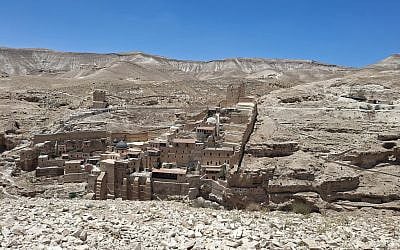
Image: Mar Saba Monastery overlooking the Kidron Valley in the Judean Desert. Mar Saba, founded approximately 1,500 years ago, is considered the oldest continuously inhabited monastery in the world. The monastery was visited by Pope Paul VI in 1964, when the Vatican returned the remains of its founder, Saint Sabbas. Today, monks and pilgrims visiting the monastery are already benefiting from the significant reduction in odors and sewage pollution that affected the area for decades. Photo source: Rafi Glick, photographed during a tour of the area last week.
From Sewage to Energy: The Restoration of the Kidron Valley Brings Life Back to the Desert.
About eight years ago, a capstone project I supervised at the Faculty of Management at Ben-Gurion University won first prize in the university’s “Green Campus” competition.
The project, titled “Ecological Wastewater Treatment – How to Turn Sewage from a Nuisance into a Resource,” explored the environmental, engineering and economic aspects of transforming wastewater into a source of energy, sustainability and regional development.
At the time, some of the ideas appeared ambitious and naturally raised questions regarding their engineering and economic feasibility.
This week, during a visit to the Kidron Valley area in the Judean Desert, I had the opportunity to see how some of these concepts are now being implemented in practice as part of the “Restoration of the Kidron Stream” project.
One of the most fascinating components of the project is located at the Og Wastewater Treatment Plant in the northern Judean Desert, where a unique hydroelectric turbine has been installed to generate electricity from the wastewater flow descending from the Jerusalem area toward Jericho and the Dead Sea.
The system utilizes the dramatic elevation differences between the Jerusalem hills and the Jordan Valley, allowing the facility to operate with energy independence and without consuming electricity from Israel’s national power grid.
During a recent professional tour conducted by Israel’s Water Authority management, project teams presented the progress achieved so far, the engineering challenges involved, and the new hydroelectric systems designed to generate energy from wastewater flow.
The tour reviewed the restoration work along the Kidron Stream, where sewage is intercepted through dedicated collection systems and transferred via sewage collectors to treatment facilities in the Horkania Valley area.
Project planners described several complex engineering challenges, including:
Constructing interception facilities,
Transporting wastewater through changing desert topography,
and excavating a tunnel beneath the cliffs of the ancient Mar Saba Monastery.
The project combines advanced environmental engineering, ecological restoration, heritage preservation and regional cooperation.
Despite the political complexities of recent years, the Kidron restoration project is also being carried out in cooperation with the Palestinian Authority — demonstrating how issues related to water, environment and infrastructure can sometimes connect different sides even during difficult periods.
Today, for the first time in decades, large sections of the Kidron streambed are free of sewage pollution.
Beyond its environmental importance, the project demonstrates how water infrastructure, renewable energy and long-term strategic thinking can transform an ongoing environmental hazard into a driver of sustainability and regional development.
The restoration of the Kidron Valley is far more than an infrastructure project.
It serves as a reminder that even in a complex region such as the Middle East, water, energy and environmental restoration can become a bridge between past, present and future.
“And the waters shall be healed.” (Ezekiel 47).
About the Author
Rafi Glick is a writer, lecturer, farmer, and business executive with decades of experience at the intersection of academia, technology, agriculture, and international trade.
• He has served as a Senior Teaching Associate at Ben-Gurion University of the Negev, Ono Academic College, Ariel University, Ruppin Academic Center, and as a guest lecturer at Sofia University’s Faculty of Economics and Business Administration (FEBA). At Ben-Gurion University he also advised the BGU–NHSA Accelerator in the Faculty of Science.
• In business, Rafi was CEO of Bidsnet Ltd., a pioneer in deploying fiber-optic cables through unconventional infrastructure (in partnership with CableRunner), delivering high-speed connectivity to homes, enterprises, institutions, and cellular networks. Earlier he held senior roles at ECI Telecom and served on the board of RLF Venture Capital, working with partners such as Intel, Teva, and the Jerusalem Development Authority.
• He contributed extensively to Israel’s trade and investment ecosystem: he directed industrial and agricultural technology divisions at the Israel Export Institute, founded Israel’s AGRITECH as international exhibition, and served on the board of the Israeli Investment Center at the Ministry of Industry and Trade.
• In his early career, Rafi established and served as the first director of the Cargo and Aircraft Supply Security Department in the Security Division at Ben-Gurion Airport (1972–1976). He lived in Kibbutz Parod until 1974.
• Rafi has also been recognized for his writing: in 2008 he was named Best Economic Blogger by TheMarker, Israel’s leading business daily.
• Today he continues to publish essays and commentary—with a special passion for astrophysics, space exploration, technology, economics, and social issues.
From Kibbutz Parod to the global stage, Rafi Glick’s career reflects a lifelong commitment to building connections—between people, industries, and ideas.
Email: rafi.glick@gmail.com