
Senior Research Fellow, S. Neaman Institute Technion
From Lab to Life: Alzheimer’s Breakthrough
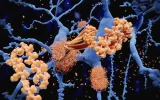
Amyloid plaque: depositphotos.com
In November, I will turn 84. According to statistics, between 78 and 84, some 13% (one in about 7.5 persons) already suffer from dementia, and between 84 and 89, that stat rises to one in five. For us seniors, dementia is perhaps the most feared negative health problem. As a result, I follow closely the progress of science in finding the causes of and cures for Alzheimer’s.
So far, results have been worse than disappointing. Dementia is characterized by buildup of plaque – a protein called amyloid-beta, or a-beta – that gums up the brain and messes up the trillions of synapses (connections) among our 86 billion neurons. Those connections give us memory, reason, logic and language. When they are messed up, it is like opening a laptop and ripping out the chips.
Today’s Science Daily cites a new study that offers hope. Here is the summary:
“Scientists [at University of California – Riverside] may have uncovered a hidden trigger behind Alzheimer’s disease. Instead of plaques being the root cause, amyloid beta appears to interfere with tau, a protein that helps keep neurons functioning properly. This disruption could set off the damage that eventually leads to the disease’s most recognizable brain changes.” Researchers found that amyloid beta can displace tau from crucial structures inside neurons, potentially disrupting brain cells long before plaques become a problem.
“For years, Alzheimer’s research has largely centered on amyloid beta (a-beta), a protein that forms clumps in the brains of people with the disease. The idea gained support because inherited mutations that increase a-beta levels can cause early onset Alzheimer’s. However, despite thousands of clinical trials designed to remove a-beta, those treatments have largely failed to stop the disease or reverse its progression. Scientists have also long known that another protein called tau accumulates in the brains of Alzheimer’s patients. What has remained uncertain is exactly how tau and a-beta are connected. “In addition to having dementia, Alzheimer’s diagnosis requires both a-beta and tau buildup in the brain,” said UCR chemistry professor and study lead author Ryan Julian. “But many labs focus on the role of one and ignore the other.” Published in the Proceedings of the National Academy of Sciences, Nexus, the new study points to a direct interaction between these two proteins.” *
- Thomas A Shoff, Maxence Derbez-Morin, Peishan Cai, Ryan R Julian. The microtubule nexus linking amyloid beta and tau: A simple and unifying theory for the underlying cause of Alzheimer\’s disease. PNAS Nexus, 2026; 5 (3) DOI: 10.1093/pnasnexus/pgag034
How did the researchers make their breakthrough? I first need to define “microtubule”: Microtubules, microfilaments, and intermediate filaments are the three primary protein fiber networks that make up the eukaryotic cell’s cytoskeleton.” Together, they provide the cell with its physical structure, internal organization, and ability to move.” Microtubules are crucial for brain health. They help neurons accept and transport within the brain cell vital energy and sustenance.
“The research team noticed that the section of tau responsible for attaching to microtubules closely resembles a-beta in both size and structure. That observation led them to wonder whether a-beta could also bind to microtubules. To investigate, the scientists attached a fluorescent marker to a-beta. By tracking changes in its movement and light emission, they were able to determine when the protein attached itself to microtubules. Their experiments revealed that a-beta and tau bind to microtubules with similar strength. As a result, when a-beta accumulates inside neurons, it can potentially push tau out of its normal position. “Our work shows amyloid beta and tau compete for the same binding sites on microtubules, and that a-beta can prevent tau from functioning correctly,” Julian said.
So, what? What does this mean for possible Alzheimer’s medication?
“Rather than focusing exclusively on removing protein clumps, researchers might target the interaction between a-beta and microtubules. Another potential strategy would be boosting the cell’s ability to clear a-beta before it accumulates inside neurons. Julian believes the findings help tie together many previously disconnected observations from Alzheimer’s research.
“This idea helps make sense of many results that previously seemed unrelated,” Julian said. “It gives us a clearer picture of what may be going wrong inside neurons and where new treatments might start.”
Related Topics