
President of Shahvand Think Tank
From London to Tehran: The Crisis of Legitimacy
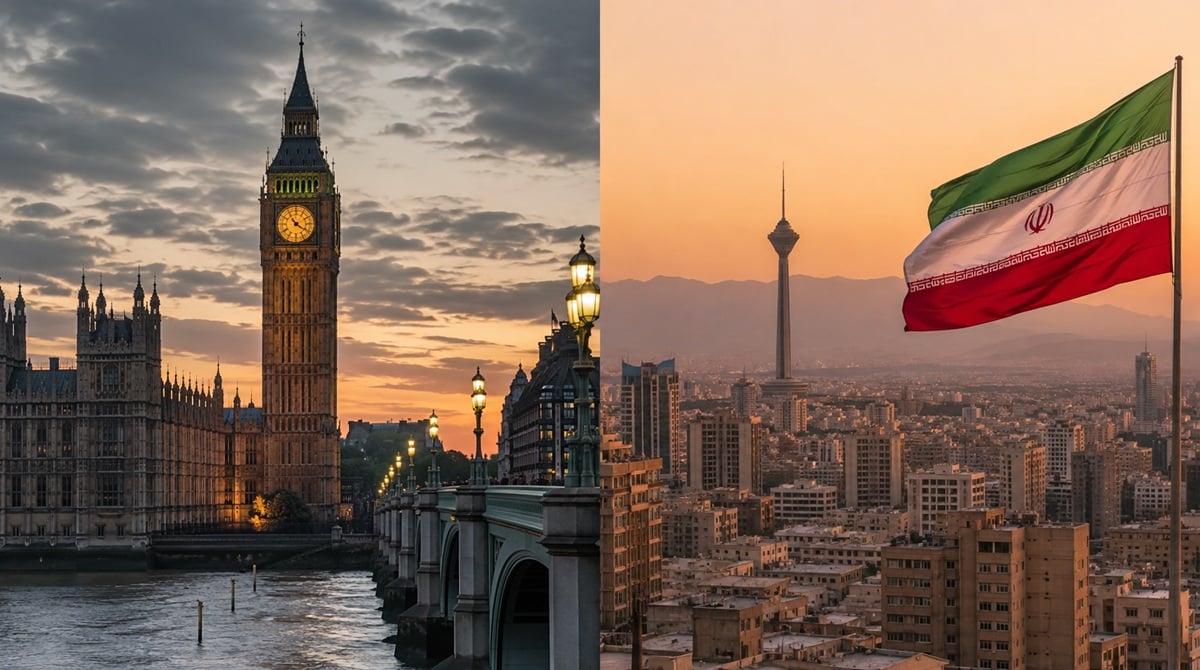
Image Source: Shahvand; From London to Tehran: The Crisis of Legitimacy
An analysis of the experience of the Islamic Republic in Iran is incomplete without reference to comparable historical cases in other societies. One of the closest parallels is the republic of Oliver Cromwell in seventeenth-century England—a case in which a monarchical order collapsed and was replaced by a regime grounded in religious and ideological legitimacy (the Church of England).
In 1649, after years of civil war, Charles I was overthrown and executed. This event was not merely the fall of a monarch, but a fundamental rupture in the traditional understanding of political authority and legitimacy in England. The new republic presented itself through slogans such as justice, religious reform, and popular sovereignty, claiming to construct a superior order to the one it replaced.
However, the process of political consolidation quickly moved away from institutional pathways. Power became increasingly concentrated in the hands of Oliver Cromwell. Relying on military authority and religious legitimacy, he established a form of personal rule that depended less on institutions than on the loyalty of armed forces under his command.
Over time, the state shifted from a political project to one of moral and cultural regulation. Cultural restrictions, control over lifestyle, and efforts to align society with a specific interpretation of religion reflected an attempt to reorganize the entirety of social life. In this sense, Cromwell’s republic can be regarded as one of the earliest examples of an ideological state in the modern era.
The system soon faced two structural challenges: growing reliance on coercive instruments and an inability to build stable institutions. The result was a widening gap between the regime’s normative claims and the lived experience of society.
Yet the crisis of ideological states is not simply the result of a gap between rhetoric and practice; such a gap exists, to varying degrees, in all political systems. The key distinction is that ideological states ground their legitimacy not only in performance, but in their claim to represent a higher truth, a historical mission, or a moral order. As a result, when a disconnect emerges between declared values and governing reality, it is not merely performance that is questioned—the very foundation of legitimacy is undermined.
After Cromwell’s death, this crisis gradually surfaced and ultimately led to the Restoration of the monarchy. This return was not simply a restoration of the past, but an attempt to re-establish political stability and reconstruct the governing order. A generational factor also played an important role: a generation that had grown up after the civil war no longer carried the emotional attachment to the revolutionary narrative, and assessed legitimacy primarily through governmental performance rather than historical memory.
The 1979 Iranian Revolution likewise began with concepts such as freedom, justice, and opposition to tyranny, but ultimately led to the establishment of a system whose legitimacy is derived from religious ideology. The key similarity between these two experiences lies not in institutional form, but in the logic of political transformation: the transition from an existing order to one that claims to embody a truth beyond ordinary political competition.
At the same time, important structural differences remain. Seventeenth-century England lacked a modern state in the contemporary sense, whereas pre-revolutionary Iran was already embedded in a modern nation-state project. This difference fundamentally shaped social expectations, institutional capacity, and governance complexity.
Despite these differences, the Islamic Republic has followed a trajectory observed in many ideological states: a gradual shift from ideological mobilization to bureaucratic and security-driven governance. In this process, ideological cohesion is progressively weakened, and regime stability becomes increasingly dependent on administrative, economic, and security institutions. While this may ensure short-term stability, it also deepens the gap between founding ideals and governing reality.
One important distinction between Cromwell’s regime and the Islamic Republic lies in the relationship between discourse and conduct. In Cromwell’s England, despite its authoritarian nature, there was a relative coherence between the personal conduct of leaders and the stated values of the regime, which helped preserve a degree of moral legitimacy.
In contrast, in the Islamic Republic, the widening gap between official discourse and parts of the governing structure has become a central factor in the erosion of legitimacy. Official emphasis on simplicity and justice stands alongside perceptions of patronage networks, wealth accumulation, and concentrated resources—tensions that are especially salient among generations with no lived memory of the revolution.
In this context, historical memory has itself become a determining factor in the reconfiguration of legitimacy. Just as in England, where perceptions of the monarchy were reassessed after the Cromwellian experiment, in Iran a significant segment of society has increasingly reinterpreted the Pahlavi era as a period of Iranian greatness and development. Regardless of the accuracy of this perception, its emergence reflects how the erosion of legitimacy in one order can reshape the historical image of the preceding one.
Overall, the comparison between Cromwell’s republic and the Islamic Republic reveals a recurring pattern: an initial promise of liberation, gradual concentration of power, expansion of bureaucratic and security structures, and eventual confrontation with a crisis of legitimacy.
However, historical experience should not be reduced to a prescriptive blueprint for the future. The Restoration of the monarchy in England was a product of specific historical conditions and cannot be treated as a universal model. What this experience highlights is not an institutional formula, but an analytical proposition: ideological states enter a phase of crisis when they can no longer maintain a balance between normative claims and governing reality. From this perspective, the central question for Iran’s future is not merely the form of the political system, but the reconstruction of legitimacy, institutions, and the relationship between state and society in a post-ideological phase.
By Raghu Kondori and Behrouz Fathali
Related Topics