


From Moral Rot to Moral Turpitude at a US Campus
Two years after the horrible day of Oct. 7, 2023, after Moral Rot and Lawlessness on the campus of Rice University, Rice has finally determined that an act of intimidation has taken place on campus. Who committed that act? Apparently, yours truly.
Let’s first recapitulate what Rice has determined was not intimidation.
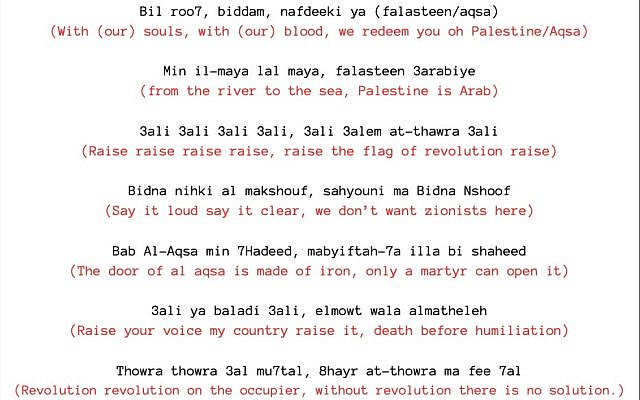
Chanting “Intifada revolution is the only solution” is not intimidation, and neither is “Globalize the Intifada”. Never mind that the Second Intifada was a 2000–2005 terror campaign aimed at Israeli civilians — which included suicide bombings, shootings, and stabbings — resulting in over 1,000 people murdered. (I lost a very good friend in the Passover Massacre, a suicide bombing carried out by Hamas at the Park Hotel in Netanya, Israel in March 2002, during a Passover festive meal, in which 30 civilians were killed and 140 were injured.) Never mind that British Prime Minister Keir Starmer has recently confirmed he believes that the call to “internationalise the intifada” is a “call to attack Jewish communities around the world”.
Erecting an unauthorized encampment on the Rice campus and chanting “From the river to the sea, Palestine shall be Arab”, is not intimidation, and neither is chanting “We don’t want Zionists here”. (Who are these Zionists? The chants “Zionists get out, free Palestine” make it clear that the reference is to Israeli Jews.)
Furthermore, in an end-of-semester email sent to campus April 28, 2024, Rice’s President Reginal DesRoches described the encampment activities as “responsible, personal expression”. So Rice students are calling on the Rice campus for ethnic cleansing, and President DesRoches refers to that as “responsible expression”.
When on April 7, 2024, I wrote to the Director of Human Resources at Rice to tell her that “I am a faculty member of Rice University, and I do not feel physically safe on the campus,” the response on April 12 was that if I do not feel physically safe, I should call RUPD and if I do not feel emotionally safe, I should seek counseling. So there was no intimidation; it is all in my head, apparently.
In mid-April 2024, a group of about ten Israelis — faculty members, staff members, and students — held a meeting with the leadership of the university, including President DesRoches. We made it clear that we do not feel safe on the Rice campus. Two people pulled out pocket knives and Pepper Spray (allowed by university policy) that they carry with them for self-defense while on the Rice campus. Some students cried when describing their experience at Rice since October 7, 2023. The leadership listened with interest, but no promise of concrete steps to address these issues was made, other than a vague statement about something to be done during Orientation Week in the fall. But no plan has ever been announced on how to keep Israelis safe on the Rice campus.

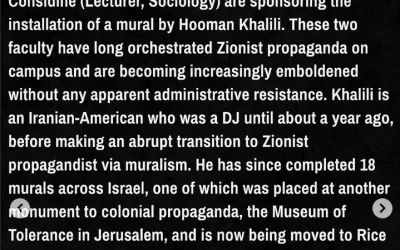
In early June 2025, my colleague, Craig Considine and I brought an internationally recognized ‘Woman Life Freedom’ mural to make its US debut at Rice University. RiceSJP “condemned” us as “Zionist faculty” who spread “Zionist propaganda” on campus. Apparently, this is not intimidation.
The argument given by Rice as to why none of the above constitutes intimidation is that there has been no provable intent of intimidation. For example, Intifada literally means “shaking off,” so that the term does not inherently imply violence. (Also, the word “holocaust” literally means a burnt offering.) In December 2023, Rice’s president, Reginald DesRoches, issued a strong. but rather generic, statement condemning antisemitism and calls for violence against Jewish students or any other group of people, but President DesRoches never addressed explicitly the threatening chants against Israelis on the Rice campus. (For a detailed analysis of antisemitism at Rice University since Oct. 7. 2023, see here.)
The other justification for the finding of “no intimidation of Israelis on the Rice campus” is that we did not receive direct personal threats of violence, unlike, for example, Israeli-born professor, Professor Michael Ben-Gad, at City University of London, where masked demonstrators stormed his classroom and issued direct threats of violence. But as the political scientist Robert A. Pape recently argued, public support for political violence encourages volatile people — those who may actually use force — to act on their worst impulses. Indeed, acts of violence towards Jews and Israelis have occurred around the world. A campus atmosphere of hate towards Israelis is indeed intimidating, even without direct threats.
The best summary of the campus climate for Jewish and Israeli students at Rice during Academic Year 2023–4 was given to me by a Jewish student in Spring 2024, while the campus was flooded by unauthorized disruptions, protests, and posters:
“I used to brag to my Jewish family and friends that Rice was a place where Jewish students like myself could experience campus life without having to encounter anti-Israel rhetoric, the BDS movement, and antisemitism more generally. My sense was that Rice’s student body was largely apolitical. Sadly, I have been proven wrong since last September, starting when Rice Pride severed ties with Houston Hillel, and continuing after October 7th when I was forced to reconcile with the fact that many of my classmates, some of whom I once viewed as friends, were posting extremist and hate-filled content on their social media accounts, in addition to attending protests and other events on campus where antisemitic rhetoric has been prevalent.
I soon realized that if I ever were to express my views publicly at Rice, I would become an outcast simply because I believe that Israel has a right to exist, regardless of any nuances that may exist in my views on what is actually happening with the conflict itself and specifically the conduct of the Israeli government. Thus, to avoid this fate, I have largely kept my silence. In the conversations that I have had with my close friends, I have found myself again and again being forced into argumentative corners where I have “agreed” to ideas and conclusions that do not reflect my true views, but really my “agreement” has only served to protect me from again becoming known as a Zionist on campus.
And I am not alone. With so few Jewish students at Rice to begin with and so many of us sharing the same fears as me, we have been largely unable to organize to defend ourselves from antisemitism and to defend our ability to live a normal life at Rice free from the extremist actions of students hellbent on imposing their views on everyone at Rice. Even worse, we are at the mercy of an administration that cares far more about optics than actually responding to the concerns of its Jewish students, an administration whose “efforts” to combat antisemitism have clearly been performative and not conducted with an actual desire to change the situation for the better.
In the meanwhile, I have had to sadly watch my few brave Jewish friends who have spoken out be outcast just as I have feared may happen to me. I once believed Rice’s care-drive culture was unique amongst elite universities, that I could at the very least trust my classmates to avoid antisemitism in their activism. I now know better. Rice may not be getting as much attention as Harvard or Penn, and I do not have to fear for my safety when I walk to class, but my classmates have shown that too many of us are just as problematic as our peers in the Northeast.”
But finally, Rice has found that intimidation did take place, and I am the perpetrator. Let’s review the facts.
On the evening of Saturday, May 10, 2025, at the procession leading to the undergraduate commencement ceremony at the Rice University football stadium, two Rice faculty members were marching wearing regalia and, on top of that, keffiyehs. The Keffiyeh is a traditional headdress worn by men from parts of the Middle East, but it has recently come to symbolize not only solidarity with Palestinians, but also support for Palestinian violence.

Rice’s Policy 820 does state that “Rice must provide its community of students, faculty, and staff multiple avenues for the safe and robust expression, discussion, and exchange of diverse points of view, even if they are unorthodox, unpopular, or controversial.” But the policy requires such protests to be approved 48 hours in advance. No approval has been granted to wearing keffiyehs during the academic procession, which was clearly an act of protest, so this act was a clear violation of Policy 820.
Some parents who attended the commencement ceremony were outraged by the politicization of an event that is supposed to highlight their children’s academic achievements. On May 13, 2025, I received emails from parents with photographs of these two faculty members. Some parents wanted to confront these faculty members, but their children stopped them, as they were afraid of being “outed” as Jewish. (Of course, this does not “count” as intimidation.) The parents wished to submit a complaint to President Reginald DesRoches, so they asked me if I knew who these two faculty members were. I recognized one, a senior faculty member, but not the other, so I posted the photograph on X, asking if anyone recognized the photograph. Before posting, I checked X’s policy on posting personal information. X prohibits posting of private information, a practice known as doxxing. Since, however, the photograph was taken in public, it is not private information, and its posting is permissible by X’s rules.
On June 6, 2025, I received an email from a colleague whom I esteem. She identified the unknown faculty member and asked me if I’d remove the X post with the photograph. I did remove the X post. Furthermore, as it became clear to me that my kefiyyeh-clad colleague (KCC, for short) is a junior faculty member, I decided not to pass the name to the irate parent and not to submit a complaint regarding the policy violation. Instead, I published A Letter to a Keffiyeh-Clad Rice Colleague.
On July 24, 2025, I learned that KCC submitted an ethics complaint against me, arguing that my posting of her photo on X was an act of intimidation, prohibited by Rice’s Policy 401. An ethics investigation was launched and on Oct. 14, 2025, I was informed that the investigation concluded that I have indeed violated Policy 401 and my posting of the photo on X is considered an act of bullying. The evidence is that KCC and her colleagues testified that KCC did indeed feel intimidated, even though she did not face any direct personal threat. The investigator considered that sufficient evidence for the claim that I performed an act of intimidation.
So, apparently, intent does not matter and direct threats do not matter. The fact that I removed the post as soon as it was requested of me and that I wrote “Causing harm to you, my kefiyyeh-clad colleague, is furthest from my intentions” does not matter. KCC felt intimidated, so I have committed an act of intimidation, end of story. No one, it seems, suggested to KCC to seek counseling to address the feeling of intimidation. (Regardless, I did not mean for KCC to feel intimidated, and I do regret that this was the result of my actions.)
But the moral turpitude I referred to in the title is not merely about the double standard that Rice exhibits in its investigations. It goes deeper. Probably due to my public disagreements with Rice’s Office of Equal Opportunity Services (EOS), the investigation was assigned to an outside counsel. When I asked the investigating counsel what code of ethics governs the investigation to guarantee a fair and neutral hearing, she referred me to a generic marketing blurb on her firm web page. When I asked her for details of her firm’s engagement with Rice, she referred me to Rice’s EOS. When I posed that question to EOS, I was told that the arrangement is confidential. In other words, this was an investigation with no fairness and no neutrality. Rice is the client of the outside counsel, and the primary ethical obligation of said counsel is to serve their client, i.e., Rice University, zealously. It seems that the purpose of assigning the investigation to an outside counsel was not to eliminate a conflict of interest; rather it was to hide a conflict of interest behind an opaque arrangement.
Hence the title: From Moral Rot to Moral Turpitude at Rice University.
Press enter or click to view image in full size
P.S. On May 29, 2025, I submitted an ethics complaint against the senior Keffiyeh-clad faculty member, arguing that wearing keffiyeh in the academic procession is an act of political protest, which requires pre-approval according to university policy. Five months later, I received a formal response: “Thank you for your report. Your concerns were reviewed and resolved in accordance with University policies and procedures.”
I did receive a follow-up clarification:
“Your complaint alleges that a Rice professor wore a keffiyeh during the pre-Commencement procession on May 10, 2025. You also allege that her act of wearing the keffiyeh was a political protest, and so it should have been registered and approved under Policy 820.
The wearing of this garment is not, by itself, a protest, counter-protest, or similar activity that fits Policy 820’s examples of a demonstration. In addition, I do not see any evidence that the professor communicated or expressed views or grievances. Lastly, there is no Rice policy on what faculty may or may not wear during Commencement events. Therefore, this occurrence was not a demonstration as defined by Policy 820, and it did not violate the policy not to request a permit.”
So a keffiyeh is just a garment. But a post on X with a photo of a professor wearing such a garment is intimidation.