
Geopolitical Analyst: Bridging Somaliland & Israel to the world
From Nairobi to Bab-El-Mandeb: Somaliland and the Emerging Counter-Alignment.
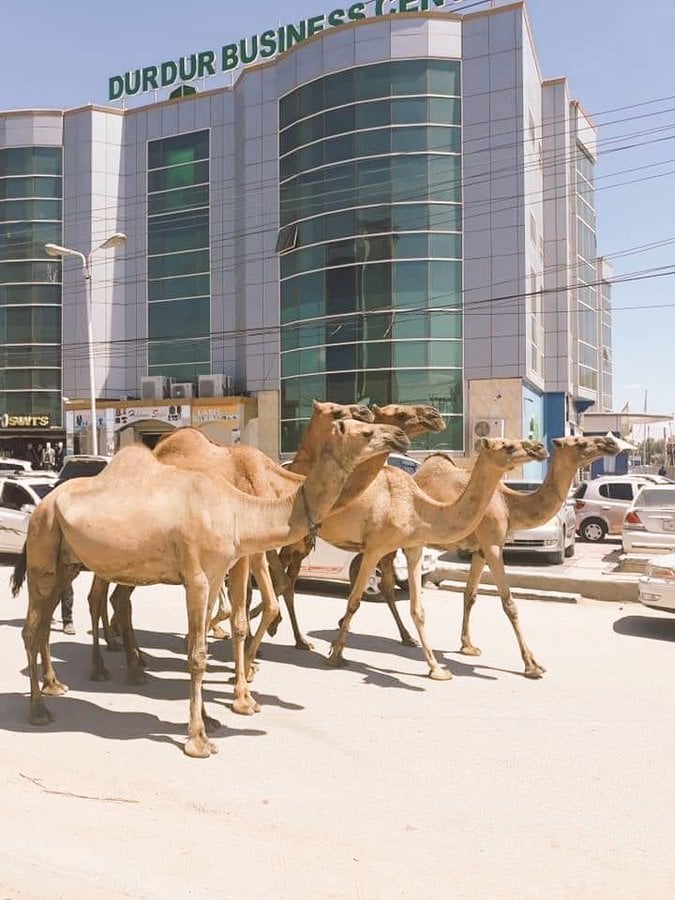
Camel Culture Nation-I was surprised, but very lucky to come across this scene in downtown Hargeisa this Summer.
President Irro’s diplomatic outreach now intersects with a widening maritime-security network connecting Israel, the United Arab Emirates, Greece and Cyprus. The convergence is real – but it has not yet become a formal counter-pact.
HARGEISA – The distance between Nairobi and the Strait of Bab-El-Mandeb is geographical. For Somaliland, however, it increasingly represents a single geopolitical journey: from campaigning for diplomatic access in Kenya to positioning itself inside the emerging security architecture of the Red Sea, Gulf of Aden and Eastern Mediterranean.
When President Abdirahman Mohamed Abdullahi Irro returned to Hargeisa on August 15, 2026, after completing his second, week-long working visit to Nairobi, the significance extended beyond Somaliland’s renewed access to Kenya’s diplomatic hub.
During meetings with diplomats, international organisations and development partners, Irro presented a sharper proposition: Somaliland seeks investment, technology, expertise and mutually beneficial partnerships rather than continued dependence on traditional foreign aid.
The visit marked a progression from the diplomatic foothold established during his first Nairobi mission in 2025 toward more confident economic and strategic engagement—demonstrating Hargeisa’s ability to deepen practical international relationships even where formal recognition remains disputed.
Nairobi was therefore not recognition. It was something more preliminary but strategically important: diplomatic access without formal status.
The journey from Nairobi to Bab-EL-Mandeb describes how that access is being converted into strategic relevance. Somaliland is no longer presenting itself solely as an unrecognised democracy seeking justice. It is increasingly offering itself as a maritime-security partner positioned beside one of the world’s most consequential maritime chokepoints.
That shift has accelerated following the Makkah Joint Defence Agreement and the continuing military pressures around Bab-El-Mandeb, the Red Sea and the Gulf of Aden.
The Makkah Pact changes the calculation
On August 7, Saudi Arabia, Turkey and Pakistan signed a Joint Defence Agreement in Makkah. Its central provision declares that an armed attack on one member will be treated as an attack on all three.
The agreement brings together Saudi financial and religious influence, Turkey’s military-industrial capacity and Pakistan’s status as the Muslim world’s only nuclear-armed state. The three governments insist that the arrangement is defensive and directed against no specific country. Nevertheless, its geopolitical weight cannot be dismissed.
Subsequent announcements indicate that the three states intend to create political and military coordination mechanisms, conduct joint land, naval, air and cyber exercises, and cooperate in drones, electronic warfare, artificial intelligence and defence production. These plans move the agreement beyond diplomatic symbolism, although no integrated command structure, activation procedure or explicit nuclear guarantee has yet been disclosed.
The Makkah Pact should not yet be described as a Middle Eastern NATO. Its members have different relationships with Iran, Israel, the United States and the Gulf monarchies. Their threat perceptions overlap, but they are not identical.
Nor is the agreement explicitly directed against Somaliland. Its relevance for Hargeisa arises primarily from Turkey’s position: Ankara rejects Israel’s recognition of Somaliland and remains a major political and security partner of Somalia. A stronger Saudi-Turkish-Pakistani security framework could therefore increase the diplomatic and strategic resources available to states opposing Somaliland’s international recognition – even if Somaliland is not formally mentioned in the pact.
The danger for Somaliland would be to respond by imagining an already-formed rival alliance. The better approach is to recognise that a counterbalancing network is developing, but that it remains flexible, incomplete and largely organised through overlapping bilateral and trilateral relationships.
The counter-alignment already exists in pieces
The northern anchor of this emerging network is the Israel-Greece-Cyprus partnership. At their tenth trilateral summit in December 2025, the three governments agreed to deepen defence and military cooperation, protect maritime routes and critical infrastructure, and establish a Maritime Cybersecurity Centre of Excellence in Cyprus. Their joint declaration also invited additional like-minded countries into ‘3+1’ cooperation formats.
The partnership is becoming operational. Israel, Greece and Cyprus agreed to expand joint naval and air exercises during 2026, while Greece has moved forward with a multibillion-dollar Israeli air-defence system. These developments point toward a durable security relationship rather than a temporary diplomatic understanding.
The United Arab Emirates provides the Gulf connection.
Abu Dhabi has deepened its strategic partnerships with both Greece and Cyprus. The UAE and Greece have reaffirmed their shared interest in freedom of navigation and maritime security, while the UAE-Cyprus strategic partnership includes energy security, infrastructure and Gulf-to-Eastern-Mediterranean connectivity.
The correct sovereign actor here is the UAE, rather than Dubai alone. But Dubai supplies a crucial commercial component through DP World and the Jebel Ali logistics system.
DP World’s investment in Berbera and the launch of a regular Jebel Ali-Berbera shipping service have already created a physical link between the Gulf and Somaliland. Berbera is consequently more than an isolated port project. It is becoming part of a corridor connecting the Gulf, the Horn of Africa and the Ethiopian market.
Israel supplies the most consequential diplomatic component.
On December 26, 2025, Israel became the first United Nations member state formally to recognise Somaliland as an independent state. President Irro’s June 2026 state visit to Israel then moved the relationship from recognition toward strategic cooperation. The Israeli presidency described the visit as an opportunity to confront shared strategic challenges and move from declarations to practical partnerships in security, technology and development.
The subsequent Israel-Somaliland Strategic Joint Declaration covered security, investment, agriculture, water, technology and infrastructure. It also placed the Red Sea and Bab el-Mandeb inside the developing bilateral relationship.
The result is not yet a five-party alliance. It is an emerging chain: Israel-Greece-Cyprus in the Eastern Mediterranean; the UAE across the Gulf and Indian Ocean; and Somaliland on the southern approaches to Bab el-Mandeb.
Hormuz Changes Somaliland’s geography into leverage
The worsening security environment around Bab-El-Mandeb makes this emerging chain more valuable. In August, the UAE accused Iran of attacking ADNOC vessels transiting the Strait of Hormuz, intensifying calls for the restoration of secure navigation. The attacks demonstrated the continuing vulnerability of Gulf shipping even after diplomatic efforts to reopen the waterway.
The disruption is economically significant. According to the US Energy Information Administration, petroleum flows through Hormuz fell from approximately 20.7 million barrels per day in the final quarter of 2025 to 14.6 million barrels per day during the first quarter of 2026. Bab el-Mandeb handled approximately 5.4 million barrels per day during the same period.
The two waterways are not interchangeable, but they belong to the same strategic system. A disruption at Hormuz affects Gulf production and exports. A disruption at Bab el-Mandeb affects access to the Suez Canal, the Mediterranean and European markets.
Meanwhile, the Red Sea and Gulf of Aden face renewed missile and drone attacks, piracy and weapons trafficking. The International Maritime Organization has warned that attacks on commercial vessels threaten seafarers, the environment and global supply chains. It has also reported a renewed surge of piracy incidents in the Red Sea and Gulf of Aden.
Research by the Carnegie Endowment additionally points to expanding connections between Yemen’s Ansarullah movement and militant organisations operating in Somalia, including arms transfers, drone expertise and intelligence activity.
In this environment, Somaliland’s value lies less in ideological alignment than in location, relative stability and institutional access. Berbera can provide port capacity, logistics, refuelling, maintenance, search-and-rescue support and humanitarian staging. Somaliland’s coastline can support maritime-domain awareness covering shipping movements, smuggling networks, piracy and airborne threats along the Gulf of Aden.
This is the strategic opportunity: Somaliland can become a provider of regional public goods rather than merely a consumer of diplomatic support.
A convergence is not a collective-defence treaty
The public record does not establish an official ‘counter-Makkah Pact’ joining Israel, the UAE, Greece, Cyprus and Somaliland.
No published declaration contains a mutual-defence clause binding these five parties. There is no announced joint command, common decision-making institution or collective military guarantee. Greece and Cyprus are European Union members with their own legal and diplomatic constraints. The UAE continues to cooperate with Saudi Arabia and Turkey on several regional issues. Each government will protect its individual relationships and freedom of action.
Recent misinformation illustrates the need for caution. India’s foreign ministry, for example, rejected as fabricated an AI-generated report claiming that New Delhi had requested a defence pact with Israel in response to the Makkah agreement. The official denial reported by the Times of India showed how quickly legitimate strategic convergence can be exaggerated into a fictional treaty.
Reports concerning foreign military deployments in Somaliland require similar discipline. Somaliland’s defence minister has denied negotiations over an Israeli military base, while separate reporting by Le Monde has alleged that the UAE is developing facilities at Berbera Airport that could support Emirati, American or Israeli operations.
Until governments publish verifiable agreements, these reports should be described as contested claims – not established facts.
Nevertheless, formal treaties are not the only measure of strategic alignment. Ports can be connected before alliances are announced. Intelligence relationships can develop before flags appear. Military exercises, technology transfers, investment agreements and coordinated maritime surveillance can produce practical alignment without a single founding document.
By that measure, Somaliland is moves closer to the emerging network.
What Hargeisa should seek
Somaliland should resist the temptation to advertise itself simply as a forward operating platform against Iran, Turkey, the Houthis or Mogadishu. Such positioning would expose the country to retaliation without necessarily providing a binding security guarantee.
Instead, Hargeisa should pursue a Maritime Security and Resilience Compact based on clearly defined services and reciprocal commitments.
First, Somaliland should propose a maritime-information fusion centre in Berbera or Hargeisa. Working with Emirati shipping operators, Israeli surveillance specialists and Greek and Cypriot maritime institutions, the centre could monitor piracy, arms smuggling, drone activity and threats to commercial navigation.
Second, it should seek coast-guard training, protected communications, radar coverage and search-and-rescue capabilities. These are defensible sovereign functions with benefits extending beyond any single alliance. Berbera should be presented as a protected commercial, humanitarian and emergency-logistics hub – not as an opaque foreign base.
Third, Hargeisa should seek inclusion in the Israel-Greece-Cyprus ‘3+1’ structure as a maritime observer or specialised partner. Even without immediate Greek or Cypriot recognition, technical participation in maritime security, cyber resilience and emergency-response exercises would institutionalise Somaliland’s strategic role.
Fourth, security cooperation must be converted into economic and diplomatic outcomes. Port investment should be accompanied by manufacturing, cold-storage facilities, fisheries development, renewable energy, vocational training and infrastructure connecting Berbera with the interior and neighbouring markets.
Finally, all agreements must remain under Somaliland’s sovereign and civilian authority. Parliamentary scrutiny and public transparency are essential. Recognition must not be exchanged for indefinite military dependency, nor should strategically valuable land be committed through unpublished arrangements.
From recognition seeker to security partner state
Nairobi demonstrated Somaliland’s diplomatic access. Israel’s recognition provided a breakthrough. Berbera connects it to Gulf logistics networks, while Eastern Mediterranean partnerships offer entry into a wider maritime-security system.
The emerging alignment is not a formal bloc but a flexible network shaped by maritime security, infrastructure and trade route protection. Its strategic implication is clear: Somaliland is shifting from peripheral diplomatic actor to a significant security partner in the Red Sea-Gulf-Mediterranean corridor, where value is defined by logistics capacity, stability, reliability, and security utility rather than formal recognition alone.
Over the next 3-5 years, Somaliland must therefore consolidate this position by institutionalising maritime security cooperation, scaling Berbera into a fully integrated regional logistics hub, and embedding itself in multilateral maritime frameworks that outlast individual political administrations. If it fails to do so, it risks remaining a transit point in other states’ strategies rather than becoming a strategic player in its own right.
Related Topics
Related Posts