
Geopolitical Analyst: Bridging Somaliland & Israel to the world
India’s 1971 Moment as Pakistan’s Alliances Put Somaliland in Focus
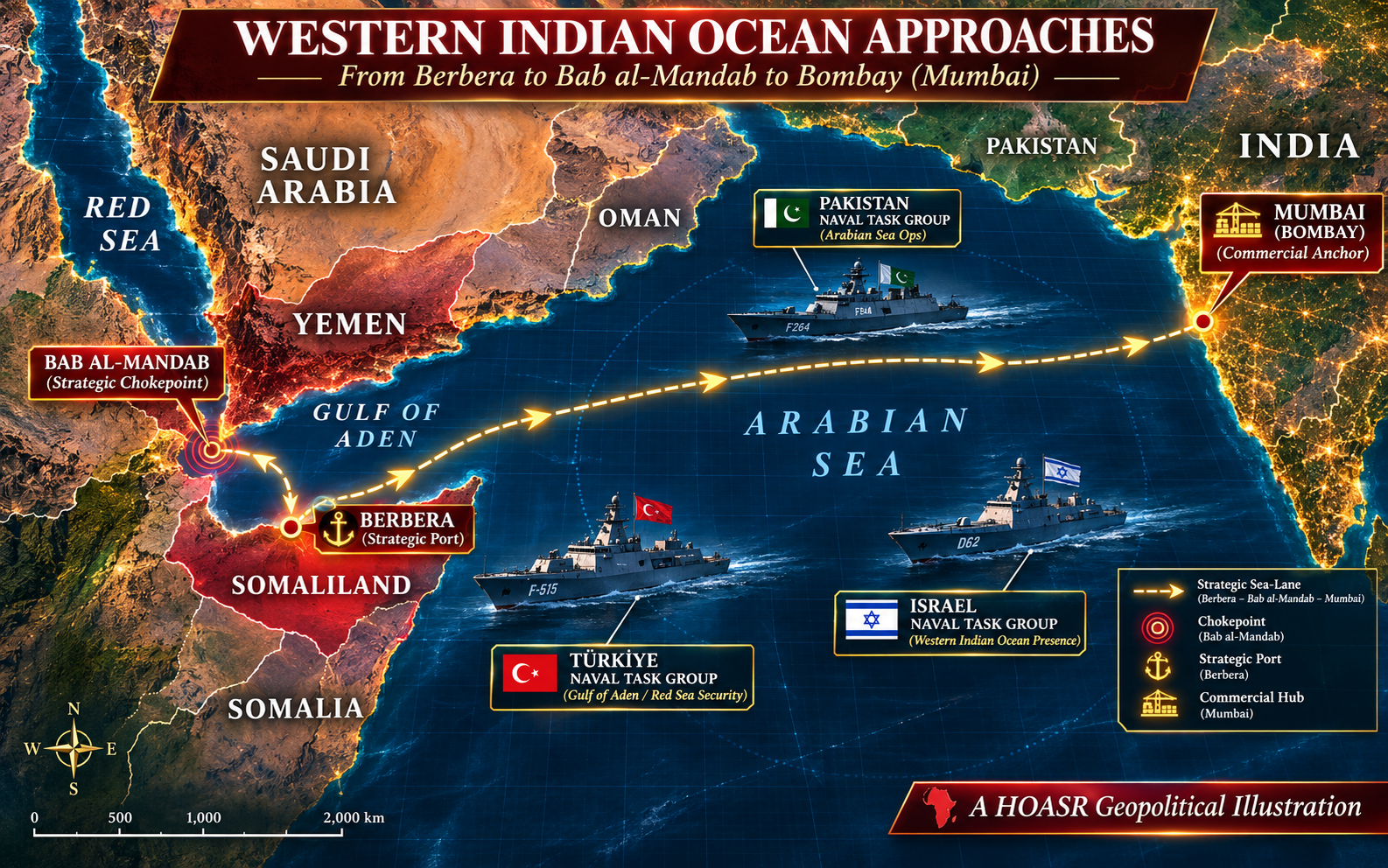
The western Indian Ocean maritime corridor connects Berbera, Bab al-Mandab and Mumbai amid expanding strategic competition involving India, Pakistan, Türkiye and Israel. Credit: HOASR Original Geopolitical Illustration.
From the 1971 confrontation with Pakistan to the strategic competition unfolding around Somaliland, India faces a changing maritime landscape in a region where its historical connections run deeper than modern diplomacy suggests.
In 1971, India recognised Bangladesh without seeking Pakistan’s permission. It established a precedent for making independent judgments about sovereignty without accepting another state’s territorial claim as an absolute veto. More than half a century later, the same historical argument has returned, this time from an Indian perspective on the Somaliland recognition debate.
In his November 7 Goa Chronicle article, *Somaliland: India’s 1971 Moment, Dr. Savio Rodrigues draws a compelling parallel between India’s recognition of Bangladesh in December 1971 and Somaliland’s longstanding claim to restored independence. He points to one striking historical distinction: Bangladesh emerged from Pakistan, whereas Somaliland had already achieved independence on June 26, 1960, before entering into union with the former Italian-administered Somalia five days later.
Rodrigues raises a question that deserves attention in New Delhi. If India could make an independent judgment about Bangladesh in 1971 despite Pakistan’s objections, what prevents it from independently recognizing Somaliland today? Although the legal circumstances are different, the wider strategic environment gives the comparison renewed significance.
In 1971, India’s confrontation with Pakistan concerned the political future of the subcontinent and the distribution of regional power. Today, India and Pakistan are engaged in a much broader competition extending from the Arabian Sea into the Gulf, the Red Sea and the Horn of Africa. Pakistan’s expanding military relationships with Saudi Arabia, Türkiye and Somalia have introduced new considerations into India’s western Indian Ocean security strategy.
Pakistan’s alliances are reaching Africa’s shores
On August 7, 2026, Pakistan, Türkiye and Saudi Arabia signed the Makkah Joint Defence Agreement, under which an armed attack against one signatory would be treated as an attack against all three. The agreement also provides for expanded military cooperation, intelligence coordination and collective deterrence. On August 31, their defence and foreign-policy leaderships agreed to establish a permanent secretariat in Saudi Arabia, initially led by a Pakistani secretary-general.
The joint statement issued by Pakistan’s Ministry of Foreign Affairs outlines further cooperation in defence technology, industrial production and military capabilities. These arrangements bring together three countries with substantial strategic interests across the Middle East and the wider Indian Ocean. Their growing institutional cooperation has implications that extend well beyond their national borders.
Pakistan has simultaneously expanded its military engagement with Somalia. On August 4, Somali Defence Minister Ahmed Moallim Fiqi visited Pakistan, where the two governments signed a memorandum of understanding on defence and security cooperation. Somali military officials also held discussions with Pakistan’s naval leadership about maritime security, professional training and strengthening Somalia’s naval and coast guard capabilities.
These contacts were followed by a visit from a senior Pakistani Air Force delegation to Mogadishu. As Somalia’s Ministry of Defence confirmed on September 22, the discussions focused on developing Somalia’s air-force capabilities and training its officers. Pakistan’s expanding relationship with Mogadishu now reaches across several branches of military cooperation.
Meanwhile, Türkiye, has been developing Somalia’s military institutions for years. Its long-term defence cooperation agreement with Mogadishu, concluded in February 2024, includes assistance in maritime security and naval development. Ankara’s existing role in Somalia, combined with Islamabad’s more recent agreements, places two members of the Makkah defence arrangement in active military relationships with the same East African government.
The strategic significance lies in the geography. Somalia faces the Gulf of Aden and the Indian Ocean, while Saudi Arabia borders the Red Sea and Türkiye possesses extensive military and maritime capabilities. For India, these overlapping relationships deserve attention because they are developing along the western approaches to an ocean central to its trade, energy security and naval operations.
India has naval power. Pakistan is building relationships.
India is hardly absent from the western Indian Ocean. Its navy has maintained counterpiracy deployments in the Gulf of Aden since 2008, protected commercial shipping and participated in regional maritime-security operations. According to a February 2024 statement by India’s Ministry of Defence, Indian naval vessels had escorted 3,440 ships and more than 25,000 seafarers since those deployments began.
India’s naval experience and operational presence are well established. However, naval power and political access are different instruments of influence. A warship can patrol international waters; long-term defence agreements create relationships with governments, military institutions and decisionmakers. Pakistan’s diplomatic and military engagement with Somalia illustrates how such relationships can expand a country’s regional influence.
India’s challenge is not a lack of maritime capability. It is how that capability should be supported by diplomatic and commercial relationships along the African coastline. New Delhi has substantial ties with Gulf partners and East African governments, but Somaliland presents a separate opportunity that its traditional regional focus has yet to fully explore.
Israel’s recognition has changed the diplomatic taboo
The strategic setting changed on December 26, 2025, when Israel formally recognised the Republic of Somaliland as an independent and sovereign state. Prime Minister Benjamin Netanyahu and Somaliland President Abdirahman Mohamed Abdullahi signed a mutual-recognition declaration, opening the way for cooperation in agriculture, technology, healthcare and other sectors.
The decision brought Somaliland into a new diplomatic relationship with a country deeply involved in Red Sea security. It also placed Somaliland within the wider strategic discussions involving Israel’s relations with Türkiye, the Gulf states and other regional actors.
For India, which maintains longstanding defence and technological cooperation with Israel, Somaliland’s changing international position introduces an additional dimension to its Horn of Africa interests. The Gulf of Aden is an essential maritime corridor connecting the Arabian Sea and Indian Ocean with the Bab el-Mandeb, Red Sea and Suez Canal. Berbera sits along its southern coastline, making the port relevant to shipping, logistics and maritime-domain awareness.
Somalia and several regional governments have opposed Israel’s recognition, invoking territorial integrity and regional stability. Somaliland, for its part, continues to ground its claim in its independence of June 1960, the subsequent union and its restoration of sovereignty in May 1991. These competing positions have acquired greater geopolitical significance as military and diplomatic partnerships develop around the Red Sea.
India and Somaliland were connected long before Pakistan entered this picture
There is another history that deserves equal attention, one that begins not in 1971 but centuries earlier.
India and Somaliland are not strangers. Indian merchants were trading in Berbera, Zeila and other ports along the Gulf of Aden long before the modern political boundaries of the Horn of Africa were established. Trade routes connected the western coast of India with the Arabian Peninsula, the Somali coastline and the African interior.
Historian Richard Pankhurst documented this relationship in his landmark 1974 research, Indian Trade with Ethiopia, the Gulf of Aden and the Horn of Africa in the Nineteenth and Early Twentieth Centuries. His work describes Indian merchants participating in Berbera’s great seasonal trading fair, importing textiles, rice, spices and manufactured goods while purchasing ivory, gums and other products from the African hinterland.
Berbera was already an important commercial meeting point between Africa and South Asia. Indian merchant communities formed part of its trading environment, and their commercial networks connected Somaliland with Bombay, Gujarat, Aden and other Indian Ocean centres.
The relationship acquired an administrative dimension during the British Protectorate. Until 1898, British Somaliland was administered through the Government of India and the Bombay Presidency. This arrangement was described in a British House of Lords debate on Somaliland on April 6, 1910, when Lord Harris recalled his own responsibility for administering the Somaliland coast as Governor of Bombay.
The Indian rupee also circulated as the Protectorate’s monetary unit, as recorded in the British government’s historical account of Somaliland’s commerce and finances. The influence of India was therefore commercial, monetary and administrative, extending into the daily economic life of Somaliland.
That historical relationship reached beyond trading houses. Indian communities contributed to the broader commercial and social environment of British East Africa, leaving influences in food, language and everyday culture. The familiarity of South Asian words, foods and customs across parts of the Somali-speaking world reflects generations of interaction across the Indian Ocean.
The educational relationship that diplomacy has overlooked
For many Somaliland families, the relationship with India is not confined to history books or colonial archives. It is part of their personal experience.
Beginning in the 1970s and continuing through subsequent decades, Somali students, including Somalilanders, travelled to India for higher education and professional training. Many returned with university qualifications and entered careers in education, medicine, engineering, business, administration and other professions.
India remained an important educational destination in the decades that followed. The Indian Ministry of External Affairs’ bilateral brief on Somalia describes India as a preferred destination for Somali students and details the continued provision of scholarships and professional training opportunities.
For those of us familiar with this generation, the connection is much more personal. Many Somalilanders who studied in India retained not only their professional qualifications but also their affection for Indian culture and their ability to speak Hindi. I am among those who still speak Hindi, a reminder of the close human connections that exist beyond official diplomatic relations.
Similar experiences can be found among Somali communities and throughout East Africa. Indian educational institutions, businesses and diaspora communities have established enduring relationships with people in Kenya, Uganda, Tanzania and elsewhere. The Indian Ocean has carried people, ideas, languages and trade between these societies for generations.
This shared history gives India and Somaliland a foundation that military agreements alone cannot create. Berbera’s historical connection with Bombay and the personal ties established through education offer a natural starting point for renewed cooperation.
What would an Indian engagement with Somaliland look like?
The possibilities extend well beyond formal diplomatic recognition.
Berbera’s port infrastructure offers opportunities in shipping, logistics, commercial investment and regional connectivity. Educational cooperation could build on the longstanding presence of Somaliland graduates from Indian universities. India’s expertise in information technology, healthcare, pharmaceuticals, agriculture and professional training could also support practical institutional partnerships.
Maritime cooperation would be particularly relevant. India’s established counter piracy experience and its maritime information-sharing capabilities could complement Somaliland’s efforts to develop coastal security and port operations. Such engagement would connect India’s existing Indian Ocean activities with a coastline that has historically participated in the same commercial networks.
The diplomatic question is more complex. India maintains relations with Somalia and works within African and multilateral frameworks where Somalia’s territorial integrity remains an established policy position. Recognition would therefore involve considerations beyond history and commercial opportunity.
Yet diplomatic engagement, investment and technical cooperation need not all depend on a single recognition decision. India’s approach could develop through several channels, reflecting the economic and maritime interests that already connect the two societies.
India’s 1971 moment returns in a different form
Dr. Savio Rodrigues has done more than revisit the Bangladesh precedent. His article brings an old Indian diplomatic decision into a contemporary debate that now encompasses the Red Sea, the Gulf of Aden and the western Indian Ocean.
In 1971, India faced a regional crisis in which Pakistan’s territorial claim conflicted with the emerging political reality in Bangladesh. In 2026, the historical circumstances of Somaliland are different, but the question of how India exercises independent diplomatic judgment remains relevant.
Pakistan is now deepening its defence relationships with countries whose strategic interests reach across the Arabian Peninsula and into the Horn of Africa. Türkiye has built a substantial military relationship with Mogadishu. Saudi Arabia, Pakistan and Türkiye have established a new collective defence framework. Israel’s recognition of Somaliland has introduced another diplomatic actor into an already contested maritime region.
India possesses the naval capabilities, commercial experience and historical connections to play a substantial role in these developments. Its relationship with Somaliland could draw upon centuries of Indian Ocean commerce and generations of educational exchange, rather than beginning from a blank diplomatic page.
The Indian Scoop: A Strategic Debate Reaches New Delhi
The significance of Dr. Savio Rodrigues’s intervention extends beyond his comparison with Bangladesh. Following his visit to Somaliland and meeting with President Abdirahman Mohamed Abdullahi Irro, Rodrigues published a series of articles in Goa Chronicle, including India, Israel and Somaliland: Three Nations Like a Lotus in a Pond and Somaliland: The Bindi on the Face of India’s Diplomatic Outreach. His subsequent 1971 Bangladesh comparison places Somaliland within India’s own diplomatic history. What began as a visit to Hargeisa has developed into a public argument about Indian strategic interests.
The geopolitical significance of this emerging discussion lies in its timing. Military relationships, commercial corridors and diplomatic influence are being developed across the Red Sea region. India has substantial interests there already. The question raised by Rodrigues is how Somaliland might figure in New Delhi’s response to that changing strategic landscape.
Related Topics
Related Posts