Geopolitical Analyst: Bridging Somaliland & Israel to the world
From Recognition to Investment: What Berbera Needs Next
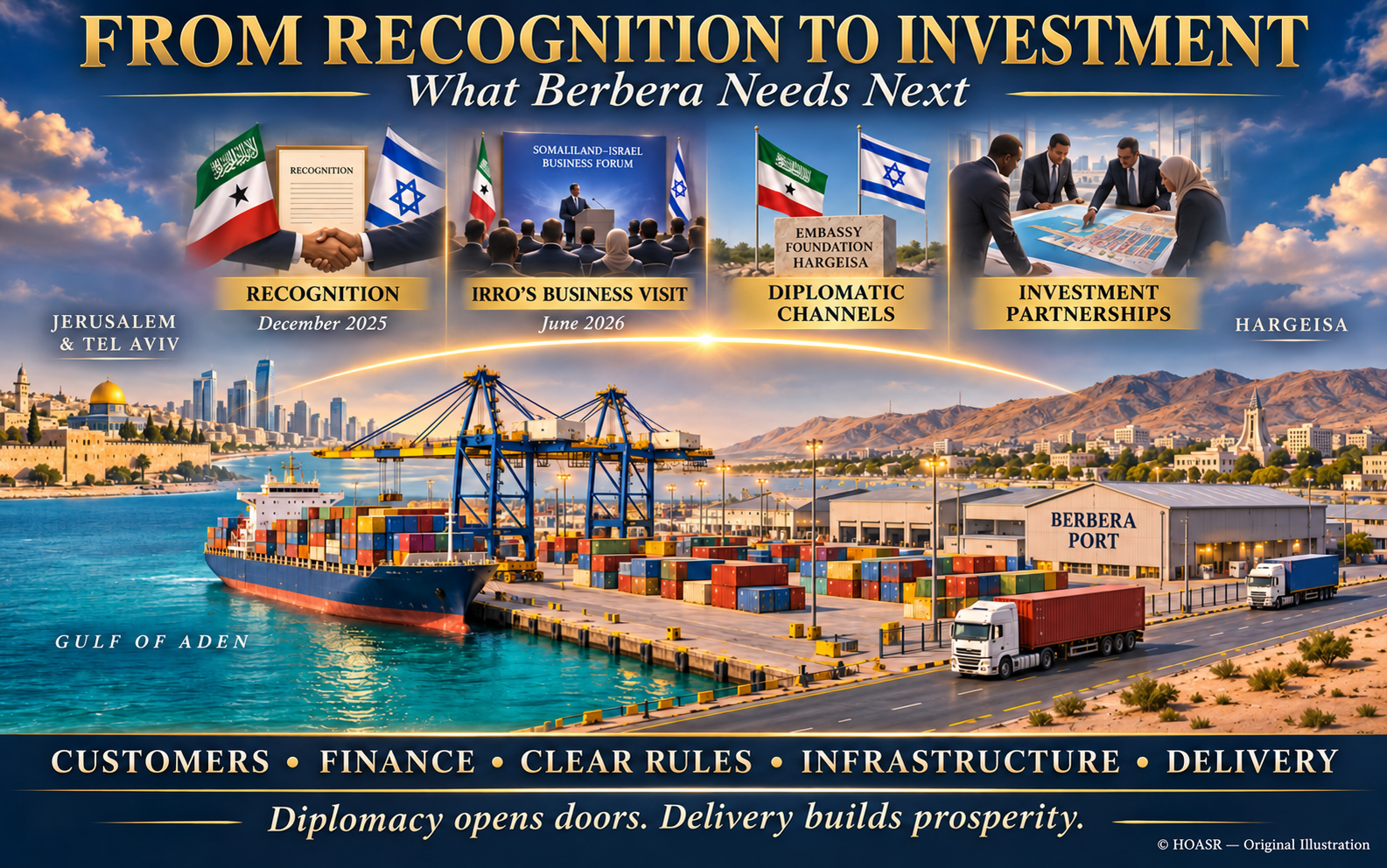
From diplomatic recognition to commercial opportunity: Somaliland–Israel ties are developing the institutions needed to support investment in Berbera. © HOASR — Original Illustration.
From recognition to embassies and business forums, a lasting relationship Between Israel and Somaliland is taking shape.
Recognition gives Somaliland greater access to decision-makers. Investment grows when that access produces projects with customers, finance, workable rules, and accountable delivery.
This developing relationship between Somaliland and Israel is beginning to bring those two processes together. What started with a declaration of recognition is acquiring diplomatic institutions and commercial connections.
The recent participation of Somaliland Ports Authority Manager Ali Dirie Ahmed in the Africa–Israel Economic Forum in Tel Aviv should be understood within that wider progress. President Abdirahman Mohamed Abdullahi Irro had already taken Somaliland’s investment case to Israeli business leaders during his June visit.
Ambassadors and embassy arrangements have since given the relationship more permanent channels. Berbera’s appearance at the latest forum suggests that engagement is extending into the institutions responsible for turning national ambitions into practical business.
Recognition opened the door
On 26 December 2025, Israel formally recognized Somaliland as an independent and sovereign state. The announcement included plans to expand cooperation in agriculture, health, technology, and the economy.
A separate statement by Foreign Minister Gideon Sa’ar explained that full diplomatic relations would include ambassadors and embassies, alongside work to institutionalize cooperation across several fields.
In fact, economic engagement was part of the relationship’s stated purpose from the beginning. Israel’s recognition announcement and Sa’ar’s statement on diplomatic relations set out that foundation.
The significance for Somaliland, extended beyond the recognition itself. It established a relationship in which its government could engage directly with another state through agreed diplomatic channels. That provides a solid basis for approaching ministries, trade organisations, companies, and financial institutions.
Those connections become valuable when officials can remain engaged long enough to resolve the questions that arise after an initial meeting.
Irro took the relationship into the business community
President Irro’s June visit facilitated that process. Somaliland’s Foreign Ministry described a state visit covering diplomacy, trade, investment, security, technology, agriculture, and development.
As acknowledged in the Knesset’s official account of the presidential delegation, the opening of Somaliland’s embassy in Jerusalem during the visit advanced the relationship to an institutional presence. Somaliland’s visit announcement and the Knesset’s account show how political engagement was developing into regular state-to-state relations.
The commercial side was equally important. According to the Central Bank of Somaliland’s June 18 account, Irro participated in the first Somaliland–Israel Business Forum in Tel Aviv, bringing together more than 200 Israeli executives, investors, and company representatives.
Discussions covered infrastructure, energy, water, agriculture, healthcare, telecommunications, and financial cooperation. The Central Bank governor’s participation also placed the financial requirements of investment within the wider diplomatic conversation. The Central Bank’s report documents that early effort to connect political goodwill with economic opportunity.
A presidential visit can secure attention that individual businesses would struggle to obtain. Its lasting value depends on whether the institutions accompanying the president continue the work afterwards.
Investors need answers about land, licensing, payments, taxation, infrastructure, and local partners. The June forum created an opportunity for those conversations to begin and a responsibility to keep them moving.
An embassy cornerstone gives continuity a physical foundation
The subsequent presentation of Ambassador Michael Lotem’s credentials in Hargeisa added another important step forward. An Israeli embassy newsletter dated November 6 confirmed that the credentials ceremony was followed by the laying of a cornerstone for Israel’s new embassy.
It presented the development as a continuation of the relationship established through recognition and Somaliland’s own embassy in Jerusalem. The official newsletter documents that progression.
The cornerstone is very crucial and important because it expresses an intention to give the relationship a durable home. An effective diplomatic channel provides continuity between visits, introduces the appropriate officials, follows up on unresolved matters, and helps businesses understand whom to deal with.
As the relationship develops, those everyday functions can become as consequential as the ceremonies that first attracted global attention.
This is how relations become institutionalized. Responsibility gradually extends beyond presidents, prime ministers and foreign ministers to ambassadors, financial authorities, port officials, technical departments, and businesses.
Reported Israeli reassurances the Jerusalem Post report that relations with Somaliland will continue despite a change of government should ease concerns in Hargeisa and provide greater confidence for advancing political and economic cooperation.
More people acquire a practical reason to maintain the relationship and cooperation then has a better chance of surviving changes in political leadership and shifts in the news agenda.
Lotem brings an economic role to the diplomatic channel
Michael Lotem’s responsibilities are particularly relevant to this next stage. The official programme for the November Africa–Israel Economic Forum identifies him as both ambassador to Somaliland and ambassador for economic and business promotion in Africa.
Lotem’s scheduled welcome remarks at the forum placed him among participants concerned with finance, infrastructure, and commercial cooperation across the African continent.
In fact, its Lotem’s dual role capacity and experience that gives Somaliland a diplomatic counterpart whose responsibilities directly include the economic relationships it wants to develop.
The practical opportunity is considerable. A diplomat working across African economic engagement can help identify suitable companies, explain commercial expectations, and connect a proposal with people able to assess it.
Somaliland, in turn, needs institutions capable of supplying reliable information and taking decisions. The most productive relationship will involve preparation and follow-through on both sides.
Berbera enters the conversation
Against that background, Ali Dirie Ahmed’s participation in the Tel Aviv forum becomes more meaningful. The Ports Authority’s announcement, reported by Horndiplomat on November 14, connected the visit with maritime trade, logistics, and investment.
It highlighted Berbera’s infrastructure, economic zone, and corridor to Ethiopia. These are specific commercial assets around which prospective partnerships can be developed. Horndiplomat’s report places the port authority within the expanding economic relationship.
The forum’s published agenda was relevant to that task. It addressed financing African projects, infrastructure ownership and operation, and preparing proposals that investors can support.
Water-sector experience and development finance also featured in the programme. These subjects concern the work needed to move from an attractive investment idea to a funded and operating enterprise. The official programme provides a useful guide to the expertise Somaliland could develop through follow-up discussions.
What Berbera needs next
Berbera already has substantial infrastructure on which to build. DP World lists its post–Phase 1 container-handling capacity at 500,000 twenty-foot equivalent units annually. The next commercial challenge is to attract more businesses that can use that capacity, generate regular cargo, and support employment around the port. DP World’s terminal information establishes the scale of the existing platform.
A manageable group of well-prepared projects would help. Warehousing, refrigerated storage, freight services, water supply, industrial electricity, and technical maintenance each offer possibilities, subject to demonstrated demand.
Every proposal should identify the customer, expected revenue, required finance, local partner, and responsible public authority. Investors should be able to understand how the project will operate and how foreseeable problems will be resolved.
The Ethiopian market remains important to that effort. The December 2025 evaluation published by British International Investment found that Berbera’s competitive reach had expanded into eastern Ethiopia, while Djibouti retained advantages for areas served by its railway.
That finding suggests Berbera should first attract cargo from markets where it can offer reliable service at competitive prices, then expand its reach as its track record grows. The BII evaluation offers a solid basis for that strategy than geography alone.
Accountability should accompany the investment drive. Somaliland’s institutions should be able to track which proposals advance, who is responsible for them, and what obstacles require government action.
Local businesses and workers also need a clear place in the process through supply contracts, training, and employment. These are the outcomes through which the public will judge the economic value of diplomacy.
The Scoop
The chronological sequence now deserves attention: recognition, a presidential visit, business engagement, embassy arrangements, an ambassador with an African economic promotion role, a reassurance of continuity, and participation by Somaliland’s port leadership in a wider investment forum.
Taken together, these developments strongly suggest a relationship acquiring the institutions needed for sustained cooperation. They give Somaliland more channels through which to pursue its economic interests.
The public sources reviewed does not yet identify a signed Berbera investment agreement arising from the November forum. The next evidence remains to be seen in named projects, financing commitments, implementation timetables, and operating results. Those would show how far the connections established in Tel Aviv have progressed.
For Somaliland, this may be the beginning of a more consequential phase. Recognition has created access. The diplomatic relationship is developing the continuity needed to use it. Berbera can now help demonstrate what that means in practice and the next chapter will be measured in tangible projects, trade and jobs.
Related Topics
Related Posts