Geopolitical Analyst: Bridging Somaliland & Israel to the world
Israel Reassures Somaliland: Recognition Beyond Netanyahu’s Government
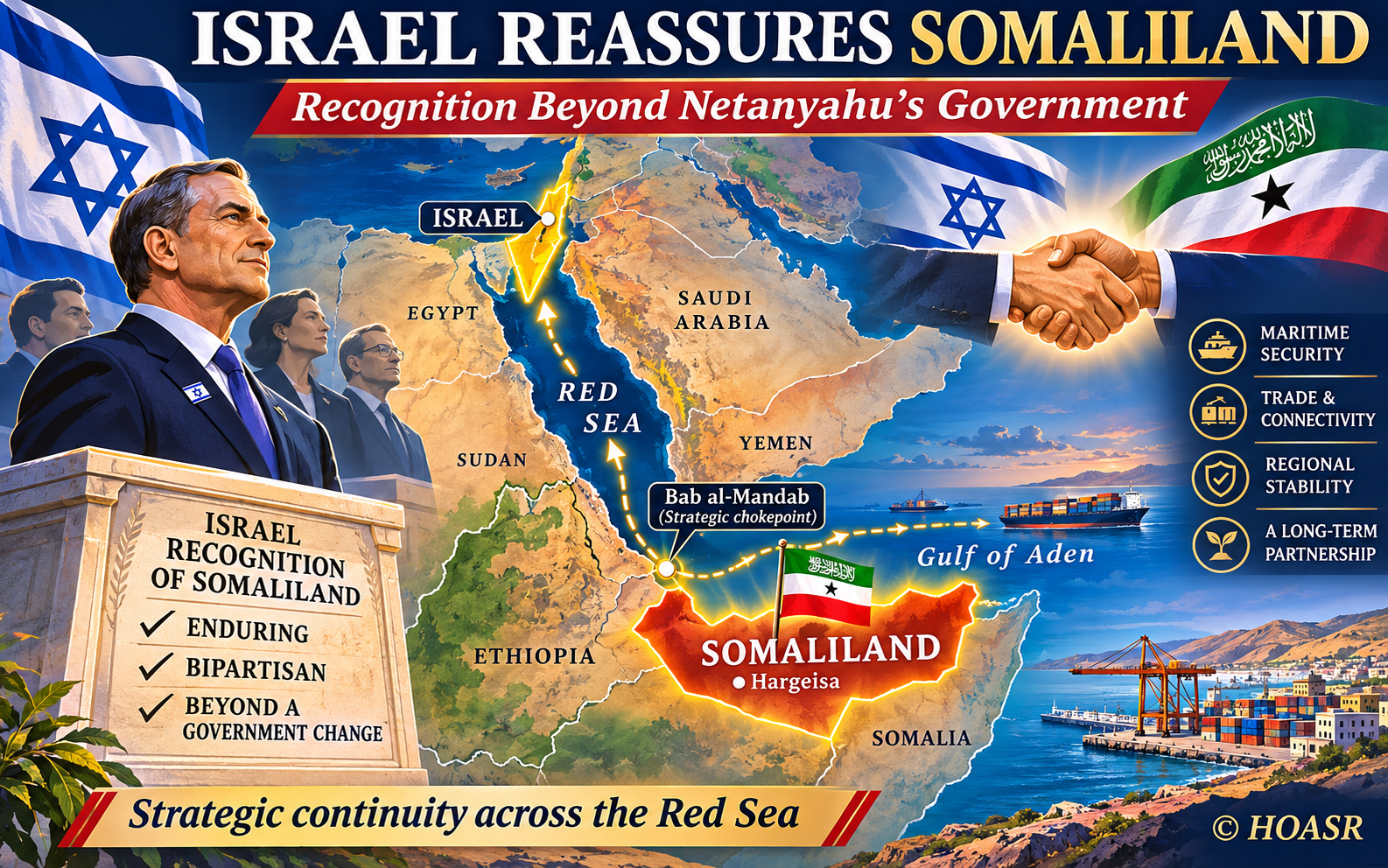
Israel’s reported reassurances to Somaliland point toward diplomatic continuity beyond Netanyahu’s government, underscoring Somaliland’s strategic location along the Gulf of Aden and Red Sea maritime corridor. © HOASR.
A day after I questioned what an Israeli change of government might mean for Hargeisa, Israeli reporting offered a revealing answer. But the difference between reassurance and an agreement still matters.
On November 11, I asked in The Times of Israel whether Israel’s recognition of Somaliland could outlast Prime Minister Benjamin Netanyahu. Twenty-four hours later, a report from Jerusalem supplied a public indication that Hargeisa had sought an answer to the same question—and had been reassured.
The timing was striking. More important was what the report said about the future of a relationship that is still less than a year old. According to The Jerusalem Post, citing Israel’s public broadcaster KAN, Israeli sources told Somaliland’s leadership that recognition would not be reversed if Netanyahu were replaced.
The sources reportedly included people outside politics, who described Somaliland recognition as a matter that was not controversial in Israel. For a country that spent decades seeking a formal diplomatic partner, that is more than a passing remark.
Hargeisa Had Asked the Right Question
Somaliland’s concern was not difficult to understand. Netanyahu announced recognition on December 26, 2025. Now, following Israel’s October election, former army chief Gadi Eisenkot has been given the chance to form a new government.
On November 8, President Isaac Herzog formally handed Eisenkot the mandate after consultations in which factions representing 67 Knesset members recommended him. He still has to assemble a coalition. There is no new Israeli government in office yet.
In my November 11 column, I argued that Somaliland should welcome Netanyahu’s role without attaching its diplomatic future to his political survival. That was not a criticism of the prime minister.
It was a reminder of how foreign relations are supposed to work: presidents and prime ministers come and go; countries have to deal with their successors. The new report shows why that clarification mattered to officials in Hargeisa as well.
Reassurance Is Not a Coalition Agreement
There is an important detail in the KAN account. It describes assurances from Israeli sources; it does not name Eisenkot as the person who made them, publish a joint statement by opposition parties, or cite a signed commitment from a prospective coalition.
We should not turn an anonymous reassurance into a promise that every Israeli party has formally endorsed. That would be go further than the evidence shows. Even with that reassurance, the message carries weight. Israel’s next cabinet may disagree over domestic reform, security, religion and the conduct of regional diplomacy. Eisenkot’s coalition talks are already exposing some of those divisions.
If Somaliland recognition is regarded by influential Israelis as a settled state decision rather than Netanyahu’s personal project, Hargeisa has reason to approach the transition with greater confidence. The real proof, of course, will come in the decisions a new government actually takes.
The Relationship Already Has an Address
Recognition was not left hanging on a press release. The Israeli government’s December 26 announcement recorded a joint declaration signed by Netanyahu, Foreign Minister Gideon Sa’ar and President Abdirahman Mohamed Abdullahi Irro. Sa’ar subsequently instructed his ministry to institutionalize the new relationship through ambassadors and embassies. Those were state actions, taken through public offices, not merely campaign promises.
The next step arrived in Hargeisa on November 1, when Ambassador Michael Lotem presented his credentials to President Irro. A cornerstone ceremony for Israel’s planned embassy followed.
The building is not yet proof of a fully developed partnership, but the accredited ambassador is a concrete fact. Regular diplomatic work has begun, and that creates channels that can keep functioning when political leaders change.
Why the Red Sea Still Matters
Israel did not discover Somaliland by accident. The country faces the Gulf of Aden, on the approaches to the Bab al-Mandab strait and the Red Sea. Berbera is part of the conversation about trade routes, port access and Ethiopia’s search for alternatives to its heavy dependence on Djibouti. Israel has its own interests in maritime security and the safety of shipping. Those interests do not disappear when a new prime minister enters office.
Yet geography is not an agreement. It would be wrong to assume that recognition has already produced military basing rights, an air-defense arrangement or a package of funded projects. What is publicly established is the diplomatic relationship and Israel’s stated interest in cooperation on agriculture, health, technology and the economy.
The next phase should be judged by the projects, investment and security arrangements the governments actually announce and deliver—not by everything outside that observers speculate.
Mogadishu Will Still Object
Israel’s reassurance does not settle Somaliland’s wider recognition dispute. Somalia rejects Somaliland’s claim to independence, and the African Union Commission has reaffirmed its support for Somalia’s sovereignty and territorial integrity.
These positions remain part of the diplomatic landscape. Nor does one government’s recognition automatically compel Washington, Addis Ababa or any other capital to do the same.
But continuity in Jerusalem would have a significance of its own. It would show that the relationship can withstand a test Somalilanders have been watching closely: the first serious possibility of an Israeli change of government since recognition.
A durable relationship could become a practical example for other capitals to study, whether they eventually agree with Israel’s decision or not. This strengthens the case for continued diplomatic engagement, while recognizing that Somaliland’s broader quest for international recognition remains a work in progress.
The Scoop: A Private Question Gets a Public Answer
Here is what makes the sequence worth noting. On November 11, my article asked whether Somaliland’s new relationship with Israel was strong enough to survive Netanyahu’s departure.
On November 12, KAN’s reporting—carried by The Jerusalem Post—revealed that Somaliland’s leadership had itself raised concerns about precisely that possibility and had received reassurances from Israeli sources.
The report does not say that the earlier column prompted those conversations, and there is no reason to suggest it did. What it does show is that the question was already being addressed where it belongs: between Hargeisa and Jerusalem.
It also changes the tone of the debate. Somaliland need not spend the coming weeks guessing whether every twist in Israeli coalition talks threatens recognition. It can ask for continuing contact with the people who may run Israel’s foreign ministry, parliament and national-security institutions.
The best reassurance is one that survives the headlines because it is followed by ordinary diplomatic business.
Netanyahu deserves credit for the decision that opened the relationship. Somaliland should not diminish that history. But its future with Israel ought to rest on something wider: working embassies, trusted officials, realistic agreements and a willingness to speak to whichever government Israel’s elected representatives produce.
Hargeisa has heard that recognition is not supposed to be up for political bargaining. That is welcome news. Now it needs to see the relationship continue after the cabinet is formed. Netanyahu opened the door; the more important question is whether Israel keeps it open when someone else holds the keys.
Related Topics
Related Posts