From Sacrifice to Prayer: Why Judaism Must Civilize Prayer
The Human Origin of Sacrifice
Sacrifice did not begin as a divine instruction. It began as a human response to vulnerability. Faced with forces beyond control—weather, fertility, illness, loss—human beings reached for a way to enlist a higher power in the struggle to survive and to flourish. Sacrifice emerged as an early religious technology: offer something valuable, and hope reality bends in return. In its raw form, sacrifice is transactional. The human gives; the divine is expected to respond.
Judaism did not invent that impulse. What it did—one of its most consequential moves—was to refine it.
Judaism’s Method: Civilizing Powerful Impulses Toward Higher Ends
The Torah does not treat human impulses as shameful; it treats them as powerful and therefore dangerous when left unshaped. Judaism’s recurring genius is not to deny what humans do, but to discipline it toward what humans should become.
That discipline follows a recognizable pattern: Judaism speaks most confidently at the highest level—justice, compassion, holiness, moral responsibility, human dignity—and then, in response to real human behavior, imposes constraints and guidelines so the practice can serve those ends rather than consume them. It rarely legislates inner experience in detail. Instead, it civilizes human tendencies by shaping the conditions under which they are expressed.
The sacrificial system is a clear example. Sacrifice is bounded, regulated, centralized, tied to moral responsibility. Not every offering is permitted. Not every place is acceptable. Not every desire justifies ritual action. The point is not merely order. The point is refinement: redirecting the human urge to bargain with reality into a disciplined form of service.
The Torah’s Silence About Prayer Is Not an Accident
This broader method becomes clearer when we notice what the Torah does not prescribe. The Torah barely legislates prayer at all. When people speak to God in the Torah, they do so spontaneously—out of crisis, longing, gratitude, or moral urgency. Barren women plead for children; leaders intercede during catastrophe; Abraham argues for justice; Moses utters a brief cry for healing. But there is no revealed blueprint for prayer, no mandated liturgy, no instruction about frequency, language, or emotional posture.
That silence matters. It reflects Judaism’s reluctance to legislate the interior life, even as it articulates moral ends with unmistakable clarity.
Prayer Replaces Sacrifice—But Without a Divinely Ordained Architecture
When the sacrificial system could no longer function, prayer emerged as its successor. Not because prayer arrived fully formed by revelation, but because the underlying human impulse remained. People still needed to ask, thank, protest, confess, hope, and reach beyond themselves.
Yet prayer entered Jewish history without a divinely ordained architecture. The forms of prayer—fixed times, texts, communal norms, melodies, rhythms—developed gradually through human authorship, historical necessity, and communal need. In this sense, prayer is no less a human construct than sacrifice once was.
At first, prayer represented a genuine refinement. It internalized the offering. Words replaced animals; intention replaced blood; the heart became the altar. Prayer could shift religious life away from managing God and toward refining the human being.
But refinement is not immunity. Over time, prayer too accumulated distortions—new ways for a human construct to drift away from its purpose.
The Core Claim: Prayer Is Meant to Strengthen and Improve Us
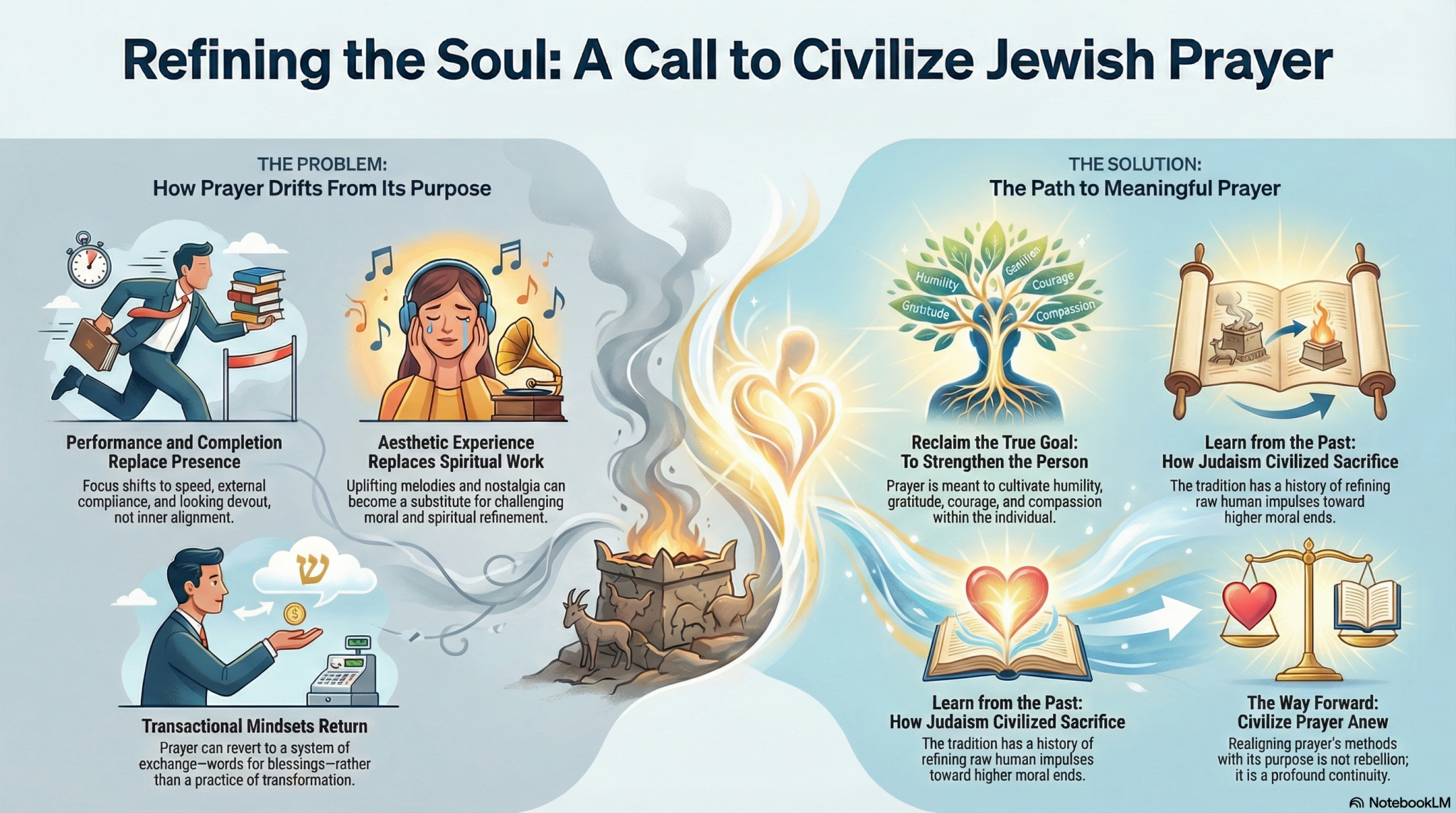
If prayer has a justification beyond habit, it is not that God needs it. Prayer is meant to do something to the person who prays: to reconnect us to what we claim to serve, to restore perspective, to awaken humility, gratitude, courage, responsibility, compassion—our aspirational purposes as human beings.
The question, then, is not whether prayer is traditional. The question is whether prayer is still reliably formative.
And this is where the need to civilize prayer again becomes urgent.
Why Prayer Now Needs Civilizing
The Mismatch Between Liturgical Demand and Human Attention
Prayer asks for attentiveness and sincerity, but it is often practiced in conditions that make sustained intention unlikely. Speed, volume, distraction, and social synchronization create a cognitive environment that overwhelms real inward focus. This is not a moral critique of congregants. It is an observation about human psychology: attention is limited.
A practice that routinely demands more attention than ordinary people can realistically give will produce predictable outcomes: numb repetition, self-reproach, or disengagement. None of these strengthen the soul.
When Completion Becomes the Metric, Purpose Is Lost
In many communities, the unspoken measure of “good prayer” is completion: Did we say everything? Keep pace? Finish on time? Perform the expected responses? This shifts prayer from inner alignment to external compliance. The ritual becomes a task to be executed.
This matters because practices train what they reward. If prayer rewards throughput, it trains throughput. It does not train transformation.
Performance Crowds Out Presence
Public ritual is inherently social, and social cues easily become the dominant goal: appearing fluent, staying in sync, doing what others do at the right moments. This need not be hypocrisy; it is often simply the way people survive a communal setting. But presence and performance compete for the same inner resources. Over time, a culture that prioritizes visible participation teaches people to substitute “I looked devout” for “I became devout.”
Aesthetic Uplift Replaces Spiritual Work
Melody can carry devotion. But it can also replace it. When prayer becomes primarily an aesthetic experience—moving, comforting, nostalgic—feeling can become a substitute for refinement. Comfort is not evil. Yet comfort alone rarely strengthens character. Prayer that reliably delivers mood while rarely producing moral clarity or deeper responsibility has slipped from formation into consolation.
Transaction Returns in New Forms
Even when explicit deal-making with God is rejected, prayer often reverts to subtler transactions: words as currency, observance as insurance, piety as protection, recitation as merit accumulation. Where the inner purpose of prayer is unclear or inaccessible, people reach for measurable substitutes. The result is a spiritual economy—anxiety disguised as devotion. That does not refine the human being; it refines the fear.
Language Without Meaning Becomes Motion Without Ownership
A practice meant to cultivate consciousness can be undermined when most participants cannot understand what they are saying in real time. Hebrew can be holy and powerful, but for many it becomes functionally opaque. In that case, prayer naturally shifts from meaning to motion: from intention to phonetics, from inner alignment to communal vibe. Something real may still occur—identity, belonging, memory—but it is not reliably the kind of strengthening prayer claims to provide.
Untrained Depth Is Expected From Untrained People
Modern Jews increasingly understand that contemplative states require training and the right setting. We would not expect serious meditation to emerge reliably from overstimulation, speed, and cognitive overload. Yet prayer communities often offer little training and few conditions for attention, while still speaking of kavanah as though it were simply a matter of trying harder.
This gap yields two predictable outcomes: people blame themselves for failing at an unrealistic task, or they lower their expectations until prayer becomes nostalgia, mood, or mere identity maintenance. Either way, prayer drifts from its purpose.
The Evidence Is the Aftermath
If prayer is meant to strengthen and improve us, it should leave traces. Not constant inspiration, not uniform emotion, but some residue: greater humility, greater patience, greater gratitude, greater moral clarity, greater courage to live differently. Yet many sincere participants report something thinner: relief that it’s over, comfort in familiar tunes, occasional uplift—without noticeable transformation.
This is not condemnation. It is diagnosis. It indicates misalignment between what prayer says it is for and what it reliably produces.
The Jewish Conclusion: Civilizing Prayer Is Not Rebellion—It Is Continuity
Judaism civilized sacrifice because powerful human religious impulses, left unchecked, drift toward superstition, manipulation, and empty transaction. Prayer emerged as a refinement of sacrifice, but prayer too is a human construct that can drift. When prayer becomes structurally misaligned with human attention and with its own professed aim of refinement, the most Jewish response is not rationalization and not maximalism. It is civilizing discipline: clarifying the ends and honestly evaluating whether the means still serve them.