
From the Cave to Performance and Ritual Act
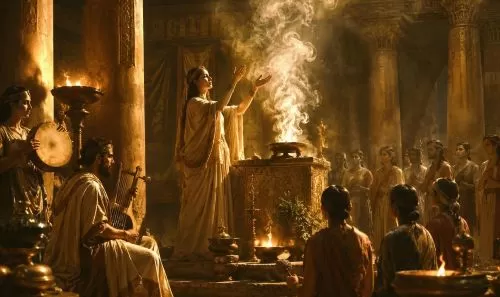
From the Cave to Performance: Art as a Living Ritual Act
This moment of dissolution resonates in a striking way with twentieth-century art: from the cave to the stage and back to the body. The boundary between exterior and interior, between reality and imagination, between darkness and light, between sound and shadow, dissolves. The cave becomes an intermediate space in which the boundaries of consciousness are dissolved. Cave art does not represent reality; rather, it constitutes a physical and embodied experience. It leaves behind neither stage nor audience, but creates a memory.
Over the past two decades, researchers have increasingly sought to understand cave paintings not merely as visual art, as it is presented in galleries and museums, but as a ritual, performative, and interdisciplinary art form, reminiscent of the artistic performances of the 1960s and 1970s. Painting is only one element within a larger artistic ensemble that includes movement, echo, sound, the smell of smoke, singing, and flickering light. The movement of the torch creates a form of theatre upon the topographical structure of the wall, producing a three-dimensional visual experience. Within the cave, a ceremony of total sensory experience takes place. The space, the painter, and the visitor, who may sometimes have arrived from outside, constitute intrinsic elements of the artwork of the Neolithic period. Consequently, this art was not “exhibited” but performed as an act within a space specifically selected for the event.
When performance artists sought to deconstruct the definition of art, they returned to the cave. Joseph Beuys (1921–1986) stood beside a live wolf in a gallery, presenting himself as an ancient shaman and declaring that “everyone is an artist.” His works became rituals of the transformation of consciousness. The performance artist Ana Mendieta (1948–1985) carried out bodily acts in relation to the earth, covering her body with mud, blood, and fire, evoking the forms engraved upon cave walls. She returned to the womb of the earth, just as the ancient painter descended into the bowels of the rock. In her words, “my body is the place from which I speak to the earth, and my art is a prayer.” The artist Marina Abramović would sit alone and silently before an audience, extending the temporal dimension of the ceremony. Time, space, her body, and the audience become parts of a shared energetic circle, reminiscent of what may have taken place in the depths of a cave.
The artist James Turrell created chambers filled solely with light, in which the spectator’s body seemed to dissolve and participate in a sensory immersion evocative of an ancient trance. In the installations of the Icelandic artist Olafur Eliasson, light, mist, and the spectator’s physical sensation of heat converge in an experience of total presence, constituting an artistic act without an object. As in the ancient cave, light serves not merely to illuminate but also constitutes scenic content in its own right. In the Paleolithic cave, therefore, what took place was in fact a multisensory ritual art form.
Thus, cave paintings may be perceived as a form of performance art, in which the painter’s body becomes integrated into the work executed upon the wall of the cave, as though the wall itself were a stage. Hybrid images express a synthesis, or a mythical conception, of unity: human beings and animals are not differentiated but represent two manifestations of a single natural force. Cave paintings therefore reflect both reverence and fear: reverence for animals as sublime entities, and fear of their nature as uncontrollable forces. Did prehistoric humans aspire to become the very animals they depicted? These works also testify to the emergence of a collective imagination—the capacity to imagine what does not exist in reality and to endow it with symbolic existence. In his mind, the painter thus created the mythical figure of the lion-man. When human beings began to narrate stories about their environment, a desire emerged to translate those narratives through other means.
Ever since prehistoric humans traced the silhouette of a horse or bison upon the walls of a cave, art has functioned as an inner mirror of memory: it does not reflect external reality but reveals how experience and imagination shape reality at every moment. Even before the emergence of words and language, the image manifested itself as an act of observing the environment through the experience of narrative. The paintings were not intended simply to describe reality but to confer upon it an existence extending beyond the present moment. Contemporary art, likewise, is not limited to presenting an image; it seeks to reveal a singular creative process through the relationship between experience and the eye. It invites us to observe how the world is constructed within us. Each image is a mirror revealing the enigmatic form of consciousness.
Ancient rock art and modern performance art represent two ends of the same thread: the exploration of human presence. The cave is not merely a geographical location but a state of consciousness. Darkness and resonance created a visual experience in which, for a time, the painter merged with the animals and with the cave itself. In reality, the only things prehistoric humans saw when leaving their dwelling were animals. The long process of emerging into daylight, the prolonged journey, the arrival at the cave, and the descent into its depths required considerable physical effort and a transformation of consciousness in order to enter the womb of the earth. This evokes the material and psychological preparations of a modern person before sitting down in a concert hall. The modern stage, the gallery, and the artist’s studio are merely new incarnations of the dark space in which prehistoric humans lit a torch in order to perceive themselves as generators of a new reality. In this sense, performance art is not a modern invention but a return to the most ancient intuition of creation: art as a living ritual act, as the body’s response to darkness. All great art is, in truth, a continuous attempt to return to the cave, to the place where human being, shadow, and voice are transformed into light.
In conclusion, a systematic examination of 452 decorated caves raises a fundamental question: what prompted human beings to enter dark, dangerous, and difficult-to-access underground spaces in order to depict precisely wild animals? In my view, we should be wary of anachronistic interpretations—that is, of projecting onto Paleolithic societies mystical or religious concepts belonging to much later historical periods. Notions such as spiritism, codified animism, structured totemism, formalized shamanism, institutionalized mysticism, ritual trance states, hallucination conceived as a religious practice, or even the conception of the cave as a cultic sanctuary, reflect our own contemporary conceptual universe more than that of the Homo sapiens of this period. We should also avoid the phenomenon of anatopism, namely the tendency to attribute, arbitrarily, clearly defined systems of belief to ancient populations without empirical foundations. Such interpretations therefore require considerable methodological caution. The interpretation of decorated caves demands a sober reading, attentive to the anthropological specificity of these ancient societies.
What cognitive representation of the cave, then, might have operated in the minds of prehistoric humans to the extent of leading them to produce paintings whose locations were far from arbitrary? According to my hypothesis, the cave functioned as a symbolic space connecting the visible with the invisible, the surface with the depths, and mythical time with an unknown past. One may hypothesize that beings associated with the earth—animals as well as humans—were perceived as having emerged from the primordial cave. The act of painting upon the walls of the cave could therefore be interpreted as a form of cultural memory, or even as the ritual reenactment of this foundational emergence from the earth, which constituted the origin of human beings and the universe. The cave was thus not perceived as a mere physical space intended to receive images, but as a component of a mental topography in which the subterranean depths acquired mythical significance.
From this perspective, one may hypothesize that a universal creation myth, which could be designated as “primordial emergence,” lay behind the mental universe of the painters. This narrative pattern, attested in numerous mythological traditions across the world, rests upon the idea that the origins of human beings and animals lie in the depths of the earth, conceived as a kind of subterranean matrix from which animals and humans emerged in order to reach the surface.