From the Encampment to the Ballot Box
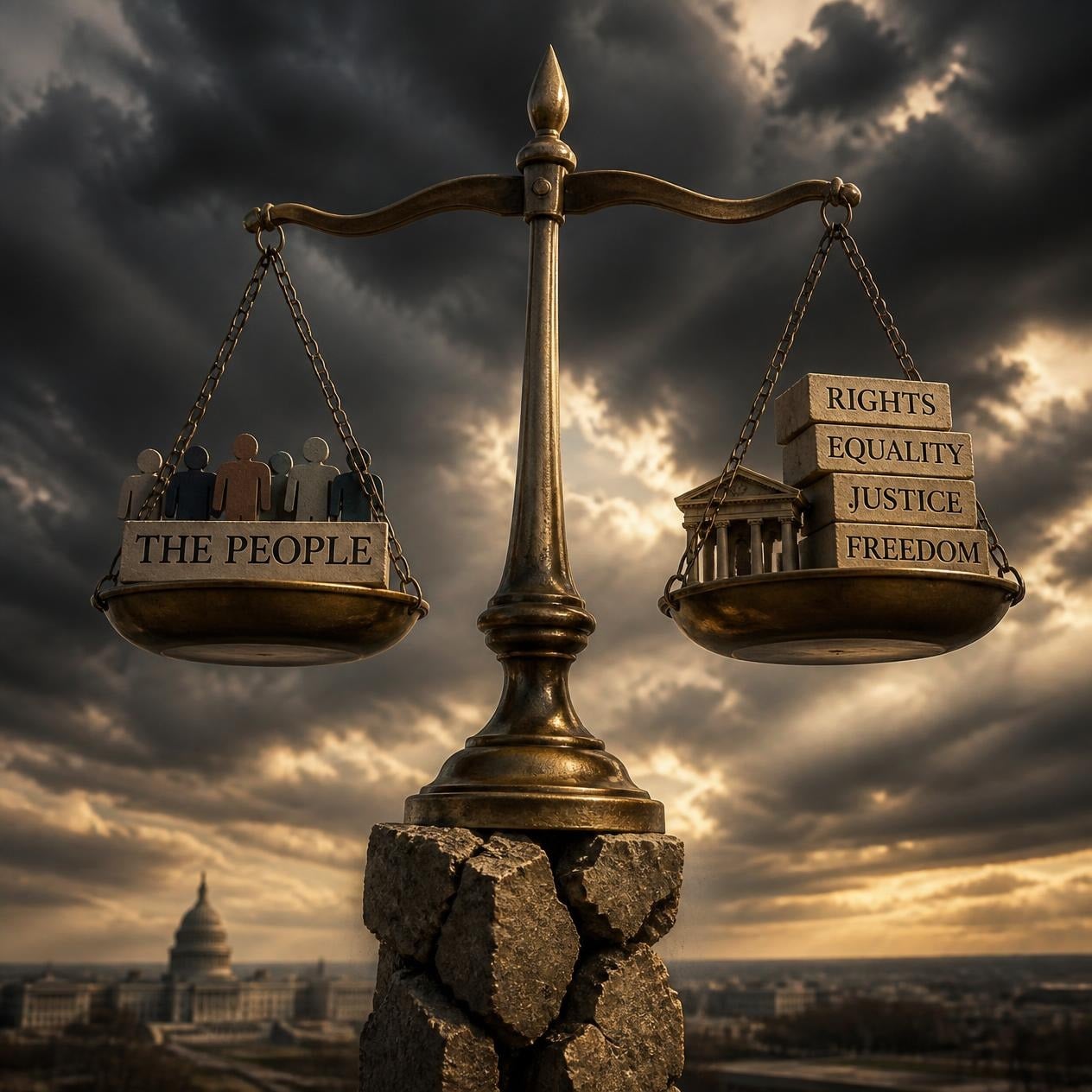
A review of FEC and IRS filings, Democratic Socialists of America (DSA) convention votes, and the fiscal shells behind the 2024 campus protests reveals a movement whose infrastructure runs from Louisville city council to the U.S. Senate and whose ideology is spreading. Pro-Israel donors spent millions trying to stop it. It didn’t matter.
On the night of August 4, 2026, Michigan Democrats nominated Abdul El-Sayed for the United States Senate over the party establishment’s chosen candidate. In Detroit, DSA-backed state Representative Donavan McKinney unseated a sitting Democratic congressman. Same night in Missouri, Cori Bush lost her comeback kid bid. By dawn, Senate Minority Leader Chuck Schumer and DSCC Chair Kirsten Gillibrand welcomed El-Sayed to the November ticket. The party that had opposed him for eighteen months had embraced him inside twelve hours. By the next day, that embrace has widened beyond the Senate leadership. Former Vice President Kamala Harris sent a fundraising appeal backing El-Sayed, telling supporters that he “needs us all to get behind him.” The appeal came through Fight for the People PAC, which reported $17.3 million in receipts through June 30, 2026. El-Sayed did not need the Democratic establishment’s machinery to win the nomination. Once he won it, that machinery began to move behind him.
That is the headline race. The bench under it is the story we need to look more closed at.
Zohran Mamdani is mayor of New York. Melat Kiros – a 29-year old with no prior campaign – beat 15-term Representative Dian DeGette in Colorado on $379,000. Darializa Avila Chevalier – an organizer of Columbia University’s encampments – defeated five-term Representative Adriano Espaillat in Manhattan. In D.C., democratic socialist Janeese Lewis George won the Democratic mayoral primary and is the heavy favorite to lead the nation’s capital.
And down-ballot: DSA-backed candidate Gabriel Sanchez won reelection to the Georgia House. Mathewos Samson won the Georgia HD-58 runoff. Aber Kawas, a DSA-backed Palestinian American, won a New York State Senate primary. Chris Rabb, a DSA state legislator, is now the Democratic nominee for a Philadelphia U.S. House seat with no Republican filed against him. In Wisconsin, DSA’s local chapters are boosting state candidate Francesca Hong, supported by a new Central Wisconsin DSA chapter that organizers formed in a single week to build the infrastructure. DSA chapters have described Hong’s gubernatorial campaign not merely as an election but as a means of building a statewide socialist movement. San Francisco Supervisor Dean Preston is a DSA member. Louisville City Council candidate JP Lyninger in on the DSA slate. In total DSA is running roughly ninety endorsed candidates for federal, state, and local office in the 2026 election cycle.
This is the not the outburst of season. It is the electoral output of an infrastructure that spent 2024 on college lawns.
What the encampments actually were
The spring 2024 Gaza and sometimes terrorist solidarity encampments were not an outburst either. They were intentional and well organized.
The coordinating body was National Students for Justice in Palestine, which in a December 2024 year-in-review credited itself with “127 student encampments, 56 divestment resolutions, over 3,000 students and faculty arrested, over 1,000,000 student mobilized for Gaza.” On October 12, 2023, a mere five days after Hamas’s massacre in Southern Israel, National SJP published a Day of Resistance toolkit that opened with a celebration: “On the 50th anniversary of the 1973 war, the resistance in Gaza launched a surprise operation against the Zionist enemy which disrupted the very foundation of Zionist settler society. On the morning of October 8th, the Palestinian resistance stormed the illegitimate border fence, gaining control of the Gaza checkpoint at Erez, and re-entering1948 Palestine.” Chapters were urged to “continue to resist directly through dismantling Zionism, and wielding the political power that our organizers hold on our campuses and in our communities.”
That was the framing five days after October 7 – before the tents went up.
By April 2024, National SJP was calling students to “join the Popular University for Gaza” and “seize our universities.” On April 25, DSA National issued a statement of “unwavering solidarity” with the encampments, calling on comrades to “support efforts nationwide to force universities to divest from the Zionist occupation” and closing with a call for “the liberation of Palestine, from the river to the sea”. The Young Democratic Socialists of America – DSA’s campus arm – reported in its own magazine that its chapters “organized, participated in, and started encampments on campuses across the country,” including at Columbia, Yale, BYU, Vanderbilt, and the University of Michigan. Approximately 2,000 arrests followed across 32 states.
In September 2024, as the new academic year began, National SJP promoted (in a since-deleted post) a demand from a group calling itself the “actionists” at Columbia University. It read: “True divestment necessitates nothing short of the total collapse of the university structure and American empire itself. It is not possible for imperial spoils to remain so heavily concentrated in the metropole and its high-culture repositories without the continuous suppression of all populations that resist the empire’s expansion; to divest from this is to undermine and eradicate America as we know it.”
This is the ideological frame the movement’s coordinators promoted to their networks.
Who paid for them
National SJP does not have a 501(c)(3) or (c)(4) of its own. It cannot legally receive tax-deductible donations under its own name. It operates as a fiscally-sponsored project of the WESPAC Foundation, a White Plains, New York-based nonprofit whose annual revenue grew from $1.07 million in fiscal 2022 to $3.99 million in fiscal 2024 – a 3.7 fold surge in the eighteen months after October 7. WESPAC houses roughly fifteen Palestine-solidarity projects, including Within Our Lifetime, the Palestinian Feminist Collective, the U.S. Palestinian Community Network, Adalah-NY, and until May 2024 the Palestinian Youth Movement, whose accumulated funds were transferred to a new sponsor at one million dollars.
American Muslims for Palestine has a similar structure. AMP itself does not have IRS filings. Its tax-exempt shell is AJP Educational Foundation Inc – registered in Falls Church, Virginia, a 501(c)(3) whose GuideStar profile is openly titled “AJP Education Foundation Inc / American Muslims for Palestine.” AJPEF reported $2.14 million in fiscal 2024 revenue and disclosed on that year’s Form 990 an “excess benefit transaction” the IRS term for a self-reported case in which an insider was overpaid or improperly enriched by the organization. Only one AJPEF officer draws a salary: Osama Abu Irshaid, AMP’s national policy director, at $117,000. AMP’s founder and AJPEF’s unpaid president is Hatem Bazian, a lecturer at the University of California, Berkeley and it also the person that co-founded National Students for Justice in Palestine.
Since 2017, the families of nine Americans and Israelis killed in Hamas attacks have been suing AJPEF and AMP to satisfy the unpaid portion of an approximately $156 million judgement originally against the Holy Land Foundation, on the linkage that AJPEF and AMP are successor entities to the Islamic Association for Palestine, which itself found liable in the HLF case for material support of Hamas. The litigation is unresolved and still is a federal civil suit.
The two ends of this ecosystem share a sunder. Solidaire Network – a left-philanthropy network founded by wealthy progressive donors including Leah Hunt-Hendrix who is AJPEF’s top disclosed institutional funder at $115,000 cumulative and gave WESPAC $290,000 across 2024-2025 in earmarks specifically for the Palestinian Feminist Collective, the Palestinian Youth Movement, and the U.S. Palestinian Community Network. It is the same donor writing checks to both fiscal shells.
What the movement believes
The movement’s ideology is published, voted on, and citable.
DSA’s national platform, Workers Deserve More, describes DSA’s project as “the eventual transformation of our economy from capital exploitation to collective liberation.” A DSA National Political Committee member has stated the goal directly: “Our goal is to reframe politics around class lines in the United States, which is what the ruling class has been doing forever. We want to transfer power from the 1% to the working class, and to replace capitalism with socialism, which means expanding democracy in every part of our lives.”
The DSA 2024 presidential statement opened with: “Workers deserve more than Trump vs. Harris. Every four years, working people are faced with the same ‘choices’ for president: a conservative Democrat, a deranged Republican.” DSA declined to endorse Kamala Harris. Its platform commitments include “an end to the U.S. war machine, a free Palestine – and the eventual transformation of our economy from capitalist exploitation to collective liberation.” The National Electoral Committee’s endorsement criteria, passed at the 2025 Convention, require endorsees to “view themselves as socialist organizers first, and legislators second.”
Two years after the encampments, at the DSA 2025 National Convention, delegates passed Resolution 22 by a 675-524 vote. It makes it an expellable offense for a DSA member to make “statements or legislation equating anti-Zionism with antisemitism,” to oppose the Boycott, Divestment, Sanctions movement, or to maintain affiliation with AIPAC, J Street, or the Democratic Majority for Israel. Endorsees must “oppose legislation deemed harmful to Palestinians,” back legislation that “supports Palestinian liberation,” and support BDS. Candidates who fail these tests are ineligible for endorsement at both national and local levels. This is the first hard-enforcement mechanism in DSA’s history. It codifies the encampment litmus test into the organization’s constitutional plumbing.
At the same Convention, delegates adopted unanimously a resolution declaring “utilizing the Democratic ballot line is the most effective strategy for building a socialist party in the United States.” They also authorized an exploratory committee for a DSA-backed 2028 Democratic presidential primary candidate. DSA is not building a third party. It is building a party inside the Democratic Party, and it says so in writing.
The infrastructure carrying these positions into elections is heterogeneous but coordinated. The Working Families Party PAC – labor-funded, raised $25.3 million in the 2024 cycle and spent nearly all of it on independent expenditures in Democratic primaries. Justice Democrats – a grassroots small-dollar operation with 2,064 large donors averaging $3,700 each in 2024 – returned in 2026 with its first federal endorsement in four years (McKinney) and joint 2026 endorsements with DSA of Kiros, Rabb, and Avila Chevalier. Sunrise movement PAC endorsed William Lawrence, a Sunrise co-founder, who is not the Democratic nominee for Michigan’s competitive 7th district. These are structurally different constituencies pointed at the same target.
As the level for formal legal coordination – the strongest form under FEC law – the Squad’s four sitting members, Alexandria Ocasio-Cortez, Ilhan Omar, Ayanna Pressley, and Rashida Tlaib, have shared the Squad Victory Fund, a Joint Fundraising Committee, since July 2020, splitting proceeds 12.5 percent to each of the four principal campaigns and their four leadership PACs. Roughly $1.6 million in the 2024 cycle. Interestingly no Joint Fundraising Committee binds any of the 2026 challengers financially to the Squad. A movement that has evolved to coordinate without the paperwork.
The money did not matter
The clearest measure of how far the movement has progressed is on the other side of the ledger.
AIPAC’s United Democracy Project has spent more than $104 million in the 2026 cycle to date, including $30.6 million against Abdul El-Sayed alone – the largest single-race independent-expenditure spend in AIPAC’s history. In the New York City mayoral race, the anti-Mamdani super PAC Fix the City raised over $32 million, with $8.3 million from Michael Bloomberg alone.
The dollar amount is not the story. The story is that it did not move the outcome.
When AIPAC’s coordinated defense of an American Jewish institution’s political posture is defeated by a movement that was on college lawns two years ago, the question is not whether pro-Israel donors are outspending the opposition. They are, by order of magnitude. The question is whether they understand what they are up against. The infrastructure that beat them was not based on money. It was built on the accountability discipline of a socialist organization aligned with ideology that has 80,000 dues-paying members, 225 chapters, 150+ college-campus affiliates, and an operational party-inside-the-party program.
That is the alarm signal.
What this means for America
If the 2026 primary map is the leading edge of what the Democratic Party’s electoral bench becomes in 2028 and beyond, then the country’s foreign policy, its economic policy, and its posture toward its own history, and people, are all in play.
On foreign policy: a Senator El-Sayed, a Representative McKinney, a movement of 90 endorsed candidates whose enabling resolution requires them to oppose “legislation deemed harmful to Palestinians” and supports BDS – this is a caucus that will oppose the standing framework of the U.S.- Israel security relationship and treat AIPAC and the American Jewish Committee, and the Democratic Majority for Israel as adversarial institutions to be defeated inside the Democratic Party. That is not a policy preference. It isa codified constitutional test.
Our economic policy: DSA’ own platform commits to “the eventual transformation of our economy from capitalist exploitation to collective liberation.” Its endorsement criteria require candidates to view themselves as “socialist organizers first, and legislators second.” The distance between that and the New Deal Democratic Party’s post-1948 anti-communist self-definition is not small. A Democratic Party whose ascendant caucus opposes capitalism as such is a much different party than the on Bill Clinton, Barak Obama and Joe Biden ran on.
On America itself: the ideological materials the movement’s coordinators promoted during the encampments – the celebration of October 7 as a “historic win” over the “Zionist enemy,” the National SJP-promoted “actionists” call to “eradicate America as we know it,” DSA National’s own call for “an end to the U.S. war machine” – describe a country whose institutions are not to be reformed but dismantled. Some of that is protest rhetoric that will not survive contact with governing responsibility. Some of it is the actual worldview of the people the movement is elevating to office. Voters have a right to know which is which before they vote in November.
The Democratic Party’s institutional response, for now, has been to congratulate the primary winners and prepare to pend general-election money on their behalf. The DSCC will get its answer in November, one way of the other. But the question the country is being asked to decide – the question that is more important than any single race – is whether a movement whole coordinators celebrated October 7 as a “historic win,” whose largest organizational vehicle has a Palestine litmus test written into its endorsement criteria, and whose stated aim is the replacement of capitalism with socialism, is that the Democratic Party becomes and leads the way for the 2028 ticket.
The question is no longer whether democratic socialists can win elections. They can. The more consequential question is what happens when a movement builds its own candidates, organizers, ideological tests, funding networks, and political infrastructure, then win access to the machinery of one of America’s two governing parties. The story is no longer about the insurgent left operating at the margins. It is about institutional power, and whether the values carried into those institutions remain compatible with the pluralism, restraint, and political tolerance on which American democracy depends.