
President of Shahvand Think Tank
From the PLO to Hezbollah
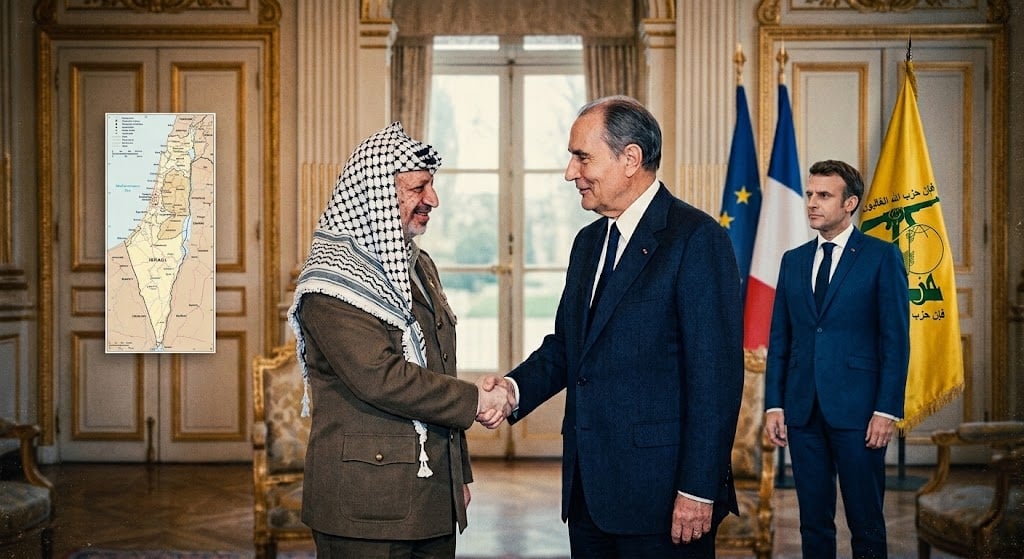
From the PLO to Hezbollah, French Diplomacy, by Shahvand
The Recurring Logic of French Diplomacy
French diplomacy has often faced the same dilemma: how to deal with an armed movement that is also a political reality. In the late 1980s, France helped create the conditions for Yasser Arafat’s transformation from guerrilla leader into a recognized political interlocutor. Today, in Lebanon, Paris appears to be applying a comparable logic to Hezbollah: preserve a political channel, encourage the movement’s integration into the state, and seek the dismantling of its military autonomy. The parallel is not perfect, but it reveals a consistent French method—turning armed actors into negotiating partners before expecting them to abandon force.
The precedent lies in Arafat’s 1989 visit to Paris. After meeting President François Mitterrand, Arafat told French television that the PLO Charter was caduc—obsolete and null and void. The statement, reported by UPI and the New York Times, did not mean that Fatah had suddenly disarmed or that the Palestinian national movement had abandoned its claim. Rather, it marked a symbolic shift: the PLO would present itself less as an armed liberation organization and more as a political representative seeking recognition, negotiation, and eventually statehood.
France understood the value of that shift. A movement that enters politics can be constrained by the responsibilities of politics. It must defend constituencies, negotiate with rivals, accept international legitimacy, and explain its choices in institutional rather than revolutionary terms. The PLO’s evolution was neither linear nor complete, but Arafat’s passage from armed struggle to the Palestinian Authority showed how diplomacy can reshape the identity of a militant movement.
Hezbollah presents France with a version of the same problem, though in a more difficult form. Unlike the PLO, Hezbollah is not an exile organization seeking recognition; it is already inside the Lebanese state. It holds parliamentary seats, participates in government coalitions, and commands social, military, and financial networks that operate across Lebanese territory. France has therefore long distinguished between Hezbollah as a political party, with which its embassy in Beirut maintained dialogue, and Hezbollah as an armed organization, as Le Monde has noted.
This distinction has become increasingly controversial, especially as Hezbollah’s military role has expanded beyond Lebanon’s borders and drawn the country into wider regional confrontation. France has condemned Hezbollah’s participation in attacks on Israel and called on it to end such actions, while simultaneously supporting the Lebanese government’s effort to extend its authority throughout the country, as stated by the French Ministry for Europe and Foreign Affairs and in its Middle East policy statement. President Emmanuel Macron has stated that there can be no stability in Lebanon without both an Israeli withdrawal and Hezbollah’s disarmament, according to LBCI.
Yet France’s approach remains recognizably political rather than purely coercive. Paris has warned that it would be unreasonable to demand that Lebanon disarm Hezbollah while the country is under bombardment, as Reuters reported. It has also emphasized the need to avoid a security vacuum in the south once UNIFIL’s mandate ends, a concern raised by French Foreign Minister Jean-Noël Barrot in The National. The implication is clear: disarmament cannot be treated as a simple police operation. It requires a political framework that gives Hezbollah’s base a reason to accept the state’s monopoly on force.
Here lies the possible French strategy. Paris may be seeking to reproduce, in modified form, the Arafat model: offer Hezbollah a political future inside Lebanon, while making that future conditional on the surrender of its weapons. Hezbollah would remain a party, but it would cease to be an armed state within the state. Its leaders would retain representation, its constituency would retain protection through Lebanese institutions, and its regional patronage would gradually lose its military justification.
The theory carries an obvious risk. Armed movements do not always transform peacefully. If Hezbollah’s leadership accepts disarmament under external pressure, more radical commanders, Iran-linked networks, or local factions could reject the agreement, retain weapons, and continue the struggle underground. Lebanon could then face a weakened official Hezbollah alongside a clandestine armed residue beyond the control of either Beirut or the movement’s own leadership. Lebanese President Joseph Aoun himself has argued that disarmament must be approached through political, military, economic, and social means, as reported by L’Orient Today.
This is why the PLO parallel should be used with caution. Arafat led an organization whose legitimacy depended on international recognition; Hezbollah’s legitimacy rests partly on its claim to resist Israel and partly on its social and sectarian roots in Lebanon. The PLO had no state institutions to defend; Hezbollah is embedded in them. A political settlement that works for an exile movement may not work for a movement that already governs territory, employs people, educates children, and commands weapons.
Still, the underlying French assumption is coherent. A political actor can be pressured, negotiated with, and eventually domesticated; a purely military actor can only be fought. By keeping open the possibility that Hezbollah may remain part of Lebanese politics after disarmament, France is not necessarily legitimizing its armed wing. It may be trying to prevent the alternative: a movement that loses its political stake and retreats entirely into clandestine warfare.
If this is France’s strategy, its success will depend on whether Hezbollah’s leaders conclude that political survival is worth more than military autonomy. Arafat made that calculation when he accepted the language of diplomacy and the constraints of international legitimacy. Whether Hezbollah can make a comparable choice—without splitting into a political shell and an underground armed core—is the central question facing French policy in Lebanon today.
Related Topics
Related Posts