
Where Objectivity Meets Reality
From truth to propaganda: media between Gaza and Moscow
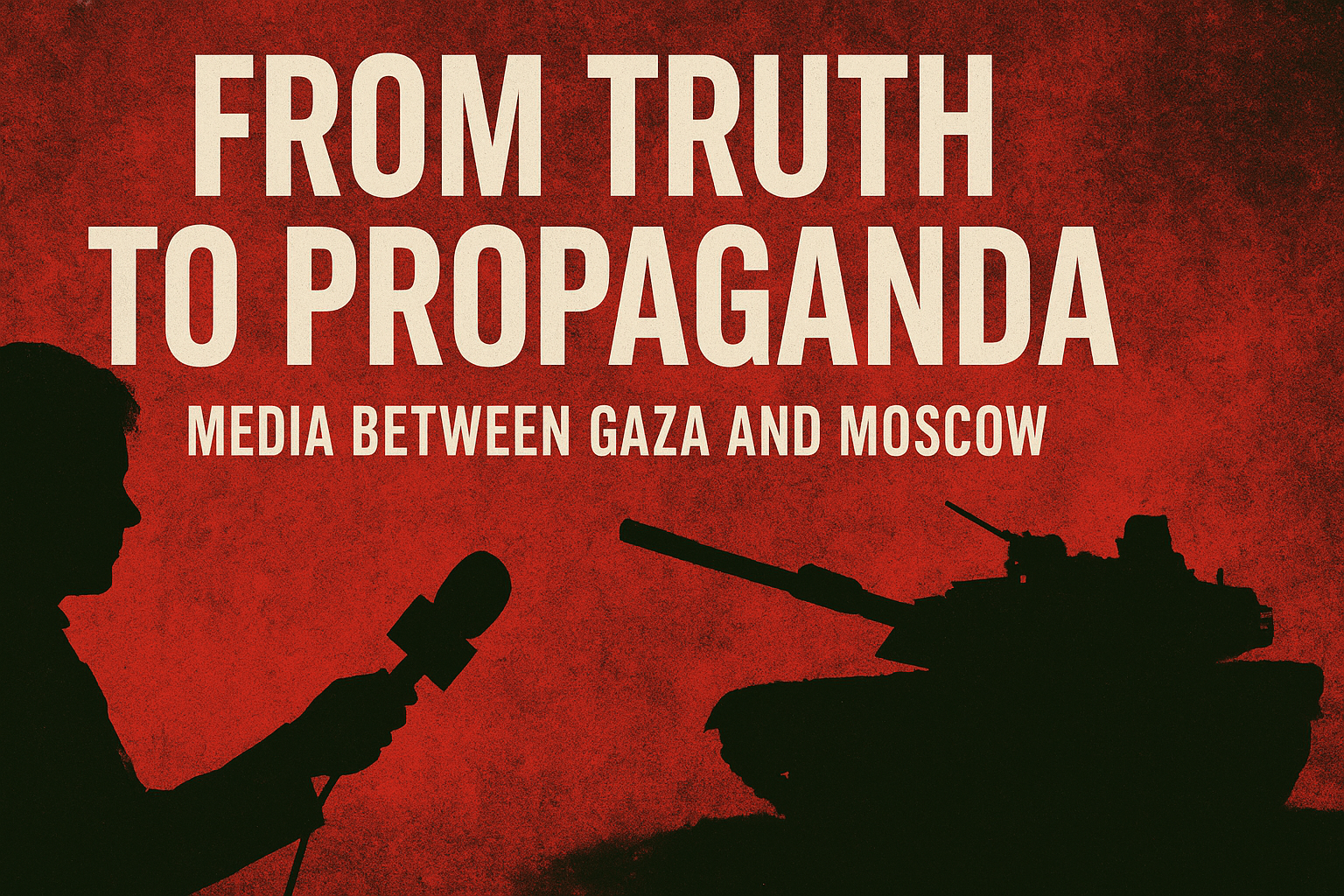
(AI-Generated illustration)
When the VRT (Belgian Flemish Public Media) states that it must not be objective but rather neutral—as prescribed by the Flemish Media Decree—it sounds reasonable at first. After all, philosophy has long taught us that absolute objectivity does not exist.
However: Immanuel Kant, the founder of transcendental idealism, reminded us that we never see the world “as it is” (das Ding an sich), but always through the categories of our own perception. Nietzsche even went further: truth, he claimed, is nothing more than a “mobile army of metaphors,” a perspective that presents itself as universal. Objectivity is thus an aspiration, never a fully realized state.
But where objectivity is a method—trying to investigate as fairly and systematically as possible—truth is a normative claim. Aristotle defined truth classically as “to say of what is that it is.” That seems simple, but in times of war such simplicity collapses. Facts are bent, numbers manipulated, images framed. And here a third concept enters: neutrality. It is precisely here that the problem arises.
Neutrality as a trap
Neutrality appears to be a virtue: not taking sides, treating everyone equally. Yet neutrality can also lead to what philosophers and media theorists call false balance: presenting two sides as equally valid even when the facts do not support such symmetry. Hannah Arendt warned that factual truth is fragile in politics, because lies and half-truths often fit more neatly into a compelling narrative than the messy complexity of reality.
An example: in October 2023, worldwide media reported on the bombing of the Al-Ahli hospital in Gaza. Almost all major outlets, VRT included, repeated the Palestinian claim that Israel was responsible. Later, technical analyses and U.S. intelligence suggested that the strike was most likely caused by a failed Palestinian rocket. Neutrality here, in practice, meant uncritically transmitting a one-sided claim as credible truth.
Gaza: numbers and sources
The same problem appears in casualty figures. Gaza’s Ministry of Health is directly controlled by Hamas, yet Western media, VRT among them, frequently cite its numbers—sometimes with the footnote that “these figures cannot be independently verified.” Still, the public perceives these figures as truth. Neutrality thus produces de facto subjectivity: Hamas’s discourse is legitimized.
This is compounded by the recent revelation that UNRWA staff members were involved in the October 7 attacks. This undermines the supposed neutrality of the UN agency, yet its reports and figures continue to be presented by the media as “reliable.” Michel Foucault would say:
What counts as truth is always bound up with power and institutions. Here we see that mechanism at work.
Iraq and Ukraine: recurring patterns
The phenomenon is not new. In 2003 the invasion of Iraq was justified by the claim that Saddam Hussein possessed weapons of mass destruction. Media largely repeated this “truth,” until it collapsed. In Russia, Vladimir Putin justifies his war in Ukraine with the rhetoric that he is defending Russia against “Nazis” and “NATO aggression.” State media spread this narrative as unquestionable fact.
The parallels are clear: truth becomes a strategic weapon, objectivity is nearly impossible to uphold, and neutrality becomes a smokescreen that often benefits one side.
Philosophical interpretation
What does this teach us?
- Truth exists, but in war it is fragile and contested. There are objective facts (a rocket struck, a building was destroyed), but attribution and interpretation are disputed.
- Objectivity is the aspiration to verify those facts as honestly as possible. In wartime this is nearly impossible, but precisely then journalism must be most vigilant.
- Neutrality is no guarantee of reliability. When neutrality means reporting unverified numbers or claims as if they carried equal weight, it becomes pseudo-neutrality that is in fact subjective and partisan.
Habermas emphasized that public communication must aim at truth-seeking, not merely at representing voices. Neutrality without truth-seeking is empty.
The implication for the media
VRT and other Western outlets often hide behind their obligation to neutrality. In practice, however, this results in systematically amplifying Palestinian figures and claims, while Israeli positions are more often framed as defensive or disputed. The outcome is not neutrality but implicit subjectivity—a narrative that lends greater credibility to the Palestinian cause than to the Israeli one.
This is not necessarily a conscious choice, but the result of a flawed philosophical understanding of neutrality. Neutrality cannot be an excuse to neglect truth or suspend objectivity. On the contrary: genuine neutrality requires exposing one’s own assumptions and holding every truth-claim to the strictest scrutiny.
Conclusion
Truth in war is never absent, but always masked. Objectivity is a methodological ideal we can never fully attain, but one we must never abandon. And neutrality, finally, cannot be a refuge for allowing lies and half-truths to circulate unchecked. When Western media, including VRT, claim to be neutral but systematically transmits unverified numbers and one-sided claims, this is not neutrality but disguised partisanship.
Or, to paraphrase Arendt:
Those who abandon facts in the name of neutrality open the door to fiction—and in wartime, that may be the greatest danger of all.
References
- Immanuel Kant, Critique of Pure Reason (1781/1787).
- Friedrich Nietzsche, On Truth and Lies in a Non-moral Sense (1873).
- Hannah Arendt, Truth and Politics, in: Between Past and Future (New York: Viking Press, 1967).
- Michel Foucault, Power/Knowledge: Selected Interviews and Other Writings 1972–1977 (New York: Pantheon Books, 1980).
- Jürgen Habermas, The Theory of Communicative Action, vol. 1 (Boston: Beacon Press, 1984).
- BBC News: “Al-Ahli Hospital Blast in Gaza Likely Caused by Palestinian Rocket, Says US Intelligence,” October 18, 2023.
- The Guardian: “UNRWA Says Several Staff Members Were Involved in Hamas’s 7 October Attack,” February 7, 2024.
- UN internal report (UN Office of Internal Oversight Services): investigation confirming that nine UNRWA staff members may have been involved in the October 7 attack, resulting in termination, August 5, 2024.
- Reuters: “Nine UNRWA staff members may have been involved in Oct. 7 attack — investigation,” August 5, 2024.
- United Nations statement, September 4, 2025: UN confirms involvement of UNRWA staff in October 7 attacks.
- The New York Times: “U.S. Report Finds No Evidence of Weapons of Mass Destruction in Iraq,” October 6, 2004.
- Reuters: “Putin Justifies Ukraine Invasion with False Claims of ‘Denazification’,” February 24, 2022.
Related Topics
Related Posts