
Urban sociologist and geopolitical commentator
Gaay, Gayatri, Gita
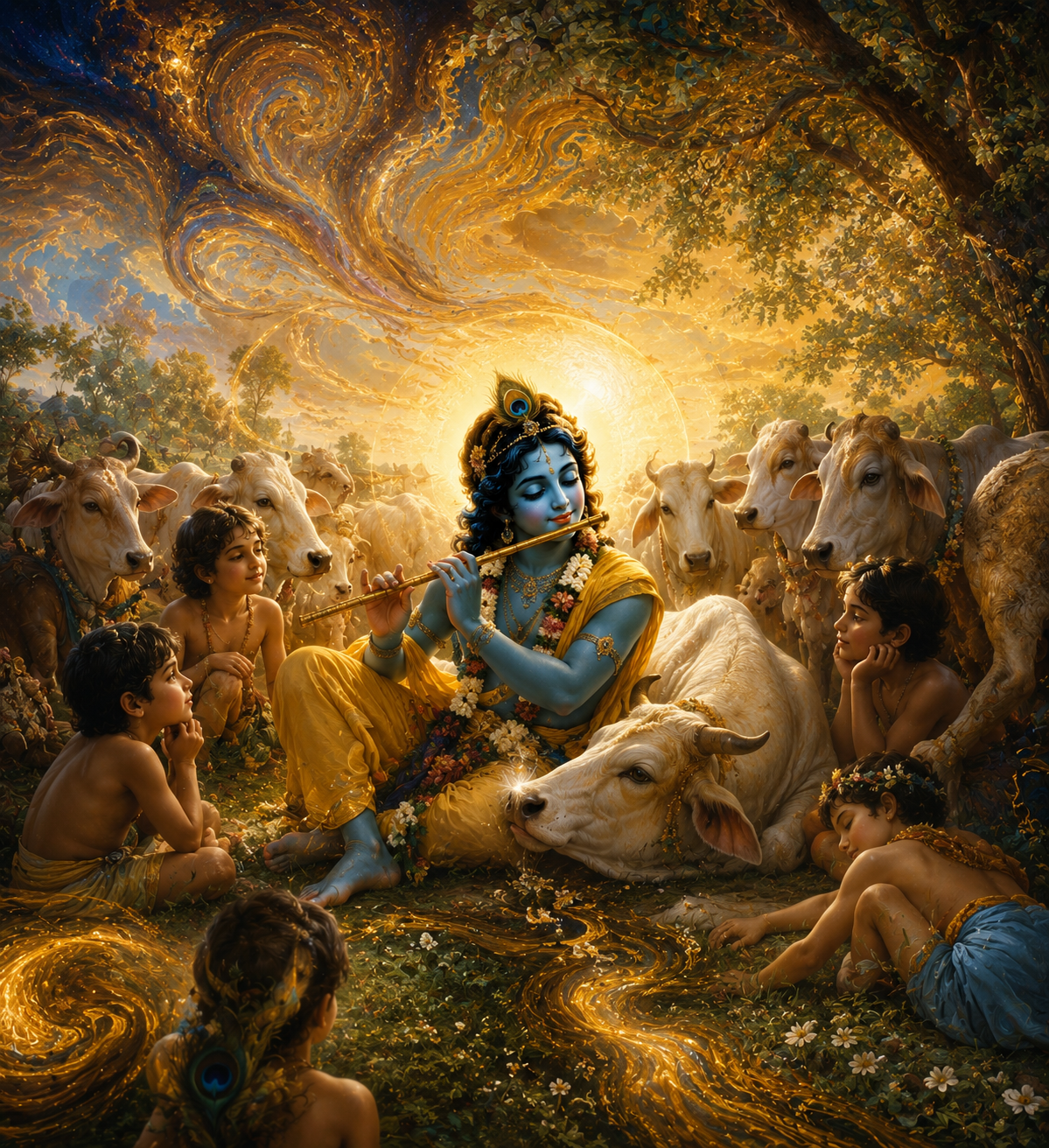
Krishna and Cowherd. AI Image. (Credit: ChatGPT)
On the Sanctity of the Cow and the Grammar of Civilizational Love
Before philosophy, there was milk.
Before the child could receive the Gayatri mantra, that solar hymn breathed into young ears at dawn, before the young man could sit with the Gita and learn the mystery of action without attachment, there was the cow (‘Gaay’ in Hindi/ ‘Gauḥ’ in Sanskrit). Standing in the blue hour before sunrise. Breathing slowly. Giving.
The Indian civilization did not first theorize the cow and then revere her. It loved her first, the way one loves a mother, without argument, without negotiation, before language arrived to explain the feeling. The theory came later, much later, as all theory does: as the mind’s attempt to catch up with what the heart already knew.
This is why any conversation about the cow in India that begins with religion will always miss the point. Religion is the form. The substance is older. The substance is gratitude so deep it became devotion, devotion so continuous it became civilization itself.
The Cow as Ecological and Moral Presence
Consider what the cow actually is, not symbolically but materially, in the long drama of human settlement on this subcontinent.
She arrived with the earliest agriculturalists and never departed. Generation after generation, she fed infants when mothers could not. She pulled plows through soil that would otherwise have resisted human hands entirely. Her dung, mixed with earth, became the living floor of homes: antimicrobial, insulating, fragrant after rain. Her urine carried medicinal properties that village healers had catalogued long before chemistry gave them names. Her body produced nothing that required her destruction. She was, in the strictest ecological sense, a being whose entire existence was structured around giving to others.
The ancient Indian imagination recognized in this something philosophically extraordinary: here was a creature that embodied ahimsa not as an ideal but as a biological fact. She did not hunt. She did not hoard. She consumed grass that grew back. She returned more than she received.
In a civilization building its moral architecture around the question of how to live without unnecessary violence, the cow became the living answer.
She was not worshipped arbitrarily. She was recognized – the way one recognizes a great soul not by their proclamations but by the quiet, consistent pattern of how they move through the world.
What Civilizations Choose to Protect
Every civilization reveals its innermost self by what it chooses to protect even when protection costs something.
The Greeks built their identity around logos: reason, measure, the examined life. The Hebrews built theirs around covenant: a relationship between humanity and the sacred that demanded accountability. The great Islamic civilizations built around tawḥīd: the unity of God, the brotherhood of the faithful, the dignity of every human soul before the one Creator.
India built, among other things, around the refusal to let appetite be the final authority over life.
This refusal is what ahimsa truly means. Not passivity. Not weakness. But the recognition that power has a direction, and that the highest expression of power is not destruction but protection. The lion is powerful. The river is powerful. The sun is powerful. But the Indian philosophical imagination was peculiarly fascinated with a different kind of power: the power that sustains without consuming, that gives without claiming, that serves without demanding acknowledgment.
The cow, again, was this principle made flesh.
And so when an Indian touches the forehead of a cow before beginning the day, something passes between them that is not merely custom. It is the renewal of an ancient understanding: that the world did not belong to humanity alone, that the strong had duties toward the gentle, that gratitude was not sentiment but cosmology.
The Harder Question: Sacrifice, Sensibility, and Shared Life
Now we must approach the harder question, and approach it, as promised, not with the cold tools of argument but with the warmer instrument of understanding.
Why should Muslims in India, or anywhere, consider voluntary renunciation of cow sacrifice?
The question must be held carefully. It must not become an accusation. The moment it does, it stops being a philosophical invitation and becomes a political demand, and political demands, however just, cannot do what love can do. Only love can actually change the interior of a civilization.
So let us think together.
Every great religion contains, within itself, a hierarchy of values. Not all that is permitted is equally sacred. Not all that is lawful is equally beautiful. The fiqh of Islam, its vast jurisprudential tradition, has always distinguished between what is obligatory (fard), what is recommended, what is merely permitted, and what is discouraged, even when not forbidden. The sacrifice of a cow on Eid al-Adha is, in the majority of Indian Islamic legal opinion, permissible, but not required where other animals suffice. This is not a diminution of the festival’s meaning. The festival is about Ibrahim’s surrender, his willingness to sacrifice what he loved most, his subordination of the self to the divine will. The animal is the symbol of that surrender, not its substance.
Surrender itself – islām in its root meaning – is the substance.
And here is where the civilizational conversation becomes genuinely interesting, genuinely alive with possibility.
For what would it mean to surrender the insistence on a particular symbol, out of love for one’s neighbors’ deepest sensibilities? What would it mean to say: I choose not this, not because I am forbidden, but because I understand what it costs you, and I love you enough to bear that cost myself?
This is not weakness. This is not theological defeat. This is, in fact, the very essence of what every mystical tradition within Islam – Sufi, philosophical, contemplative – has always called the greater jihad: the struggle against one’s own ego, against the insistence that one’s rights matter more than one’s responsibilities toward the sacred fabric of shared life.
The saints of Islam did not become luminous by cataloguing their entitlements. They became luminous by discovering new capacities for tenderness.
Against the Sterility of Cultural Relativism
Cultural relativism will object here. It will say: who are you to impose your civilization’s values on another? Every culture has its practices. Every practice is meaningful within its own frame. To ask one community to modify its behavior on behalf of another’s sentiments is a form of cultural imperialism.
This argument sounds generous. It is, in fact, the most sterile position available to the human mind.
For notice what it actually does: it makes genuine encounter impossible. If all values are equally relative, then no civilization can call another toward greater compassion, greater beauty, greater depth. The Japanese cannot ask the world to reconsider the slaughter of whales. The indigenous peoples of the Amazon cannot ask the global economy to reconsider the destruction of forests they consider sacred. Parents cannot ask children to show kindness toward the elderly. The entire moral life of humanity collapses into a procedural standoff where only power decides.
This is not moral pluralism. This is moral paralysis.
Real pluralism is not the refusal to be affected by one another. Real pluralism is the willingness to enter one another’s interior worlds and to come out changed. Not conquered. Changed. Enlarged.
The greatest encounters between civilizations – the Islamic Golden Age’s engagement with Greek thought, the Sufi movement’s absorption of Indian mystical traditions, the Christian encounter with Hindu non-violence through Gandhi – have always involved this willingness to be genuinely moved. To discover in the other not a threat to oneself but a completion.
The Modern Crisis of Extraction and Violence
There is something the West is slowly, painfully rediscovering, something India never entirely forgot.
The industrial slaughterhouse has become one of modernity’s most troubling inventions. Not merely because of the suffering it industrializes, though that suffering is real and immense. But because of what it does to the human beings who participate in it and the societies that normalize it. A civilization that can treat fifty billion animals annually as pure raw material – creatures with nervous systems, with fear responses, with social bonds – without sustained moral crisis, has lost something it will not easily name.
Philosophers in the West now speak of animal consciousness with a seriousness that would have seemed eccentric fifty years ago. Scientists have documented grief in elephants, joy in rats, complex social memory in crows. The ecological movement speaks of the rights of rivers and forests, of the sacred trust between humanity and the living systems that sustain it.
These are not Hindu ideas. But they rhyme with Hindu ideas.
They rhyme because they arise from the same deep human intuition that gave India its reverence for the cow: that life is not raw material. That other beings are not merely means to human ends. That a civilization built entirely on extraction, of minerals, of oil, of animal bodies, of the patience of the earth, is a civilization consuming its own foundation.
The Indian reverence for the cow is, in this light, not a relic of pre-modern superstition but an early, sophisticated formulation of what the most advanced contemporary ethics is struggling toward. It deserves not condescension but genuine intellectual engagement.
Gaay, Gayatri, Gita: A Sequence of Civilizational Meaning
And so we return to the three words: Gaay, Gayatri, Gita.
They do not stand alone. They stand in a sequence that is itself a teaching.
Gaay, the cow, is the earth’s gift. She represents the principle that existence is generous, that the universe provides, that gratitude is the appropriate response to life.
Gayatri, the great mantra, is the mind’s gift. It is the prayer that the human intellect be illumined, that we see through the surfaces of things to the light that animates them. That we not be deceived by the obvious into missing the essential.
Gita, the dialogue between the human and the divine on the field of life’s great choices, is the spirit’s gift. It teaches that action must be purified of cruelty, that duty is not merely the exercise of permission but the discovery of one’s deepest responsibility toward existence.
Together they teach a single thing: that the human being who has truly understood life does not kill what nourishes, does not darken what illumines, does not wound what trusts.
This teaching does not belong to Hinduism alone. It belongs to humanity. It is the intuition that survives in every tradition that has gone deep enough: in Jainism, in certain currents of Buddhism and Christianity, in the Sufi masters who wept for all of creation, in the Jewish mystics who saw the divine spark imprisoned in every form of life.
The Civilizational Opportunity Before Indian Muslims
The unique position of Indian Muslims, and here the essay arrives at its most delicate and most necessary point, is not one of historical accusation. It is one of extraordinary civilizational opportunity.
India has been home to one of the world’s great experiments: the encounter, over centuries, between Islam’s universalism and the subcontinent’s ancient pluralism. This encounter has produced extraordinary things: architecture, music, poetry, cuisine, spiritual traditions that enriched both. The Sufi saints who walked into Indian villages did not come as conquerors of souls. They came as seekers. They sat with Hindu philosophers. They listened. They were changed by what they heard, and India was changed by them.
That is what genuine civilization looks like. Not coexistence through mutual indifference. Coexistence through mutual transformation.
In that spirit, the invitation extended here is not a demand. It is not a reproach. It is the oldest kind of human request: can you see what I see? Can you feel what I feel? And if you can, even partially, even provisionally, will you let that seeing change something in you?
The cow stands in the morning light. She has always stood there.
She does not argue her case. She does not protest. She only gives, and gives, and gives, with a patience that outlasts every ideology, every court ruling, every communal riot, every political cycle.
If there is a future worth having on this subcontinent, a future not of enforced uniformity but of freely chosen love, not of power’s victory but of understanding’s slow, quiet triumph, it will be built by people who chose to revere something beyond their own entitlement.
It will be built by people who looked at the cow in the morning light and felt, across every difference of creed and custom, the same ancient, wordless thing:
Here is a being that trusted us. Let us be worthy of that trust.
Related Topics
Related Posts