
Strategic Intelligence Consultant & Insights Advisor
Gaza 2005: Ariel Sharon’s Great Strategic Mistake
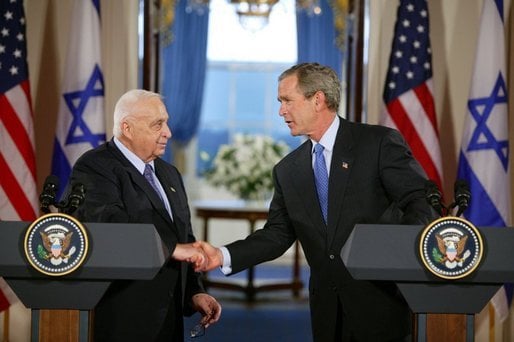
President Bush and Prime Minister Sharon, White House, April 2004. (Wikimedia Commons)
Twenty-one years after the disengagement, the lesson is not that Israel shouldn’t have tried — it’s that geography can never come before politics and security
The image Israel never forgot
In August 2005, something happened that fits awkwardly into the usual stereotypes about the Israeli-Palestinian conflict. Israeli soldiers and police officers entered Jewish communities in the Gaza Strip and removed Israeli citizens from their homes. Families wept, residents gathered in synagogues, and soldiers embraced the very people they had been ordered to evacuate. The evacuation of 21 Israeli settlements meant the removal of more than 8,000 civilians, and the last Israeli soldier left the Strip on September 12, 2005.
That image is worth dwelling on, especially 21 years later. An Israeli government dismantled Jewish communities and used its own state apparatus to uproot its own citizens from homes some had lived in for decades. Those settlements were, under the prevailing international legal view, illegal — a fact that diminishes neither the domestic political cost of evacuating them nor the gravity of the decision. And this is the strongest pro-Israel argument about 2005: no one can seriously claim that Israel was unwilling to bear real costs to test a different relationship with the Palestinians. The plan itself expressed the hope that they would use the withdrawal to abandon the cycle of violence and return to dialogue.
The real question, then, is not whether Israel made a concession. It did. The question is why Sharon believed that physical withdrawal could precede a viable political and security architecture — and why he failed to foresee who would reap the political rewards.
What Sharon believed he would gain
The disengagement was not a purely altruistic gesture. The cabinet decision of June 6, 2004, defined its purpose as a better “security, political, economic and demographic situation” for Israel. Protecting a few thousand Israelis inside a far larger Palestinian society demanded a disproportionate military burden, and Sharon wanted to defend from clearer lines.
But there was also a genuine political prospect: Gaza could become a test case for Palestinian self-government. George W. Bush described the removal of the settlements as meaningful progress toward the two-state vision and a “real contribution” to peace. For many Israelis, the logic of separation carried a simple promise: we leave Gaza, you take responsibility for Gaza, and both societies gain the space to live apart — and perhaps, one day, peacefully side by side.
The mistake was strategic, not moral
Sharon correctly diagnosed a problem: indefinitely protecting small communities inside Gaza was extraordinarily costly. Where he failed was at the next step. He confused withdrawal with strategy.
There was no agreement tying the withdrawal to specific Palestinian obligations, and no binding mechanism ensuring that a Gaza without Israeli settlements would not become the base of an armed Islamist movement. The plan itself envisaged a demilitarized Gaza, with the Palestinian security forces expected to meet their obligations to combat terrorism; implementation, however, went ahead without a political system capable of enforcing those conditions.
The conventional narrative also needs a correction. More recent scholarship (Elie Podeh) shows that the disengagement was not strictly “unilateral”: there was behind-the-scenes coordination with the United States, the Quartet, Egypt, Jordan and the Palestinian Authority. The problem, I would argue, was not an absence of coordination but the absence of a negotiated political contract that would have given the more moderate Palestinian leadership legitimacy and political ownership of the withdrawal. That same research observes that Hamas’s electoral victory in 2006 was owed in part to its success in casting the withdrawal as a triumph of armed “resistance” — while attributing the failure of the enterprise both to Israel’s reluctance to use it as a platform for the peace process and to the Palestinian Authority’s own lack of resolve in curbing Hamas and Islamic Jihad.
The irony is that Ariel Sharon knew the risk in advance. In the Knesset, on October 25, 2004, he acknowledged that opponents of the plan were warning him the withdrawal would be read as retreat under pressure and would encourage terrorism — a warning he rejected outright. He proceeded anyway. And there is one more uncomfortable reality: his close adviser Dov Weisglass described the disengagement in 2004 as “formaldehyde” for the peace process — freezing it and deferring final-status negotiations on borders, Jerusalem and refugees (a remark he later said had been taken out of context, insisting the freeze was conditional on Palestinian inaction against terror). The motives were mixed, and that compels a more precise formulation of the critique. If the absence of political continuity was not an omission but a choice, then Sharon’s error was not that he ran out of time to build a political architecture; it was that he believed Israel could withdraw territorially while freezing politically, without paying the price of that freeze. He made an enormous, irreversible concession without demanding — or even seeking — a corresponding political transition from the other side.
When Hamas won the interpretation of the withdrawal
In strategy, what matters is not what you believe you are signaling; it is what your adversary understands. For Israel, the withdrawal meant “we do not want to rule Gaza.” For Hamas, the message was: “armed resistance made Israel leave.” By September 2005, Palestinian armed factions were already presenting the withdrawal as a military victory — politically devastating for Fatah, which had argued for years that national goals are advanced through negotiation.
This does not mean the withdrawal “elected” Hamas. The elections of January 25, 2006, had a more complex dynamic: the Carter Center recorded political ineffectiveness and alleged corruption as the sources of Fatah’s vulnerability, while Hamas possessed organized social networks. But the result was historic: the Change and Reform list won 74 of 132 seats, against Fatah’s 45. Just months after the Israeli withdrawal, Hamas could form a government. The critical question remains: did Sharon, by refusing to convert the withdrawal into a negotiated achievement of the Palestinian Authority, unwittingly hand Hamas its most powerful political argument?
From the ballot box to armed takeover
Hamas’s victory did not lead to an orderly democratic transition. What followed was a struggle with Fatah over the security services, international isolation, kidnappings and assassinations — and, in June 2007, civil war. Between June 7 and 14, Hamas seized the Palestinian Authority’s headquarters and imposed its control over the entire Gaza Strip. According to the Palestinian Centre for Human Rights, 161 Palestinians were killed that week, among them 41 civilians, with serious violations committed by both sides. Human Rights Watch subsequently documented arbitrary arrests, torture and restrictions on freedoms in Gaza — and corresponding Fatah abuses in the West Bank. Less than two years after the withdrawal, the Palestinian political system had split in two.
Twenty-one years on, what is the lesson?
It would be an exaggeration to say Sharon “caused” October 7, 2023. Hamas has its own ideology and its own responsibility. But it would be equally ahistorical to claim that 2005 has nothing to do with what followed. The chain is visible: unilateral withdrawal; its appropriation by Hamas as a victory of “resistance”; electoral ascent; civil conflict; the armed takeover of Gaza; the militarization of an autonomous power center on Israel’s border — a militarization that neither the blockade nor the successive rounds of conflict over the following sixteen years reversed; and finally the catastrophe that followed October 7. The year 2005, in other words, did not remain the mistake of a single prime minister: the same logic — territory first, politics later — was never abandoned by his successors. Even in 2026, Hamas’s formal dissolution of its de facto government has not resolved the fundamental security question facing Israel. Administrative withdrawal is not disarmament. As long as Hamas retains an armed capability, the central issue remains whether Israel should be expected to withdraw before that threat has been demonstrably removed. For Israel, the sequencing is therefore not a technical detail but the core strategic lesson of Gaza since 2005: withdrawal without enforceable demilitarisation risks creating the conditions in which an armed movement can regroup, rearm and once again threaten Israeli territory.
In 2005, Israel did something its critics often insist it would never do: it dismantled its settlements, forcibly and painfully evacuated its own citizens, and withdrew its army from the interior of the Gaza Strip. It did not relinquish every external security function. Israel continued to control its own border crossings and maintained control over Gaza’s airspace and maritime approaches. But this should not be confused with a fictitious withdrawal. Gaza had neither the military, institutional nor technical capacity to control an independent airspace or maritime security regime, while Israel faced obvious risks from weapons smuggling, rocket fire and cross-border attacks. In those circumstances, retaining control of these external security dimensions was, from the Israeli perspective, not a substitute for withdrawal but a basic safeguard accompanying it.
That distinction became even more important after Hamas seized Gaza by force. Israel was no longer dealing simply with a weak Palestinian administration, but with an armed Islamist movement openly hostile to the Jewish state and capable of exploiting any security vacuum. The problem with the 2005 disengagement, therefore, was not that Israel retained too much security control; arguably, it was that Israel relinquished direct control of the territory without first securing a political and security order capable of preventing Hamas from filling the vacuum. Israel could withdraw its soldiers and settlers, but it could not responsibly outsource the protection of its airspace, coastline and borders to an authority that lacked either the capacity or, ultimately, the ability to prevent Gaza from becoming a base for armed confrontation.
And here lies the hardest conclusion. Withdrawing from Gaza may well have had a logic: Israel had no obvious strategic interest in governing a dense Palestinian population indefinitely, or in protecting small Israeli communities inside a deeply hostile environment. But the existence of that logic does not mean the decision was ultimately right. Under the actual conditions — a weak Palestinian Authority, Hamas steadily building political and military power, no binding disarmament mechanism, and no credible guarantee that Gaza would not become a base for attacks — Ariel Sharon should perhaps have concluded that Israel could not yet leave.
The mistake, therefore, was not merely technical. It was not only that the withdrawal was big enough to change control of the territory but not political enough to change the political outcome. It was deeper: Sharon may have confused an understandable desire for Israel — to stop being directly present inside Gaza — with a viable strategy. The failure does not prove that Israel did not try; it proves that Israel tried under conditions in which the other side was not ready, was not unified, and could not guarantee that the concession would not be turned into a launching pad for war.
Sharon’s fatal error was believing that geography could precede politics and security. He removed Israel before securing who would fill the space left behind, and he underestimated that, for Hamas, Israeli restraint would be presented not as an opportunity for peace but as proof that violence works. The lesson of 2005 is not easy, but it is clear: peace requires the willingness to cede land and power. It also requires the composure to recognize when withdrawal produces not peace but a power vacuum. And when that vacuum is likely to be filled by a terrorist organization, staying — meaning a continued security presence, not the settlements, and however difficult, costly and politically painful — may be less dangerous than a premature exit.
Related Topics
Related Posts