
Gaza: And Now for Plan B. (There Never Was a Plan A)
I am finally coming round to a view about how to resolve the Israel-Palestine problem that I’ve enthused about and backed away from repeatedly for a while. Before revealing its details, though, I feel I should note various caveats.
First, it’s a loose view. If I could find a better one, I’d happily jump from one to the other. I don’t have any reason to promote this one if another makes more sense.
Second, I allow myself this view as an indulgence. I’m just a bystander: I wield no influence, and it matters little what I think. No one with any political power is desperate to know my opinion or is going to be swayed by what I say.
Third, it’s clear to me—from having tested the idea on friends—that what I’m proposing is off the scale when it comes to mainstream ideas. Not only do I not expect to get applauded for it, I expect to get opposed and even condemned by anyone who bothers to take note.
Fourth, I’m aware that the view I’ve gravitated to is partly the product of my being Jewish, and that others will identify it as being attractive to me only because I am Jewish, and not because it has any objective merit. In fact, probably the opposite: that it is utterly unrealistic and I am only drawn to the madness of it because I am Jewish and therefore blind.
(I should say, though, that those with contrary views no doubt also hold them not because those views necessarily have objective merit, or greater objective merit than mine (though those who entertain them will insist that they do), but because they also come from a background that shapes their thinking (though they, again, will not agree that that’s the case).
So . . . my view reflects my growing thinking that there is no virtue in the so-called Two-State Solution, except to the extent that it is equally injurious to both sides. That is to say, its value lies not in the solution it misleadingly claims to represent but in its equity.
Equity aside, what the Two-State Solution offers is the settling of a half state on each of the two parties—something neither party wants. It asks both sides to accept a compromise which fundamentally undermines each party’s own wish.
The upshot of this is the view, entertained by the world, that to lock Israelis and Palestinians into a state of equal dissatisfaction is virtuous because neither side gets everything, and neither side can therefore claim victory. It requires both parties to act graciously about having a stalemate forced upon them—a fraud that’s mostly pleasing to those who don’t have a dog in the game.
Peacemakers and intermediaries can point to examples elsewhere in the world where warring parties have eventually put aside their weapons, if not their grievances, and learned to live side by side—and that such a model has proved to be the best one available when two parties make claims to the same piece of land, or the right to rule it.
One only has to look to Europe—theatre of tribal violence for thousands of years—or to medieval England, with conflicts as local as those of the Yorkists and Lancastrians. Today, who cares? (Well, maybe the Flemings and Walloons in Belgium. And the Turks and Greeks in Cyprus. And the Northern Irish and Southern Irish. And people in the Balkans. And of course the Russians and Ukrainians. But you get the point. Mostly, we’re at peace.)
Those who urge others to settle for a stalemate choose not to see that what they are calling for is a condition of maximum destabilisation. Here, a position that neither side likes has to be sustained, because the slightest swing away from it would confer a benefit to one side and a loss to the other that would bring the whole delicate system crashing down.
Pleasing the combatants, not the peace-makers
A solution whose only merit is that both sides are left equally unhappy is something that only outsiders would have the temerity to impose.
What interests me is whether any other solutions offer substantially better rewards—and there obviously are. For Arabs. it would be preferable if Israelis could be removed from their land, either by forcibly relocating them to anywhere else in the world—somewhere with so little population that their presence would either not make any difference (parts of Africa, perhaps, or Siberia) or where their presence could be beneficial.
That, in fact, was exactly what the argument once was for the return of the Jews to Israel, a view shared by T.E. Lawrence—unexpectedly, given his reputation as an Arabist.
The other solution, for the Arabs, is the annihilation of Israelis—effectively a second Holocaust—the plan for which had been prepared, and saw its initial stage realised, in Hamas’s massacre of 7 October 2023.
Both of these preferred solutions reflect the absolute unwillingness to accommodate Jews in a maximalist Palestine, an unwillingness rubber-stamped by every other Muslim country—even Turkey, Azerbaijan, Morocco and Iran, where Jews nominally have protected minority status.
The bottom line, for the Arab would-be possessors of Israel, is not just their own racial supremacy but racial intolerance—ultranationalism of a sort not just different from but wholly opposite to the accommodation of Arabs in Israel, where there are some 400 operating mosques.
The preferred solution for many—perhaps most—Israelis is, or has been, the Two-State Solution, because Israelis are, or were, mostly fair-minded, liberal and democratic, and the Two-State Solution was so woolly in its conception that one could believe in it if one didn’t quiz it too hard.
It is evident, however, that since 7 October, a growing number have felt less confident that a deal can be done with the other side, and this has resulted in a growing drift towards a provocative defiance of the status quo.
It upsets me to think that what I see as a more attractive solution is also a solution that may be favoured by those who no longer harbour any goodwill for co-existence. I don’t see myself as in any way part of that cohort, and I don’t support it or its ideology or its methods. My heart is with the democratic, liberal but kippah-wearing Left.
And yet, I would rather see a solution that gives each side very much more than it would get if the Two-State Solution was enacted, and that would at the same time save each side from the Solution’s downsides.
And so to Plan B
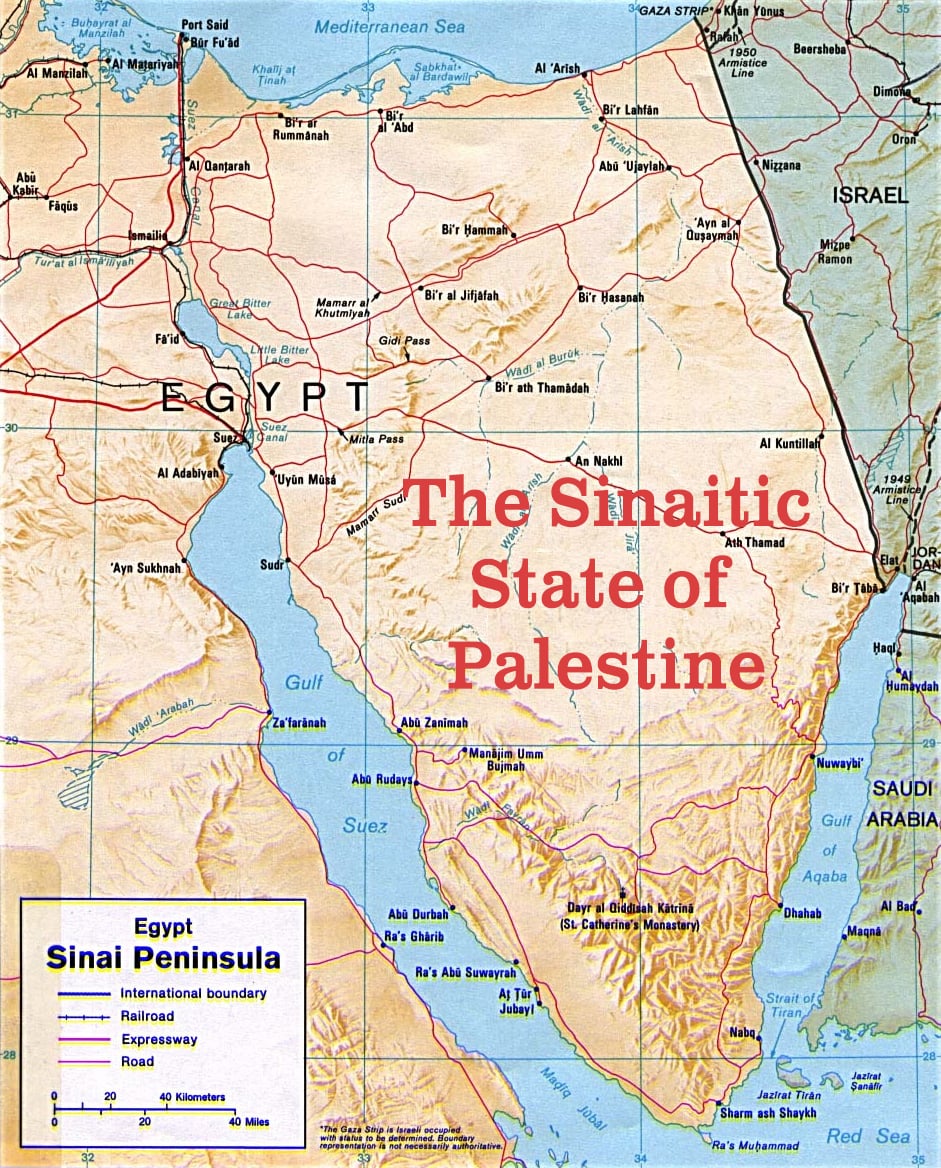
What is that better solution? It is (a) to give Israel undisputed ownership of Gaza and the West Bank, making it a whole country rather than one that is pitted on both sides by dents and gaps; and (b) to create a purpose-built Palestinian state that will unify and benefit the whole of the Palestinian population and enable them to realise their aspirations as a people—albeit such aspirations have only existed since and because of the formation of Israel as a modern state.
This new country would take as its site the whole of the Sinai Peninsula, with the exception of a border corridor on the east side of the Suez Canal, which would remain under the control of Egypt.
Sinai is a spectacular opportunity. It has a 220-km coastline on the Mediterranean looking north, and a 500-km coastline on the Gulf of Suez and the Gulf of Aqaba looking south. It is wholly undeveloped and offers conditions for growth and prosperity that neither Gaza nor the West Bank come anywhere near to.
It is, in addition, a single landmass where the Palestinians’ current divisions—geographical, political and cultural—could at last be healed. The very prospect makes a mockery of the current hankering for a state that would operate from two non-contiguous territories either side of Israel proper—or three territories, if the Israeli authorities allow the E1 development project that will expand Jerusalem east to Maale Adumim.
In addition, Sinai is large: at about 60,000 square km, it’s three times the size of Israel, which has a landmass of only 20,000 square km. That would put a new Palestinian state on a par with Croatia, Czechia, Latvia and Lithuania—all very respectable small-to-medium European countries. By any standard, that’s a very good deal; Israel, the size of Wales, Slovenia, Sardinia and—in the USA—New Jersey, is a pigmy by comparison.
What it would require is Egypt’s willingness to sell the land off. That is something Egypt might be tempted to do, given its historic lack of interest in Sinai and the fact that the peninsula represents only 6 percent of its total area. There would also undoubtedly be an appealing flow of funds—from the USA, the Arab League and other countries, either in the form of gifts and aid, or loans raised against the future economic prosperity of the new polity.
Sinai for the Palestinians promises everything that’s not available now, and still wouldn’t be available if Palestine had to straddle the land between the river and the sea. It offers the prospect of full employment, and a belief in the future rather than continued entrapment by the past, something that benighted Palestinian youth urgently needs—if nothing else to relieve it of its obsession with hatred and revenge—and to bring it at last into the warm embrace of secular neoliberalism and its more redeeming values.
That, by contrast, would be something the whole world might wish to take part in instead of continuing to act collectively in a way that traps the Palestinians in a dependency culture that degrades and demoralises them.
What’s not to like?
Well, everything, of course, if the prospect of nationhood, independence and economic success are trivialities beside what the hardliners will insist is a loss of face—the disgrace of giving up on a century-long (but only a century-long) mission to oppose the Jews’ Manifest Destiny of returning to their homeland, and to oppose it at the cost of sacrificing every benefit that could have been gained from peaceful cooperation.
It will be opposed, also, of course, by the academic Left, which will theorise it as the ultimate moral outrage, a genocidal crime, the erasing of legitimate self-determination, and the imposition of American military-industrialist fascist corporate capitalist colonialist imperialist perfidy.
And then there’ll be Islamic opposition. And the opposition of Africa. And of Asia. And the media. And the Church. And people who are nice and reasonable and fair, like us but not Jewish, and who work as volunteers for Oxfam, and give money to Amnesty.
And those whose values are dictated by the selfless work they do for the United Nations and its agencies, for which Under-Secretaries-General have a base salary of approximately $200,000 to $220,000, with cost-of-living adjustments based on the duty station’s location (an uplift of 30-40% in New York, for example, and about 20% in Geneva, where the anxst-ridden Tom Fletcher is based) plus Post Adjustments worth an additional 88.7%, and Dependents’ Allowance, and other benefits including pension contributions, health insurance, and education grants for children.
Yes, the incentives are real for those who dedicate themselves to the needs of the poor, encouraging their sense of victimhood and doing all they can to block constructive efforts to get them out of their self-destructive mindsets—because if people didn’t feel like victims any more, what would happen to the Holy who minister to them?
The adoption by Palestinians of their own Sinaitic state—a Res Publica Sinaitica—would require the UN’s endorsement, and that would involve an unimaginable climb-down by those who have inhabited the narrowest, meanest, most ideological mental cul-de-sacs for the last 75 years.
And what would all those placard-waving, graffiti-spraying, swastika writing, street-protesting, Facebook-trolling, synagogue-burning, Jew-shooting, protesters do then on their weekends? No—far better to hold onto the current formula for a three-state—Israel, Gaza, West Bank—solution in which two of the parties—the Arab parties—don’t even recognise the legitimacy of each other’s administrative bodies.
Perfect. I must be wrong, then.