
I write what I see
What Gaza Really Exposed

Serving facts with frosting. Jewish identity, iced and unapologetic (courtesy Levinsky).
I stood in the sun holding a cookie I’d made—a Jewish man blowing a shofar, frozen in sugar and defiance. With Tisha B’Av approaching, I thought about how many times we’ve mourned destruction while the world looked away—or worse, applauded. The shofar is meant to awaken, to call us back. But today, no sound seems to cut through the noise. Gaza didn’t expose the world’s conscience. It exposed something far older, far more familiar: the lie.
This week, The New York Times published an article by Aaron Boxerman titled “In a First, Leading Israeli Rights Groups Accuse Israel of Gaza Genocide.” The headline alone reads like a moral gavel strike—amplified by the chorus of readers below the fold, many of whom seize the moment to deliver sweeping pronouncements about humanity, dignity, and Gaza as a cosmic mirror.
One such comment reads like a sermon: “Gaza was not merely a military conflict—it was a profound and all-encompassing test . . . Gaza did not fall—it exposed the world.”
These words aren’t just poetic; they’re weaponized—designed to invert a reality in which Hamas thrives on Palestinian suffering, and to recast Israel’s war to eliminate that very threat as the ultimate crime. But if Gaza is indeed a mirror, then let us not gaze into it and see only the reflection of our favorite slogans.
Boxerman’s article cites two Israeli human rights organizations—B’Tselem and Physicians for Human Rights–Israel—now publicly accusing Israel of committing genocide. These groups aren’t new to this discourse. Their accusations may feel groundbreaking to some readers, but only because so many seem completely unaware of their long-standing record of vilifying Israel. And that’s what’s most unsettling. Judging by the flood of comments beneath the article—many of them from people who likely consider themselves well-informed, thoughtful, morally grounded—you’d think this was a shocking revelation. But it’s not. It’s a recycled narrative, repackaged for those eager to be outraged, even if it means being willfully blind.
What’s truly inexplicable is how little impact the firsthand horror of October 7 had on these same readers. They watched—with front-row seats—Israeli families hunted, murdered, raped, burned alive. They saw it. We all did. And yet somehow, it didn’t break them. It didn’t shake their moral compass. There was no fear, no outrage, no collapse of certainty. That silence is not just disturbing—it’s a warning sign. When the most primal human atrocity no longer evokes empathy, we we’re all in danger.
As a rule, genocide isn’t defined by tragic civilian casualties. It’s defined by intent—the deliberate aim to destroy a people, in whole or in part. Israel’s intent has been consistent and explicit: to destroy Hamas, a terrorist entity that slaughtered its civilians, abducted its children, and uses its own population as cannon fodder and press bait. In Gaza, Hamas built its empire beneath hospitals, in schools, in mosques, and in UN compounds. To ignore that and remove Hamas from the equation entirely is what I consider complicity.
And if Israel’s intent matters, then let it be known: we have been screaming this truth into the universe—not just since October 7, but for decades. Decades of terror, of suicide bombings, rocket fire, kidnappings, and burned bodies. And still, no one listens. Still, the world prefers to cast us as the villain in a horror story written by our enemies.
Boxerman’s article at least acknowledges that Israel says it’s targeting Hamas. But in tone and framing, the piece—and especially its headline—reinforces the narrative that Israel is the aggressor, and that the moral burden of this war rests entirely on its shoulders. Beneath the article, the comments section blossoms into a moral theater of abstraction, where readers divide the world into those who “stand with humanity” and those who support the evil Zionist entity.
But let’s talk about what Gaza really exposed.
It exposed the global appetite for anti-Israel bloodlust disguised as moral clarity. It exposed how easily the language of human rights can be hijacked to advance Hamas’s narrative. It exposed how the suffering of Palestinians—real, painful, and tragic—is endlessly amplified when it can be blamed on Jews, and just as easily ignored when it stems from internal tyranny, honor killings, or Hamas executions in the street.
None of this is to deny that there is death and pain in Gaza. There is. But it’s not Israel’s fault. It’s the consequence of a war forced upon us by a terror regime that hides behind its own civilians. The same people now crying “genocide” had no such moral crisis when cities across Europe were bombed to defeat the Nazis—where thousands of innocent Germans, including children, died. Was that genocide? Or was it the price of dismantling a regime that brought horror into the world? If you can hold moral clarity in that context, why does it vanish when the victims are Israeli, and the enemy is one you’ve chosen to romanticize?
This war, like every war, will be remembered for its victims. But let us also remember that a genocidal terror regime started it all; they’re embedded in civilian infrastructure, funded and armed by Iran, and cheered on by a global movement that confuses moral outrage with moral accuracy.
So no—Gaza didn’t expose the world, it exposed the lie that all human rights groups are neutral and that Hamas can be ignored in any moral equation. And it exposed the lie that a democracy fighting for its survival is indistinguishable from those who want to see it burn.
The real mirror is held up to those who read about Israel’s war against Hamas and see only darkness—not because there is none, but because they refuse to acknowledge where it came from.
Extra Reading:
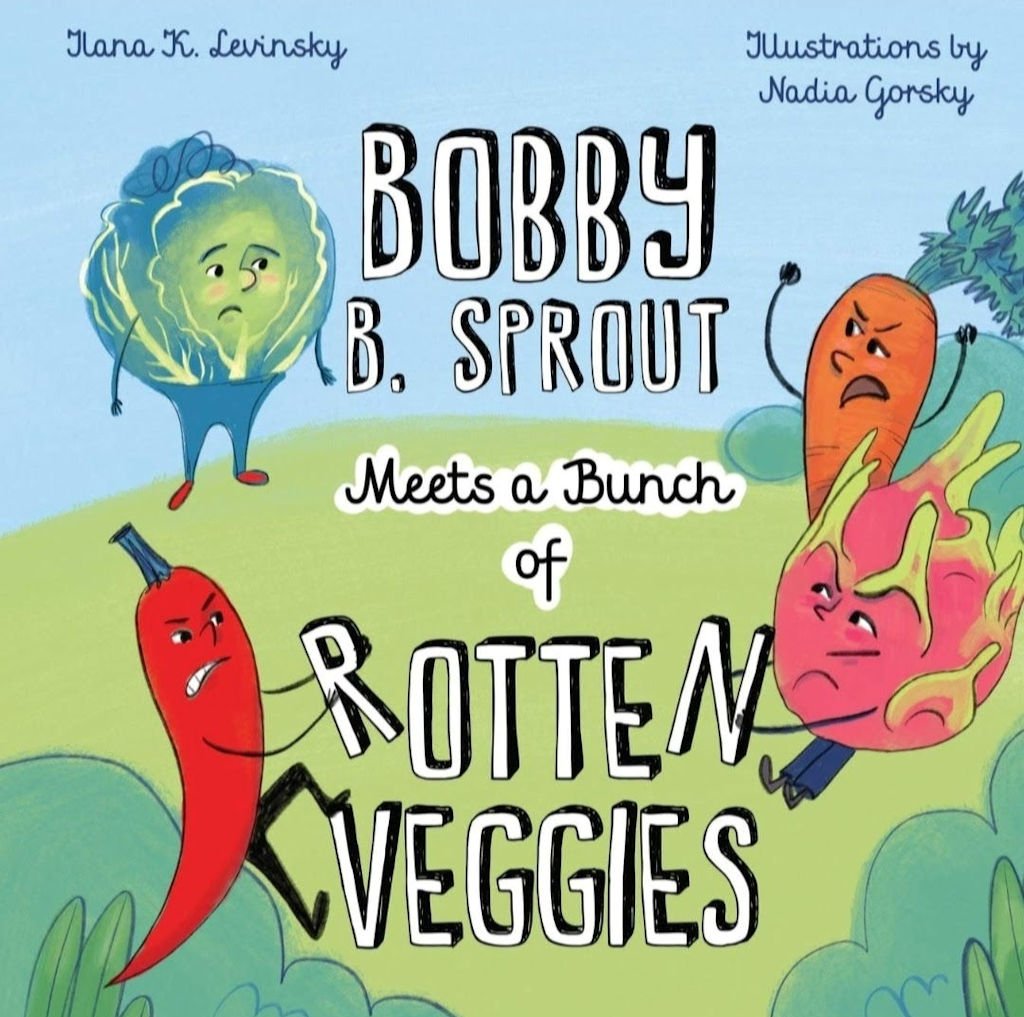
Bobby B. Sprout Meets a Bunch of Rotten Veggies
Written by Ilana K. Levinsky
Bobby B. Sprout is a cheerful young Brussels sprout with a thirst for adventure. Life in his garden patch is good, but the world beyond is calling. When he rolls into a new patch, he expects excitement and new friends—but what he finds is a group of rotten, unfriendly vegetables who make it clear he doesn’t belong.
Told with humor and heart, this imaginative tale is an allegory for anyone who’s ever felt like the outsider. Through Bobby’s journey, readers are invited to reflect on difference, exclusion, and the quiet bravery it takes to face the unfamiliar. You can find your copy on Amazon.
Related Topics
Related Posts