The views expressed herein are solely mine.
Gaza’s “Technocrats”: Terror in Suits
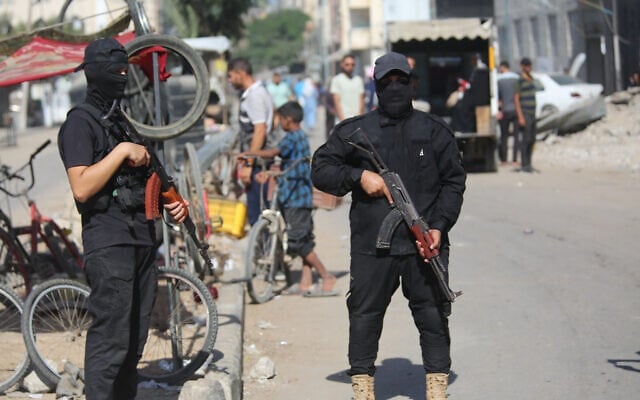
Hamas police forces deploy in Gaza City on October 11, 2025. (Ali Hassan/Flash90)
Make no mistake: the so-called technocratic government for Gaza is not reform. It is rebranding. A committee built to be “acceptable” inside Gaza is, by definition, captive to the same networks that turned the Strip into a terror enclave. Different CVs. Same power map. What’s being sold as neutral governance is a familiar Palestinian Authority sequel: corruption institutionalized, terrorism managed rather than dismantled, and time purchased for chaos to regroup. And now that the names are public, the fiction should end.
Let’s be clear: this committee did not fall from the sky. It is populated by figures who have spent their careers inside the same political ecosystem that allowed terrorism and factional violence to metastasize in Gaza and the West Bank. Most of its fifteen members come straight from Fatah and the Palestinian Authority—the very apparatus that has long coexisted with Hamas because confrontation was always deemed too costly.
Start at the top: Ali Sha’ath, the chair. Washington markets him as a neutral administrator. Reality says otherwise. His pedigree runs straight through the PA system—donor dependency, patronage, and security double games. He is not a technocrat; he is a product of the same machinery that mirrors Hamas’s power logic across Palestinian institutions.
And here’s the tell: Sha’ath is not formally Hamas. That misses the point. He holds this position because Hamas accepted him. In Gaza, that is the only credential that matters. A chair “acceptable” to all stakeholders survives by never challenging the men with guns. Do otherwise and you end up like Yassir Abu Shabab. Thence, this is not leadership; it is negotiated paralysis.
Meanwhile, security makes it worse: Sami Nasman, handed internal security, is an even clearer warning sign. A former senior PA security officer, he comes from institutions that historically coordinated with Hamas, brokered ceasefires with it, and at times absorbed its forces rather than dismantling them. In Gaza, whoever controls arrests controls impunity. An interior minister without a monopoly on force becomes a traffic cop for terror.
Justice follows the same script: Adnan Abu Warda supplies legal camouflage. In factional systems, courts do not deliver justice; they deliver selectivity. Files disappear. Investigations stall. Violence is laundered as politics. Terror survives not despite bureaucracy, but through it.
Follow the money: Bashir al-Rayyes at finance will oversee reconstruction budgets, payrolls, procurement, NGOs, and aid pipelines. In Gaza, finance does not serve citizens; it serves loyalty. Aid becomes oxygen. Contracts become rewards. Corruption becomes policy. This is how terrorist infrastructure rebuilds without firing a shot.
Then comes the economic cover: Ayed Abu Ramadan will now control licenses, imports, contractors, and trade corridors—the exact terrain where armed groups thrive once tunnels go quiet. Rent-seeking does not disappear; it mutates. Commerce becomes camouflage.
Humanitarian language does not save it: Health under Aed Yaghi sounds neutral but functions strategically. In Gaza, hospitals and aid corridors are not safe zones; they are operational assets. Administration without enforcement becomes a shield.
Post-war power is land: Agriculture under Abdul Karim Ashour and housing and land under Osama al-Saadawi control what truly matters—permits, rebuilding lists, and territory. Who rebuilds. Who waits. Who stays in rubble. Loyalty is rewarded while dissent is punished.
Education is the long war: Under Jabr al-Daour, curriculum, hiring, and campus politics will normalize terrorism without slogans. As a result, you do not need incitement when grievance becomes civic.
Infrastructure is authority: Telecoms under Omar al-Shamali is pure dual-use power—data, access, blackouts, coordination. Control communications and authority enforces itself without uniforms.
Soft power finishes the job: Social affairs under Hanaa Tarazi completes the machine. Welfare, NGOs, aid distribution—soft coercion at scale. Benefits for compliance. Pressure for everyone else.
Therefore, let’s dispense with the excuse: no, not every official carries a party card. Most are not publicly listed members of terrorist groups. That is not the test.
The reality is structural: they operate inside a shared political ecology where Hamas and Fatah have negotiated power, security, and survival for decades—while Hamas remains the dominant armed force.
Which brings us to the truth: this cabinet exists because Hamas, Fatah, and Gaza’s armed clans can tolerate it. That means veto power without responsibility. Coexistence without disarmament. Governance without sovereignty.
Call it whatever you want: in reality, it is PA 2.0—laundered corruption, postponed terrorism, and Gaza reset as a staging ground.
Bottom line: different faces. Same endless war.
Related Topics
- 2025 Hostage Deal
- Donald Trump
- Gaza
- Gaza Border
- Gaza Disengagement
- Gaza Reconstruction
- Gaza Rocket Attacks
- Gaza Strip
- Hamas
- IDF
- Iran
- ISIS
- Islam
- Israel At War
- Jewish-Arab violence
- Middle East
- October 7 anniversary
- Palestinian Authority
- Palestinian Statehood
- Palestinians
- Peace Builders
- Peace Process
- Qatar
- Terrorism
- The Arab World
- Trump Peace Plan
- Turkey
- US Politics
Related Posts